
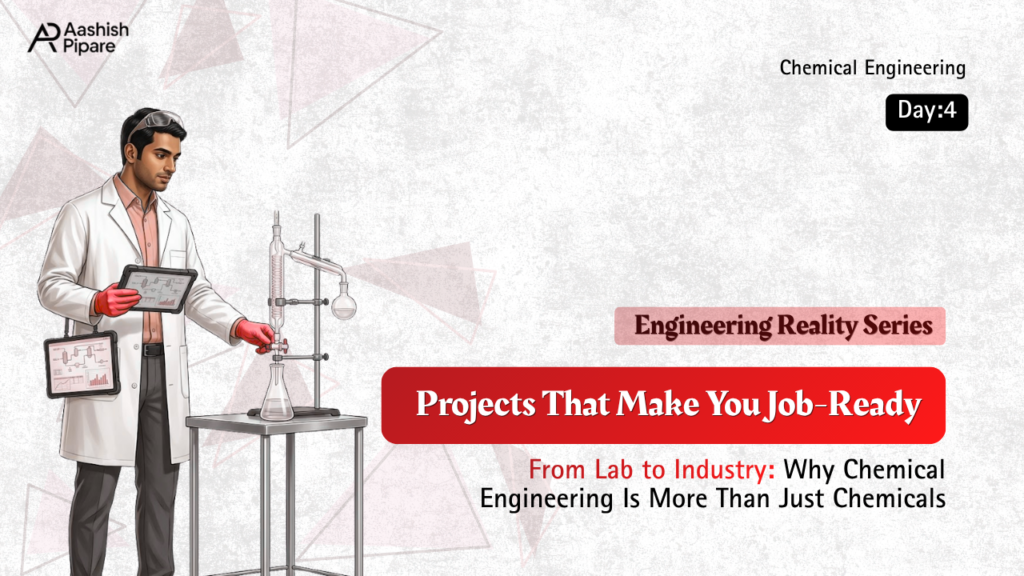
a. What are some beginner-level projects in this branch?
Beginner-level projects are an excellent way for Chemical Engineering students to connect classroom theory with practical applications. These projects help students understand fundamental engineering concepts, develop problem-solving skills, gain laboratory experience, and build confidence in handling chemical processes and equipment. They also provide a foundation for more advanced projects in later years and can strengthen a student’s resume, portfolio, and technical knowledge.
At the beginner level, projects are usually small-scale, low-cost, and focused on understanding basic principles such as heat transfer, fluid flow, separation processes, reaction kinetics, and water treatment. At the expert level, these same principles are applied to large industrial systems such as refineries, chemical plants, pharmaceutical facilities, and energy production units.
Below are some of the most valuable beginner-level projects for Chemical Engineering students.
1. Distillation Experiment (Liquid Separation)
Distillation is one of the most important separation processes in Chemical Engineering. A beginner project can involve separating a mixture of two liquids with different boiling points, such as water and ethanol.
Concepts Learned:
- Vaporization and condensation
- Boiling point differences
- Heat transfer
- Mass transfer
- Separation efficiency
Skills Developed:
- Experimental setup
- Data collection
- Temperature measurement
- Process analysis
Example: A student builds a simple laboratory distillation apparatus and measures the purity of the separated liquid at different operating conditions.
2. Heat Exchanger Model
Heat exchangers are used in almost every chemical industry to transfer heat between fluids.
A beginner project can involve designing and testing a small heat exchanger using copper tubes, water circulation, and temperature sensors.
Concepts Learned:
- Heat transfer
- Energy conservation
- Thermal efficiency
- Temperature profiles
Skills Developed:
- Data analysis
- Heat balance calculations
- Experimental observation
Example: Students compare inlet and outlet temperatures to calculate the heat transfer rate and efficiency of the system.
b. What are industry-level projects I should aim for?
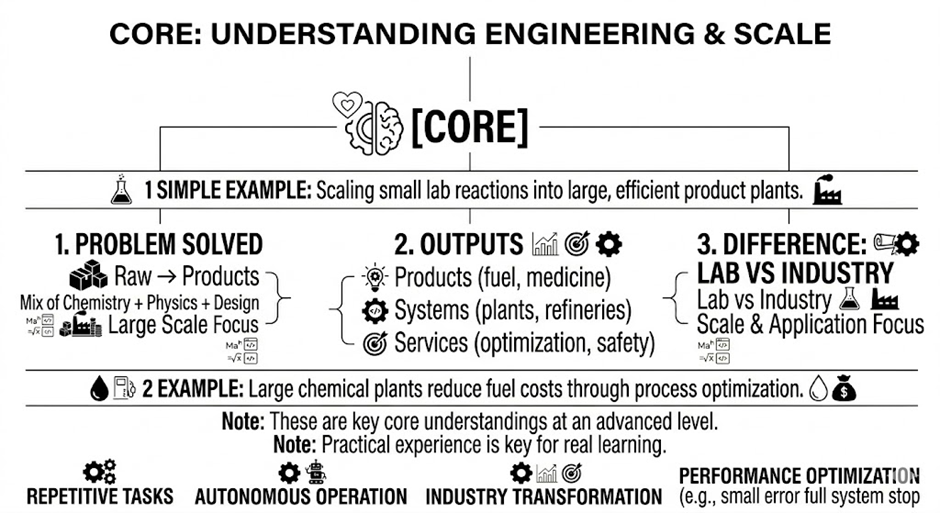
Industry-level projects are advanced projects that closely resemble the real challenges faced by chemical engineers in manufacturing plants, refineries, pharmaceutical industries, energy facilities, and environmental management systems. These projects require the application of multiple chemical engineering concepts such as thermodynamics, fluid mechanics, heat transfer, mass transfer, reaction engineering, process control, safety analysis, economics, and sustainability.
Unlike beginner projects that focus on understanding individual concepts, industry-level projects focus on solving complex, real-world problems involving large-scale industrial operations. These projects demonstrate technical competence, practical understanding, problem-solving ability, and readiness for professional engineering roles.
At the beginner level, many of these projects are performed using simulations, case studies, or pilot-scale models. At the expert level, engineers implement these solutions in actual industrial facilities where even small improvements can save millions of dollars, reduce environmental impact, and improve safety.
Below are some of the most valuable industry-level projects that Chemical Engineering students and professionals should aim for.
1. Chemical Plant Design Project
Plant design is one of the most comprehensive projects in Chemical Engineering because it integrates almost every major subject in the discipline.
The project involves designing an entire production facility, including:
- Process flow diagrams (PFDs)
- Material balances
- Energy balances
- Equipment selection
- Reactor design
- Distillation systems
- Utility systems
- Safety analysis
- Economic evaluation
Possible plant design projects include:
- Petroleum refinery
- Fertilizer plant
- Pharmaceutical manufacturing unit
- Biodiesel production plant
- Polymer manufacturing facility
Skills Developed
- Process design
- Equipment sizing
- Process simulation
- Economic analysis
- Industrial problem-solving
Example: Designing a fertilizer plant capable of producing 500 tons of urea per day while minimizing energy consumption and operating costs.
2. Process Optimization Project
Process optimization is one of the most important responsibilities of chemical engineers in industry.
The goal is to improve:
- Production rates
- Product quality
- Energy efficiency
- Resource utilization
- Process reliability
These projects often involve:
- Data analysis
- Process simulation
- Mathematical modeling
- Optimization techniques
Skills Developed
- Analytical thinking
- Process improvement
- Data-driven decision-making
- Cost reduction strategies
Example: Optimizing a distillation column to reduce steam consumption while maintaining product purity.
c. How can I build a portfolio in this domain?
A portfolio is a collection of your best academic, technical, and practical work that demonstrates your skills as a Chemical Engineer. It acts as proof of your abilities beyond classroom grades and helps recruiters, professors, and employers understand what you can actually do. In today’s competitive job market, a strong portfolio can significantly improve your chances of securing internships, research opportunities, higher studies admissions, and full-time jobs.
Chemical Engineering is a practical and industry-oriented field. Therefore, a good portfolio should showcase not only your theoretical understanding but also your ability to apply engineering concepts to real-world problems. It should reflect your knowledge of chemical processes, process design, safety, simulations, laboratory work, data analysis, and industrial applications.
At the beginner level, a portfolio may consist of laboratory experiments, mini-projects, and academic assignments. At the expert level, it should include industrial projects, process optimization studies, research publications, and real-world engineering solutions.
Why Is a Portfolio Important?
A portfolio helps you:
- Demonstrate practical engineering skills.
- Showcase projects and achievements.
- Highlight software proficiency.
- Present problem-solving abilities.
- Build credibility with employers.
- Differentiate yourself from other candidates.
- Track your technical growth over time.
Many students have similar academic qualifications, but a portfolio helps employers identify candidates who have applied their knowledge beyond the classroom.
1. Include Process Simulation Projects
Process simulation is one of the most important skills in modern Chemical Engineering.
Use software such as:
- Aspen Plus
- Aspen HYSYS
- MATLAB
- COMSOL Multiphysics
- Python
For each simulation project, include:
- Project objective
- Process description
- Process flow diagram
- Simulation screenshots
- Key calculations
- Results and conclusions
Example
A project involving the simulation of an ethanol-water distillation column using Aspen Plus can demonstrate your understanding of separation processes, mass balances, and process optimization.
2. Showcase Laboratory Experiments
Laboratory work demonstrates hands-on engineering experience.
Include reports related to:
- Heat transfer
- Fluid mechanics
- Mass transfer
- Reaction engineering
- Process control
- Water treatment
- Thermodynamics
Each report should contain:
- Objectives
- Equipment used
- Experimental procedure
- Observations
- Calculations
- Results and analysis
Example
A heat exchanger experiment report showing thermal efficiency calculations can demonstrate practical understanding of heat transfer principles.
d. What kind of internships should I target?
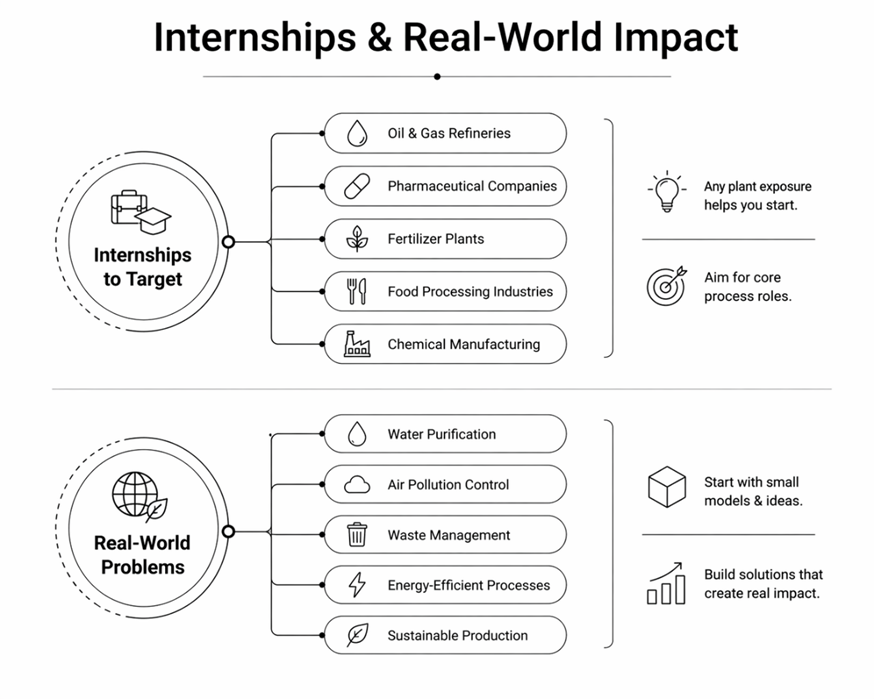
Internships are one of the most important parts of a Chemical Engineering student’s professional development. They provide exposure to real industrial environments, help bridge the gap between classroom learning and practical applications, and allow students to understand how engineering principles are used in large-scale production systems. A good internship not only strengthens technical knowledge but also improves communication skills, teamwork, problem-solving ability, and industry awareness.
For Chemical Engineering students, the ideal internship is one that offers exposure to process operations, plant equipment, safety practices, quality control, process optimization, or engineering design activities. The best internship choice depends on your career goals, interests, and the industry you want to enter after graduation.
At the beginner level, internships help students understand how industries operate. At the expert level, internship experiences often influence specialization choices and future career paths.
Why Are Internships Important?
Internships help you:
- Understand industrial processes.
- Gain practical engineering experience.
- Learn about plant operations.
- Improve technical skills.
- Build professional networks.
- Strengthen your resume.
- Explore career interests.
- Increase employability after graduation.
Employers often prefer candidates who have industrial exposure because they require less training and adapt more quickly to professional environments.
1. Petroleum and Refinery Internships
Petroleum refining is one of the largest employment sectors for chemical engineers.
Internships in refineries provide exposure to:
- Crude oil processing
- Distillation units
- Catalytic cracking
- Heat exchangers
- Pumps and compressors
- Process control systems
- Utilities and energy management
Skills Gained
- Process flow understanding
- Plant operation knowledge
- Safety procedures
- Equipment familiarity
Example
An internship at an oil refinery allows students to observe how crude oil is converted into petrol, diesel, jet fuel, and other valuable products.processed.
e. Are there open-source or real-world problems I can work on?
Yes, Chemical Engineering offers numerous opportunities to work on real-world and open-ended problems that directly impact industries, the environment, public health, and global sustainability. Unlike purely academic exercises, these problems involve practical challenges faced by governments, industries, communities, and researchers. Working on such projects helps students develop technical skills, build strong portfolios, contribute to society, and gain valuable experience in solving meaningful engineering problems.
Many of the world’s biggest challenges—such as clean water access, pollution control, sustainable energy production, climate change mitigation, waste management, and efficient manufacturing—require chemical engineering solutions. Even as a student, you can contribute through simulations, small-scale prototypes, data analysis, process design projects, and research studies.
At the beginner level, these projects may involve laboratory experiments, software simulations, or small demonstration models. At the expert level, the same ideas can evolve into industrial technologies, commercial products, or groundbreaking research innovations.
Why Work on Real-World Problems?
Real-world projects help you:
- Apply classroom knowledge.
- Develop practical problem-solving skills.
- Build a strong portfolio.
- Gain industry-relevant experience.
- Improve research abilities.
- Contribute to society and sustainability.
- Enhance employability and higher-study applications.
Employers often value candidates who can demonstrate experience solving actual engineering problems rather than only completing academic assignments.
CONCLUSION:
Project-based learning in Chemical Engineering helps students apply theoretical concepts to real industrial processes. It develops practical knowledge, problem-solving ability, and industry readiness. By working on real-world projects, students become capable of designing efficient, safe, and sustainable chemical systems