1. What are some beginner-level projects in this branch?
When I look back at the early stage of learning Civil Engineering, I realize that beginner projects are not about building something impressive—they’re about training your engineering thinking. The biggest mistake students make is jumping directly into advanced software without understanding basic behavior of structures and materials.
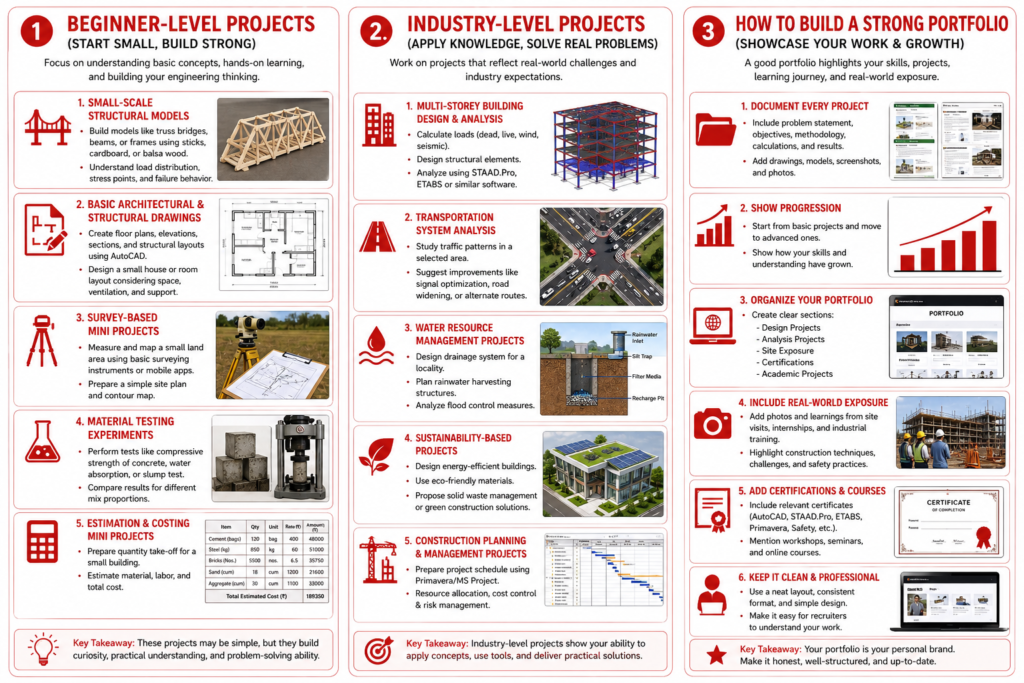
A very effective starting point is small-scale structural models, like truss bridges or simple beam systems made using sticks, cardboard, or lightweight materials. What makes these projects valuable is not the model itself, but the process—how you decide the shape, how loads are distributed, and where failure occurs. When your model breaks, that’s actually where real learning happens, because you understand weak points and design flaws.
Another strong beginner project is creating basic architectural and structural drawings using AutoCAD. Instead of just copying designs, try designing a small house or room layout yourself. Think about ventilation, spacing, and structural support. This builds your ability to visualize spaces and translate ideas into technical drawings, which is a core skill in this field.
You can also take up survey-based mini projects, like mapping a small land area using basic tools or even smartphone apps. This helps you understand how land measurement works in real scenarios. Additionally, simple material testing experiments, such as comparing different concrete mixes or testing compressive strength, can give you practical exposure to how materials behave.
From my experience, these beginner projects may not look “professional,” but they build the most important skill—thinking like an engineer instead of just studying like a student.
2. What are industry-level projects I should aim for?
As you progress, your projects should start reflecting the kind of problems engineers actually solve in the real world. At this stage, it’s not just about understanding concepts—it’s about applying them in a structured and realistic way.
One of the most important industry-level projects is multi-storey building design and analysis. This involves calculating loads (dead load, live load, wind, seismic), designing structural elements, and analyzing stability using software like STAAD.Pro or ETABS. What makes this project valuable is that it closely mirrors real structural engineering work.
Another impactful project is transportation system analysis, where you study traffic patterns in a specific area and propose improvements. This could include signal timing optimization, road widening suggestions, or alternative route planning. Such projects show that you can connect engineering with real-world urban problems.
You can also work on water resource management projects, such as designing a drainage system for a locality, planning rainwater harvesting, or analyzing flood control measures. These projects are highly relevant, especially in cities facing water-related challenges.
If you want to stand out, try focusing on sustainability-based projects—for example, designing an energy-efficient building, using eco-friendly construction materials, or proposing waste management systems. From what I’ve observed, industry-level projects are judged not by complexity alone, but by how well they solve a real problem in a practical and efficient way.
3. How can I build a portfolio in this domain?
This is something I wish more students took seriously from the beginning. In Civil Engineering, your portfolio becomes proof of your practical capability, not just your academic performance.
Start by documenting every project you work on—no matter how small. For each project, include the problem statement, your approach, calculations, drawings, and final outcome. If you’ve used software, include screenshots of your designs or models. If you’ve done physical models, include photos and explain what you learned from them.
Over time, your portfolio should show progression—from basic projects to more complex ones. This tells recruiters that you are not just learning, but growing consistently. You can organize your portfolio into sections like design work, analysis projects, site exposure, and certifications.
Another important thing is to include real-world exposure. If you’ve visited construction sites or worked on internships, document what you observed—construction techniques, challenges, safety practices, etc.
From my experience, a strong portfolio doesn’t need to be fancy—it needs to clearly show that you can apply knowledge, solve problems, and understand real-world engineering work.
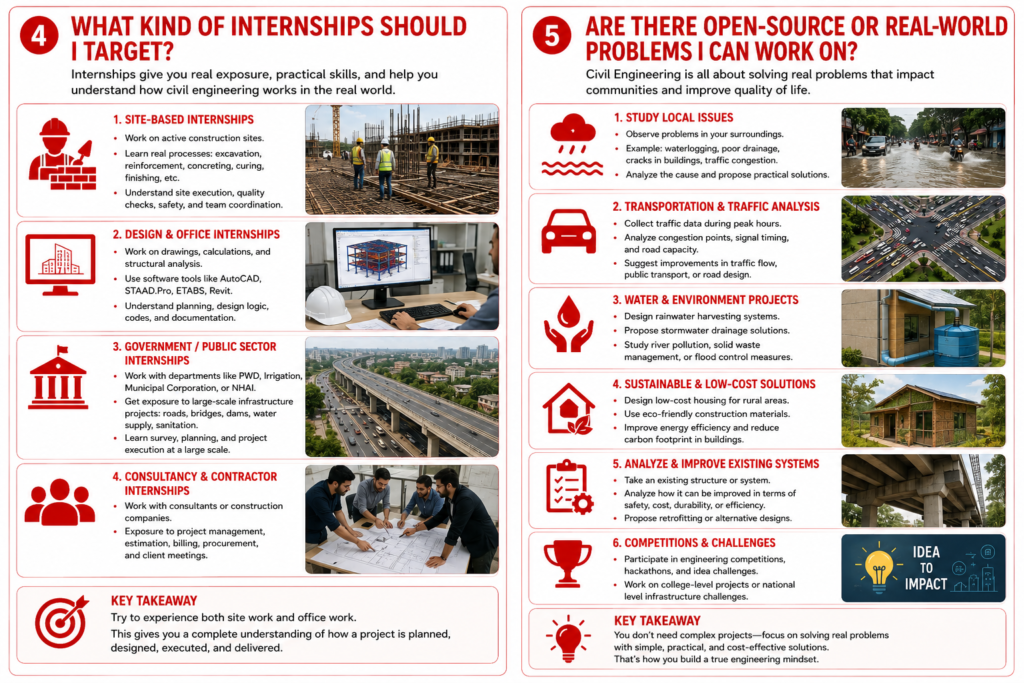
4. What kind of internships should I target?
Internships in Civil Engineering are not just helpful—they are absolutely essential. This is a field where you cannot rely only on classroom learning.
In the early stage, you should aim for site-based internships, even if they are short-term or unpaid. Working on a construction site exposes you to real processes—foundation work, reinforcement placement, concrete pouring, curing, and finishing. You also learn how teams coordinate, how timelines are managed, and how problems are solved on-site.
As you gain more knowledge, you can target design internships, where you work with drawings, calculations, and software tools. These internships help you understand the planning and analysis side of projects. Ideally, you should experience both site work and office work, because together they give you a complete understanding of the field.
Another good option is internships with government bodies or infrastructure companies, where you can see large-scale projects like roads, bridges, or water systems.
From my perspective, the goal of internships is not just to get a certificate—it’s to understand how real projects function and where your role fits in.
5. Are there open-source or real-world problems I can work on?
Civil Engineering doesn’t have traditional “open-source” platforms like software development, but it offers something even more valuable—real-world problems everywhere around you.
You can start by observing issues in your own surroundings. For example, if there’s frequent waterlogging in your area, you can study the drainage system and propose improvements. If traffic congestion is a problem, you can analyze peak hours and suggest better traffic management solutions.
You can also work on sustainable solutions, such as designing low-cost housing, planning rainwater harvesting systems, or proposing eco-friendly construction materials. These are real challenges that cities and communities face every day.
Another approach is to take an existing structure or system and analyze how it can be improved—whether it’s reducing cost, increasing durability, or improving efficiency. You can also participate in engineering competitions, hackathons, or college-level projects that focus on infrastructure challenges.
From my experience, the best projects are not the ones that look complicated—they are the ones that solve real problems in a simple, practical way. That’s what truly builds your engineering mindset.