
(This is where all your effort translates into real outcomes—jobs, salary, and growth.)
What are the core job roles in this branch?
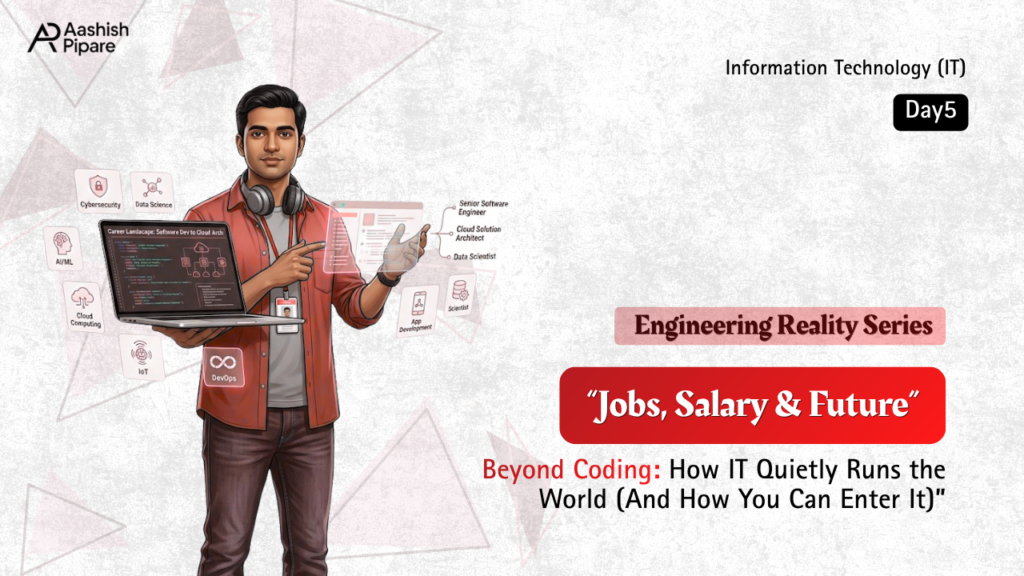
When I first looked into IT careers, I assumed there were just one or two common roles like “software engineer.” But once I explored the field, I realized IT is actually very broad, and that’s both an advantage and a challenge.
One of the most common roles is Software Developer, where you build applications, websites, or systems. This is what most students aim for, but even within this, there are specializations like frontend, backend, and full-stack development.
Then there are roles like Data Analyst and Data Scientist, where you work with data to extract insights. I’ve seen many students shift into this area because companies today rely heavily on data for decision-making.
Another important role is System Administrator or Cloud Engineer, where you manage servers, networks, and cloud infrastructure. With the rise of cloud platforms like Amazon Web Services and Microsoft Azure, these roles are becoming more important.
You also have Cybersecurity roles, which focus on protecting systems and data, and DevOps engineers, who work on automation and deployment pipelines.
From what I’ve seen, the biggest advantage of IT is flexibility—you’re not stuck in one path. You can start in one role and gradually shift as your interests evolve.
What is the average starting salary in India?
This is something every student wants to know, and honestly, the answer is not very straightforward because it varies a lot.
From what I’ve observed, the average starting salary for IT graduates in India usually ranges between ₹3 LPA to ₹8 LPA for most entry-level roles. If you get into service-based companies like Tata Consultancy Services or Infosys, the starting salary is often on the lower side of this range.
However, if you manage to get into product-based companies or top tech firms like Google, Microsoft, or Amazon, the packages can go significantly higher, sometimes even ₹10 LPA to ₹30 LPA or more.
What I’ve learned is that salary in IT is highly skill-dependent. Two students from the same college can have completely different salaries based on their projects, skills, and preparation.
So instead of focusing only on the average, it’s better to focus on becoming someone who can break the average range.
Which companies hire heavily in this field?
One thing I noticed early is that IT is one of the few branches where hiring happens at a massive scale.
In India, large service-based companies like Tata Consultancy Services, Infosys, Wipro, and HCL Technologies recruit thousands of freshers every year. These companies are often the entry point for many students.
Then there are product-based and global companies like Google, Microsoft, Amazon, and Adobe, which offer better roles and salaries but have tougher selection processes.
Startups are another major area. From my experience, startups may not always offer very high initial salaries, but they give you hands-on experience and faster growth, which can be very valuable in the long run.
So the hiring landscape in IT is wide—you just need to position yourself according to your goals.
What is the future demand (2025–2040)?
From everything I’ve observed and researched, IT is not just growing—it is becoming the backbone of almost every industry.
Between 2025 and 2040, areas like Artificial Intelligence, Cloud Computing, Cybersecurity, and Data Science are expected to grow rapidly. Companies are becoming more digital, and that means they need more IT professionals to build and maintain systems.
However, one important thing I’ve realized is that demand will not be equal for everyone. Basic or repetitive roles may decrease due to automation, while roles requiring advanced skills and problem-solving will increase.
So yes, the future demand is strong, but it will favor people who keep upgrading their skills. IT is not a “learn once and relax” field—it’s a continuous learning journey.
If you stay updated and adaptable, the opportunities in this field can be long-term and global.
Can this branch lead to entrepreneurship or startups?
This is actually one of the biggest strengths of IT, and something that attracted me personally.
Unlike many other branches, IT gives you the ability to build products with minimal resources. You don’t need a factory or heavy investment—you just need skills, an idea, and execution.
Many successful startups today are built on IT solutions—apps, platforms, SaaS products, or digital services. Companies like Flipkart and Zomato started with simple ideas but scaled through technology.
From what I’ve seen, students who work on real projects during college already take their first step toward entrepreneurship. Even freelancing or building small tools can eventually turn into a business.
The only thing is—entrepreneurship in IT requires more than technical skills. You also need problem-solving ability, market understanding, and consistency.
But yes, if your goal is to build something of your own, IT is one of the best branches to support that journey.