

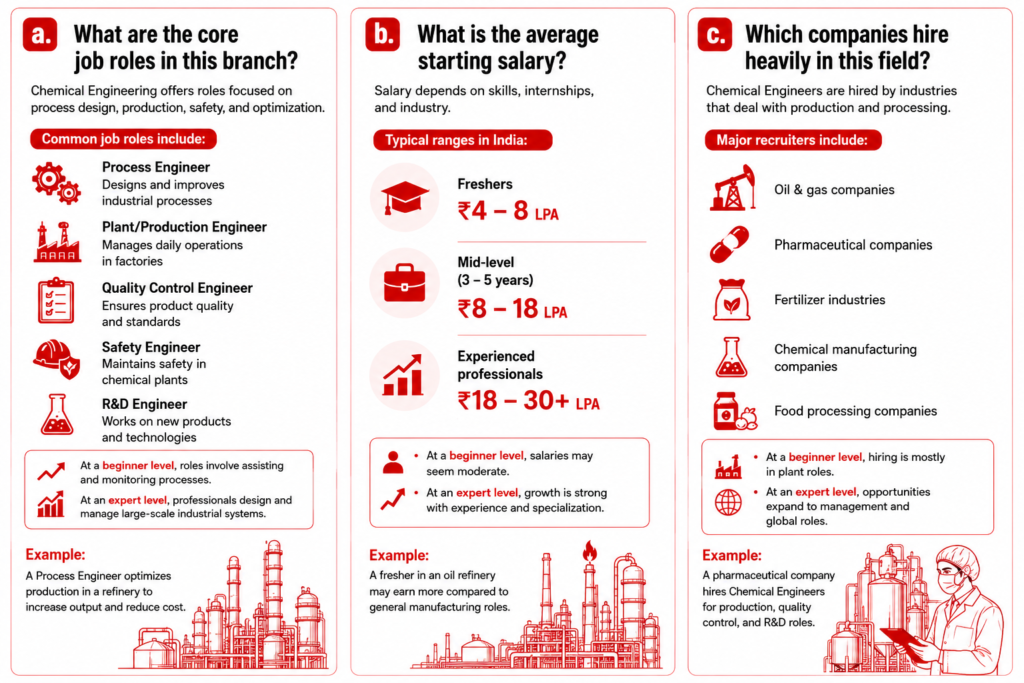
a. What are the core job roles in this branch?
Chemical Engineering is a diverse branch of engineering that focuses on converting raw materials into valuable products through chemical, physical, and biological processes. Chemical engineers work in industries such as oil and gas, pharmaceuticals, food processing, fertilizers, petrochemicals, energy, and environmental management. Their responsibilities range from designing industrial processes to ensuring safety, quality, and sustainability.
1. Process Engineer
A Process Engineer is responsible for designing, developing, optimizing, and improving industrial manufacturing processes. They analyze production systems to increase efficiency, reduce costs, improve product quality, and minimize environmental impact.
Key Responsibilities:
- Design chemical production processes and equipment
- Monitor plant performance and productivity
- Improve process efficiency and reduce waste
- Troubleshoot operational issues
- Ensure compliance with safety and environmental regulations
Example:
A Process Engineer in a refinery may optimize crude oil processing to increase fuel production while reducing energy consumption.
2. Plant/Production Engineer
Plant or Production Engineers oversee the day-to-day operations of manufacturing facilities. Their goal is to ensure smooth production, maintain equipment reliability, and achieve production targets efficiently.
Key Responsibilities:
- Supervise plant operations and production teams
- Monitor equipment performance and maintenance
- Manage production schedules
- Reduce downtime and operational losses
- Coordinate with different departments for smooth operations
Example:
A Production Engineer in a fertilizer plant ensures that production targets are met while maintaining product quality and operational safety.
b. What is the average starting salary?
The salary of a Chemical Engineer depends on several factors, including educational qualifications, technical skills, internships, industry sector, company reputation, location, and work experience. Chemical Engineering is considered one of the core engineering branches, and salary growth can be significant as professionals gain expertise and move into specialized or managerial roles.
Salary Range in India
Freshers (0–2 Years Experience)
A newly graduated Chemical Engineer can typically expect a salary between ₹4–8 LPA (Lakhs Per Annum).
Factors affecting fresher salaries:
- College reputation and academic performance
- Internship experience
- Knowledge of process simulation software
- Communication and problem-solving skills
- Industry type (oil & gas, pharmaceuticals, petrochemicals, etc.)
Top companies in sectors such as oil and gas, specialty chemicals, and pharmaceuticals often offer higher starting packages compared to small manufacturing firms.
Example:
A fresher joining a refinery, petrochemical company, or leading pharmaceutical organization may earn around ₹6–8 LPA, while roles in smaller manufacturing plants may start around ₹4–5 LPA.
Mid-Level Professionals (3–5 Years Experience)
With a few years of industry experience, Chemical Engineers can earn between ₹8–18 LPA.
At this stage, engineers gain expertise in:
- Process optimization
- Production management
- Quality assurance
- Plant operations
- Project execution
Professionals who handle critical industrial processes or manage teams often receive higher compensation.
Example:
A Process Engineer with 5 years of experience in a petrochemical plant may earn ₹12–18 LPA depending on responsibilities and company size.
Experienced Professionals (8+ Years Experience)
Senior Chemical Engineers, Plant Managers, Technical Specialists, and Operations Leaders can earn ₹18–30+ LPA.
Professionals at this level are responsible for:
- Managing large production facilities
- Leading engineering teams
- Strategic planning and decision-making
- Process design and innovation
- Cost optimization and operational excellence
Highly experienced professionals working in multinational corporations or specialized industries may earn significantly higher packages.
Example:
A Plant Manager in a large chemical manufacturing company may earn ₹25–30+ LPA, along with performance bonuses and additional benefits.
c. Which companies hire heavily in this field?
Which companies hire heavily in the field of Chemical Engineering?
Chemical Engineering is a core engineering discipline that plays a vital role in industries involving chemical production, manufacturing, processing, energy generation, pharmaceuticals, food technology, and environmental management. As a result, Chemical Engineers are in demand across a wide range of sectors. Their expertise in process design, production optimization, quality control, safety management, and research makes them valuable to both private and public organizations.
1. Oil and Gas Companies
The oil and gas sector is one of the largest employers of Chemical Engineers. These companies are involved in extracting, refining, processing, and distributing petroleum products.
Roles Available:
- Process Engineer
- Refinery Engineer
- Production Engineer
- Operations Engineer
- Safety Engineer
Major Recruiters:
- Reliance Industries Limited (RIL)
- Indian Oil Corporation Limited (IOCL)
- Bharat Petroleum Corporation Limited (BPCL)
- Hindustan Petroleum Corporation Limited (HPCL)
- Oil and Natural Gas Corporation (ONGC)
- Shell
- ExxonMobil
- Chevron
Example:
A Chemical Engineer working at a refinery may optimize fuel production processes to increase efficiency and reduce operating costs.
2. Pharmaceutical Companies
Pharmaceutical industries require Chemical Engineers for manufacturing medicines, developing production processes, maintaining quality standards, and ensuring regulatory compliance.
Roles Available:
- Production Engineer
- Process Development Engineer
- Quality Control Engineer
- Validation Engineer
- Research Engineer
Major Recruiters:
- Sun Pharmaceutical Industries
- Cipla
- Dr. Reddy’s Laboratories
- Lupin
- Aurobindo Pharma
- Biocon
- Pfizer
- Abbott
Example:
A Chemical Engineer in a pharmaceutical company may help scale laboratory drug formulations into large-scale commercial production.
3. Fertilizer Industries
Fertilizer manufacturing involves large-scale chemical processing and production, making it a major employment sector for Chemical Engineers.
Roles Available:
- Plant Engineer
- Process Engineer
- Production Manager
- Operations Engineer
Major Recruiters:
- National Fertilizers Limited (NFL)
- Coromandel International
- Chambal Fertilisers
- Rashtriya Chemicals & Fertilizers (RCF)
- IFFCO
Example:
Engineers monitor ammonia and urea production processes to maximize output while maintaining environmental standards.
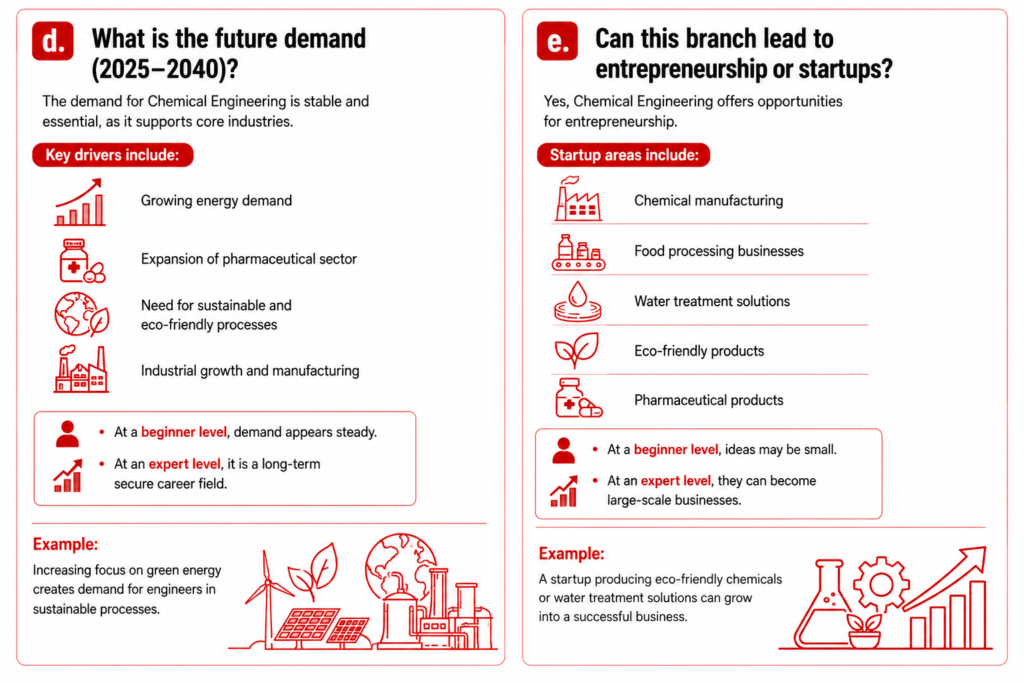
d. What is the future demand (2025–2040)?
Chemical Engineering is expected to remain one of the most important and stable engineering disciplines from 2025 to 2040. Unlike some fields that experience rapid fluctuations based on technological trends, Chemical Engineering serves as the backbone of essential industries such as energy, pharmaceuticals, chemicals, food processing, water treatment, and manufacturing. Since these industries are fundamental to economic growth and human development, the demand for Chemical Engineers is expected to remain strong for decades.
The future of Chemical Engineering is also evolving beyond traditional chemical plants. Engineers are increasingly involved in sustainable technologies, renewable energy, biotechnology, advanced materials, environmental protection, and industrial automation. This transformation is creating new career opportunities while maintaining the relevance of traditional chemical engineering roles.
e. Can this branch lead to entrepreneurship or startups?
Yes, Chemical Engineering offers excellent opportunities for entrepreneurship and startup creation. Unlike many engineering branches that focus mainly on services or software development, Chemical Engineering provides the knowledge required to create, manufacture, and commercialize physical products that are used by industries and consumers every day. From chemicals and pharmaceuticals to food products and environmental solutions, chemical engineers can build businesses across a wide range of sectors.
The combination of technical knowledge, process design skills, production expertise, and understanding of industrial operations makes Chemical Engineers well-equipped to become entrepreneurs. Many successful industrial businesses around the world were founded by professionals with strong backgrounds in chemical engineering and manufacturing.
CONCLUSION
The career landscape in Chemical Engineering is stable, industry-focused, and essential for economic growth. It offers opportunities in core industries, research, and entrepreneurship. With the right skills and experience, professionals can achieve strong career growth and long-term stability.