
How will AI impact this branch?
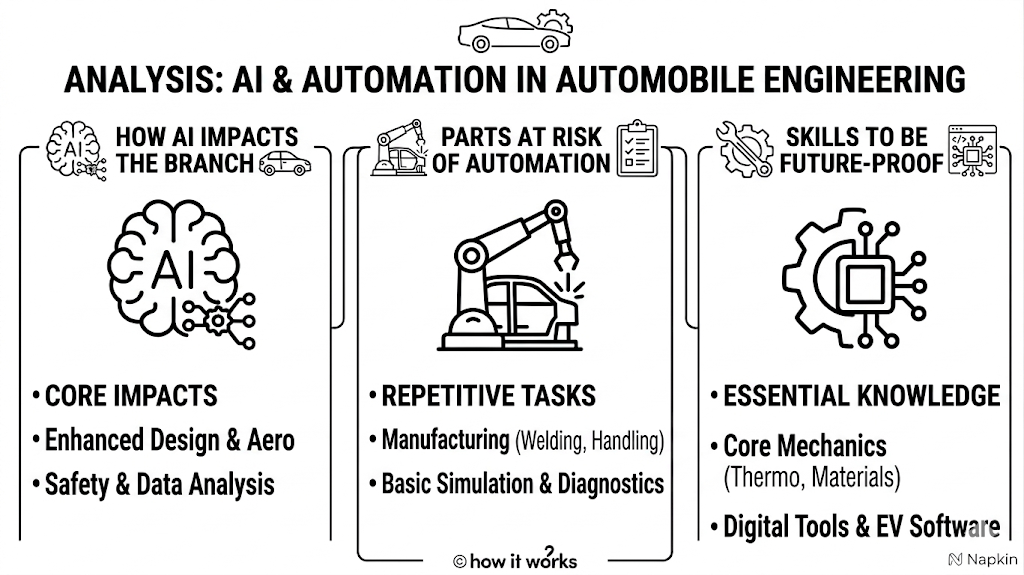
From my perspective, artificial intelligence is already beginning to reshape Automobile Engineering in ways that are much deeper than many students initially realize. In the past, automotive engineering focused mainly on mechanical performance, but now AI is becoming part of how vehicles are designed, tested, manufactured, and even driven. I have seen AI being used to analyze enormous amounts of vehicle data to improve fuel efficiency, predict component failure, and enhance driver safety. In modern design environments, AI can help simulate crash behavior or optimize aerodynamics much faster than traditional methods. It is also becoming central to autonomous driving systems, where vehicles must interpret traffic, pedestrians, and road conditions in real time. From what I have observed, AI will not remove the need for automobile engineers, but it will change the way engineers solve problems by making vehicle systems more intelligent and data-driven than ever before.
What parts of this field are at risk of automation?
From what I have seen, the parts of Automobile Engineering that are most at risk of automation are the repetitive tasks that can be standardized through machines or software. In manufacturing plants, assembly operations such as welding, painting, inspection, and parts handling are already heavily automated through robotic systems. I have also noticed that routine design modifications and basic simulation work can increasingly be assisted by AI-driven software, reducing manual effort. In service sectors, some vehicle diagnostics that once required experienced technicians can now be performed by onboard software systems. However, in my experience, the deeper engineering tasks such as innovation, system integration, failure analysis, and advanced problem-solving remain difficult to automate because they still require human judgment. Automation tends to replace repetitive execution, but the creative and analytical side of engineering continues to depend on skilled professionals.
What skills make me future-proof in this domain?
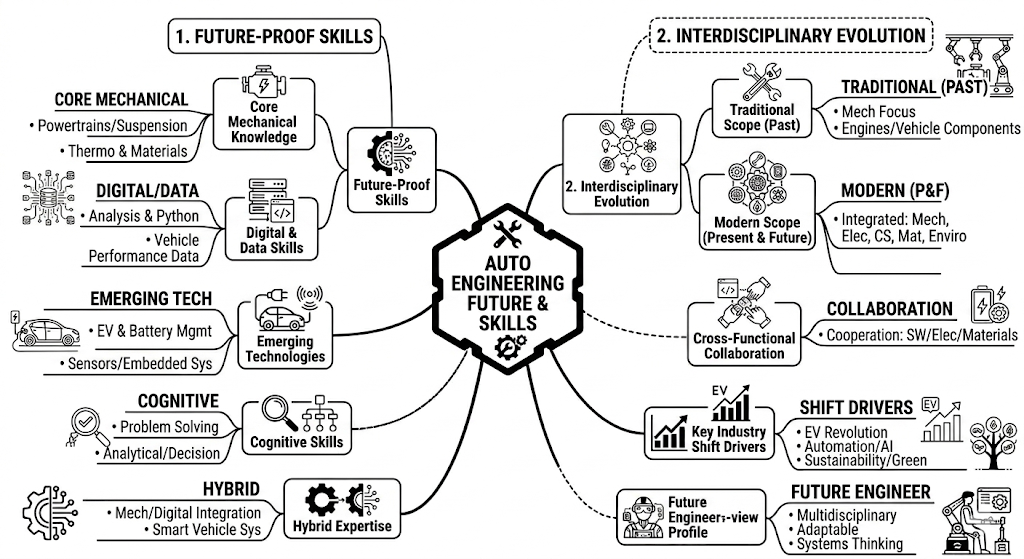
From my experience, the skills that make an Automobile Engineer future-proof are the ones that combine traditional mechanical knowledge with digital adaptability. A strong understanding of vehicle systems such as powertrains, suspension, thermodynamics, and materials will always remain important because every new technology still builds on those fundamentals. At the same time, I have noticed that engineers who understand data analysis and tools like Python have a growing advantage because modern vehicles generate large amounts of performance data. Knowledge of electric vehicle systems, battery management, sensors, and embedded software can also make a major difference. I believe problem-solving remains one of the most valuable skills because machines can provide information, but engineers must still interpret complex situations. In my experience, the safest career path belongs to engineers who can understand both the mechanical heart of a vehicle and the digital systems that now control it.
Is this branch evolving towards interdisciplinary roles?
From my perspective, Automobile Engineering is clearly evolving into a much more interdisciplinary field than it was in the past. Earlier, an automobile engineer could focus mostly on engines and mechanical systems, but now modern vehicles combine mechanical engineering, electronics, computer science, materials science, and environmental engineering. I have seen automobile engineers working closely with software developers on autonomous systems, with electrical engineers on battery technologies, and with material scientists on lightweight vehicle structures. The growth of electric vehicles has made this shift even more noticeable because designing a modern car now involves energy systems, data systems, and sustainability concerns together. In my experience, the future of this branch belongs to engineers who are comfortable working across multiple disciplines rather than staying limited to only one traditional specialization.
Conclusion:
AI and automation are transforming Automobile Engineering into a smarter, data-driven, and interdisciplinary field—automating repetitive tasks while increasing demand for engineers who can integrate mechanical, electrical, and digital systems.
CTA:
Build strong fundamentals in vehicle systems, learn data and software skills (like Python), and stay adaptable—this is how you remain future-proof in the evolving automotive industry.