
🔹How will AI impact this branch?
Artificial Intelligence (AI) is rapidly transforming Electrical Engineering by making systems smarter, more efficient, and highly predictive. Traditionally, electrical systems were designed to operate based on fixed rules and manual supervision. Today, AI enables these systems to learn, adapt, and make decisions automatically.
One of the most important applications of AI is in predictive maintenance. In industries, machines and electrical equipment generate large amounts of operational data such as temperature, voltage, vibration, and load conditions. AI algorithms analyze this data to detect patterns and predict failures before they occur. For example, an AI system can detect abnormal motor vibrations and alert engineers before the motor fails, preventing costly downtime.
Another major application is in smart grids. Traditional power grids distribute electricity in a one-way flow, but smart grids use AI to monitor demand and supply in real time. AI can automatically adjust power distribution, reduce losses, and prevent overloads. For example, during peak demand, AI systems can redirect power from less-used areas to high-demand zones.
AI is also used in energy optimization. By analyzing consumption patterns, AI helps reduce energy waste in homes, industries, and cities. Smart systems can automatically switch off unused equipment or adjust energy usage based on demand.
In power plants and industrial systems, AI improves operational efficiency by optimizing processes such as load management and fault detection. Engineers can simulate different conditions using AI models and choose the best operating parameters.
AI also accelerates research and innovation. Engineers can use machine learning to design better electrical systems, optimize circuits, and develop new technologies.
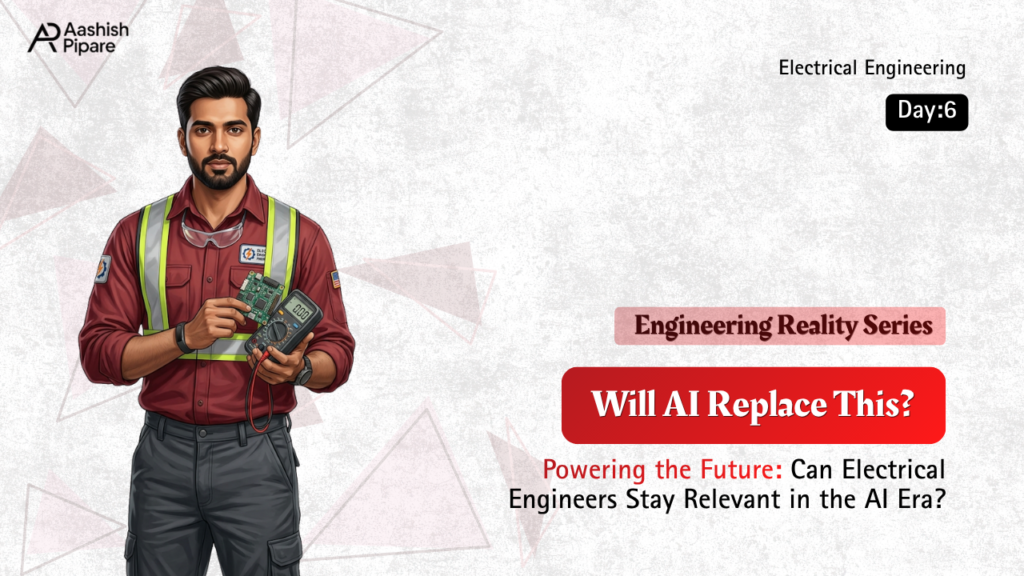
Overall, AI does not replace electrical engineers—it enhances their capabilities. Engineers who understand AI can design smarter systems and solve problems more efficiently.
👉 The future electrical engineer is not just a system operator—but a data-driven decision-maker.
🔹What parts are at risk of automation?
Automation is changing the nature of work in Electrical Engineering by replacing repetitive, manual, and routine tasks. However, it is important to understand that automation does not eliminate jobs—it transforms them.
Tasks that are most at risk include:
- Basic system monitoring
- Routine inspections
- Data collection and reporting
- Simple maintenance operations
For example, earlier engineers had to manually monitor voltage and current levels in power systems. Today, automated systems continuously track these parameters and generate reports instantly.
In industrial environments, automated systems can:
- Detect faults
- Adjust machine operations
- Perform repetitive control tasks
For instance, automated control panels can regulate motor speed and power supply without human intervention.
However, automation has clear limitations. Tasks that require:
- Complex decision-making
- Critical thinking
- System design and innovation
cannot be fully automated.
For example, if a major fault occurs in a power system, automated systems may detect it, but engineers must analyze the situation, decide the best solution, and implement corrective actions.
Similarly, designing a new electrical system or improving efficiency requires human creativity and expertise.
Automation reduces manual workload but increases demand for skilled engineers who can manage and improve automated systems.
👉 Routine work may disappear—but high-skill roles will grow stronger.
🔹What skills make me future-proof?
To succeed in the era of AI and automation, electrical engineers must develop a hybrid skill set that combines traditional knowledge with modern technologies.
The most important foundation is strong core electrical knowledge. Concepts like circuit analysis, power systems, and electrical machines remain essential.
On top of this foundation, engineers must learn:
🔸 1. AI and Data Analysis
Understanding how to analyze data and use AI tools is becoming essential. Engineers must interpret system data and make informed decisions.
🔸 2. Programming Skills
Languages like Python and C are valuable for automation, embedded systems, and data processing.
🔸 3. Automation & Control Systems
Knowledge of PLC, SCADA, and control systems is highly demanded in industries.
🔸 4. Renewable Energy Systems
With the shift toward sustainability, knowledge of solar, wind, and energy storage systems is crucial.
🔸 5. Problem-Solving & Critical Thinking
Machines can process data, but engineers must interpret results and solve complex problems.
For example, an engineer who understands both power systems and AI can design smart grids that automatically optimize energy distribution.
Other important skills include:
- Communication and teamwork
- Adaptability to new technologies
- Continuous learning mindset
👉 Future-proof engineers are those who combine electrical expertise with digital intelligence.
🔹Is this branch evolving towards interdisciplinary roles?
Yes, Electrical Engineering is rapidly evolving into a highly interdisciplinary field, integrating multiple domains to solve modern challenges.
One of the strongest integrations is with Computer Science, especially in areas like AI, machine learning, and software systems. Engineers now need to understand both hardware and software.
The integration with Artificial Intelligence allows engineers to develop intelligent systems that can learn and adapt. For example, AI-based energy management systems can optimize electricity usage automatically.
Another important area is Internet of Things (IoT), where electrical devices are connected and controlled through the internet. Smart homes, smart cities, and industrial automation systems rely heavily on this integration.
Electrical Engineering also overlaps with:
- Mechanical Engineering (in robotics and machines)
- Electronics Engineering (in circuits and devices)
- Environmental Engineering (in renewable energy systems)
For example:
- Smart homes combine electrical systems with IoT and AI
- Electric vehicles combine electrical, mechanical, and software systems
- Smart cities integrate power systems with data networks
This interdisciplinary evolution:
- Expands career opportunities
- Encourages innovation
- Makes the field more dynamic
Engineers who learn across multiple domains have a significant competitive advantage.
The future belongs to engineers who are not limited to one field—but can connect multiple technologies into one system.
Conclusion
In conclusion, AI and automation are transforming Electrical Engineering by making systems smarter, efficient, and data-driven. While routine tasks are automated, the demand for skilled engineers in design, analysis, and innovation continues to grow.
Learn AI, upgrade your skills, and stay future-ready.