
a. How will AI impact this branch?
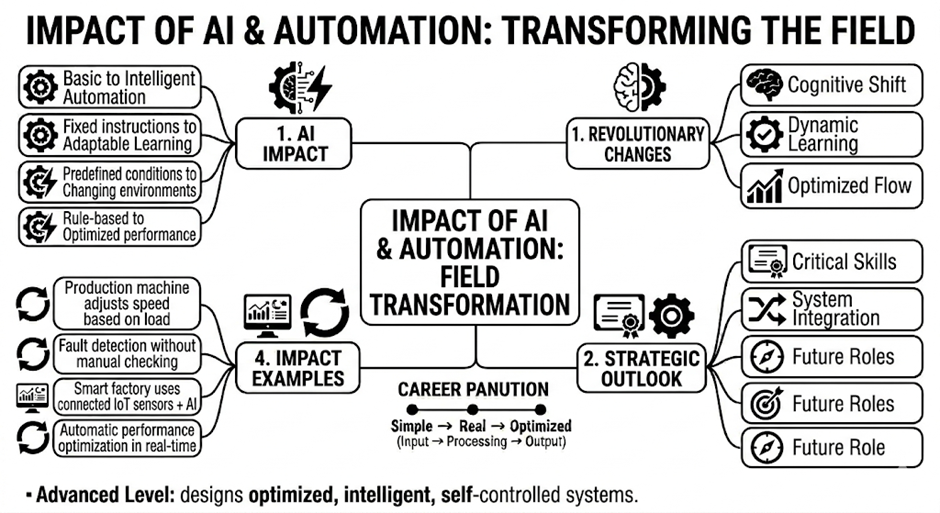
Artificial Intelligence (AI) is transforming Mechatronics from basic automation → intelligent automation.
Earlier systems:
- Follow fixed instructions
Now systems:
- Learn from data
- Adapt to changes
- Make decisions automatically
At a beginner level, systems are pre-programmed.
At an expert level, systems become smart, adaptive, and self-optimizing.
Example:
A traditional air conditioner runs at fixed settings.
An AI-based system adjusts temperature automatically based on room conditions and user behavior.
This improves efficiency and comfort.
b. What parts of this field are at risk of automation?
Some tasks in Mechatronics can be automated, especially:
- Basic machine control
- Routine monitoring
- Simple programming tasks
- Repetitive maintenance checks
At a beginner level, these tasks are common.
At an expert level, engineers focus on design, innovation, and system improvement.
Example:
Machines can automatically monitor their own performance and send alerts without human involvement.
c. What skills make me future-proof in this domain?
To stay relevant, you need to go beyond basic automation skills.
Key future-proof skills include:
- AI and Machine Learning basics
- IoT (Internet of Things)
- Advanced control systems
- Embedded systems programming
- Data analysis and system optimization
At a beginner level, focus on fundamentals.
At an expert level, focus on smart system design and innovation.
Example:
A smart factory system uses IoT sensors and AI to optimize production automatically.
d. Is this branch evolving towards interdisciplinary roles?
Yes, Mechatronics is becoming highly interdisciplinary.
It is evolving into combinations like:
- Mechatronics + AI
- Mechatronics + IoT
- Mechatronics + Robotics
- Mechatronics + Data Analytics
At a beginner level, subjects are learned separately.
At an expert level, engineers integrate multiple domains.
Example:
A smart home system:
- Sensors collect data (Mechatronics)
- IoT connects devices
- AI makes decisions
his is interdisciplinary integration.

Conclusion :
AI and automation are transforming Mechatronics Engineering into a field of intelligent, adaptive, and self-optimizing systems. The focus is shifting from basic control to smart decision-making and system optimization. This makes mechatronics a highly future-ready and evolving domain.
CTA (Call To Action):
- Start learning AI, IoT, and advanced control systems to stay ahead in mechatronics.
- Build smart automation projects that combine sensors, data, and decision-making.