Impact of AI & Automation
🔹How will AI impact this branch?
Artificial Intelligence is transforming marine engineering by making systems smarter, safer, and more efficient.
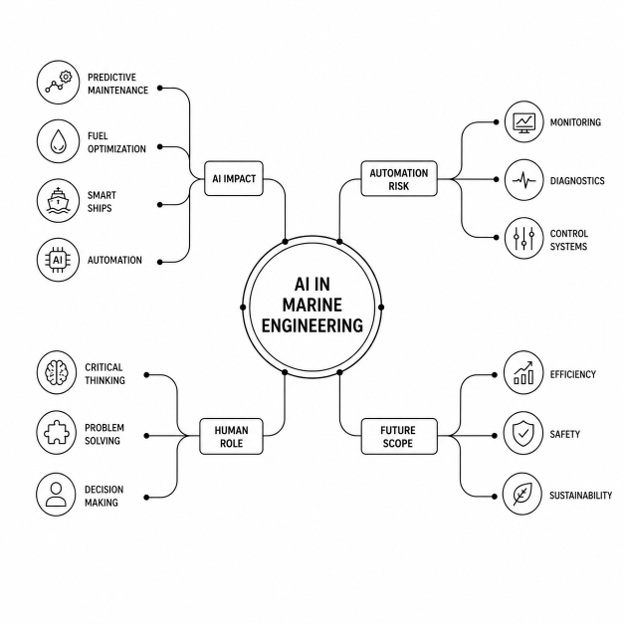
AI is widely used in predictive maintenance, where sensors collect data and algorithms predict failures before they occur.
For example, engine vibration data can indicate early signs of damage, allowing engineers to act before breakdown.
AI is also used in fuel optimization, helping ships reduce consumption and emissions.
Smart ships use AI for navigation, monitoring, and system control.
AI reduces human error and improves decision-making.
🔹What parts of this field are at risk of automation?
Routine and repetitive tasks are most at risk.
Monitoring systems, basic diagnostics, and some operational controls are increasingly automated.
For example, automated control systems can manage engine performance without constant human input.
However, complex decision-making, troubleshooting, and emergency handling cannot be automated.
Engineers are still essential for:
- Critical thinking
- Problem-solving
- System understanding
🔹What skills make me future-proof in this domain?
To stay relevant, engineers must combine core knowledge with modern skills.
Key future-proof skills include:
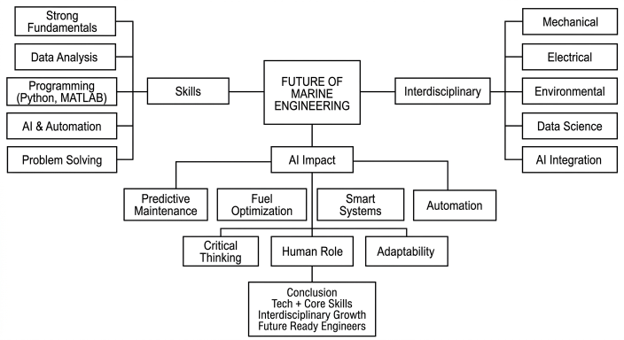
- Strong fundamentals in marine systems
- Data analysis and interpretation
- Understanding of AI and automation
- Problem-solving and adaptability
For example, engineers who can analyze engine data and improve performance will always be valuable.
The future belongs to engineers who can adapt and evolve.
🔹Is this branch becoming interdisciplinary?
Yes, marine engineering is rapidly becoming interdisciplinary.
It now combines:
- Mechanical engineering
- Electrical engineering
- Environmental science
- Data science and AI
For example, designing an eco-friendly smart ship requires knowledge from multiple fields.
Engineers who learn across disciplines have greater opportunities and growth.