
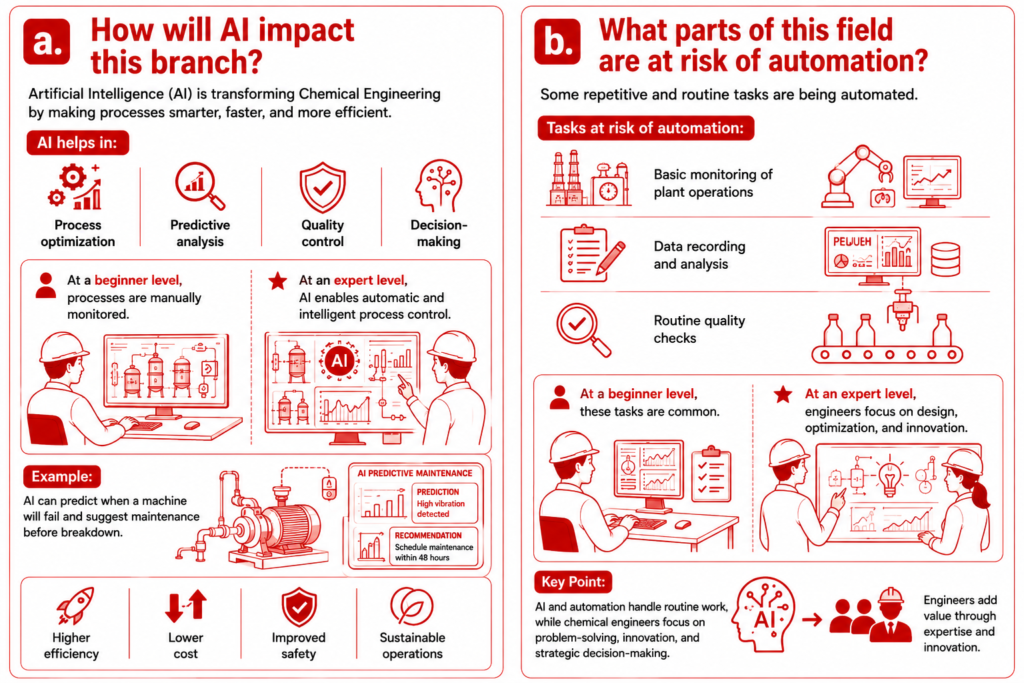
a. How will AI impact this branch?
Artificial Intelligence (AI) is rapidly transforming the field of Chemical Engineering by making industrial processes smarter, faster, safer, and more efficient. Traditionally, chemical plants relied heavily on manual monitoring, operator experience, and fixed control systems. Today, AI is enabling industries to analyze massive amounts of data, predict problems before they occur, optimize production in real time, and improve decision-making.
Rather than replacing Chemical Engineers, AI is becoming a powerful tool that helps engineers solve complex problems, improve productivity, reduce costs, and achieve sustainability goals. As industries move toward Industry 4.0 and smart manufacturing, AI is expected to become an essential part of chemical engineering operations.
b. What parts of this field are at risk of automation?
Automation, Artificial Intelligence (AI), Industrial Internet of Things (IIoT), and smart manufacturing technologies are changing the way chemical industries operate. Modern plants are becoming increasingly automated, allowing companies to improve efficiency, reduce costs, increase safety, and minimize human error.
However, automation does not mean that Chemical Engineers will become obsolete. Instead, it is transforming the nature of their work. Tasks that are repetitive, rule-based, and data-driven are more likely to be automated, while activities requiring creativity, engineering judgment, problem-solving, innovation, and strategic thinking will continue to require human expertise.
As industries adopt Industry 4.0 technologies, Chemical Engineers will increasingly shift from routine operational roles to higher-value roles involving process design, optimization, sustainability, and innovation.
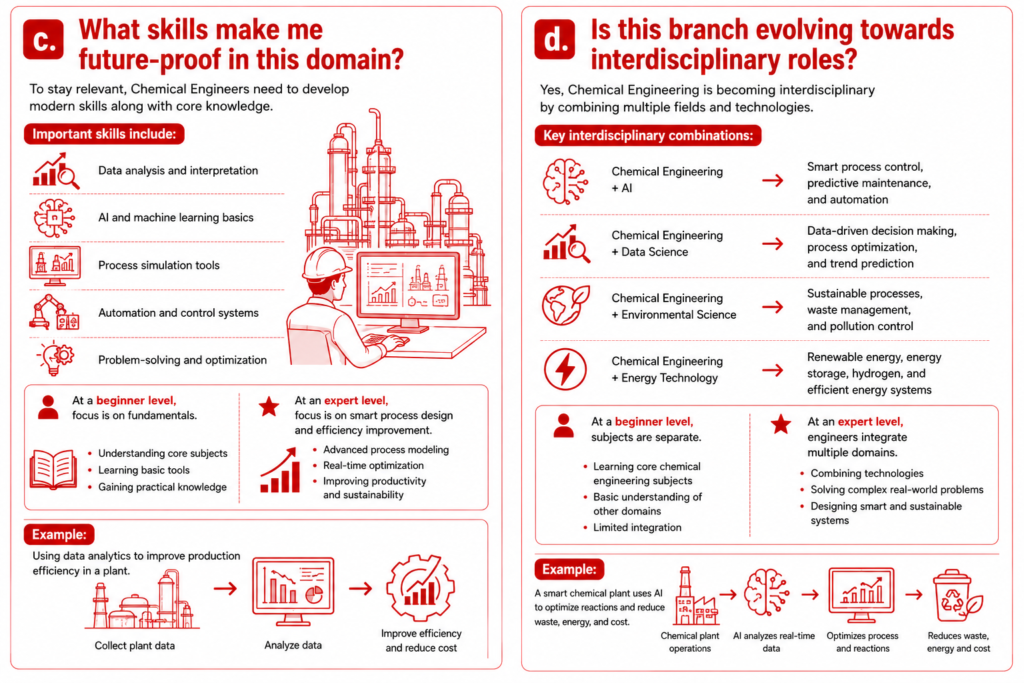
c. What skills make me future-proof in this domain?
The field of Chemical Engineering is evolving rapidly due to advancements in Artificial Intelligence (AI), automation, data analytics, sustainability, digital manufacturing, and Industry 4.0 technologies. While core chemical engineering concepts remain essential, future engineers must also develop modern technical and analytical skills to stay competitive in the job market.
The most successful Chemical Engineers of the future will be those who combine strong engineering fundamentals with digital, analytical, and interdisciplinary skills. Companies are increasingly looking for professionals who can optimize processes, improve efficiency, reduce costs, and support sustainable industrial growth.
d. Is this branch evolving towards interdisciplinary roles?
Yes, Chemical Engineering is rapidly evolving into an interdisciplinary field. Traditionally, Chemical Engineering focused mainly on chemical processes, manufacturing, and industrial plant operations. However, modern industries face increasingly complex challenges related to sustainability, digital transformation, energy efficiency, environmental protection, and advanced manufacturing. As a result, Chemical Engineers are now working at the intersection of multiple disciplines.
Today’s Chemical Engineers are not limited to chemical process design alone. They often collaborate with experts in Artificial Intelligence (AI), Data Science, Environmental Science, Energy Technology, Biotechnology, Materials Science, and Automation Engineering. This interdisciplinary approach allows engineers to solve complex real-world problems more effectively and create innovative solutions for future industries.
The future of Chemical Engineering lies in integrating knowledge from different domains to improve productivity, sustainability, and technological advancement.
CONCLUSION:
AI and automation are enhancing Chemical Engineering by making processes more efficient, safe, and intelligent. While routine tasks are automated, the demand for skilled engineers in design, optimization, and innovation is increasing. This evolution makes the field more advanced, interdisciplinary, and future-ready.