
How difficult is this branch compared to others?
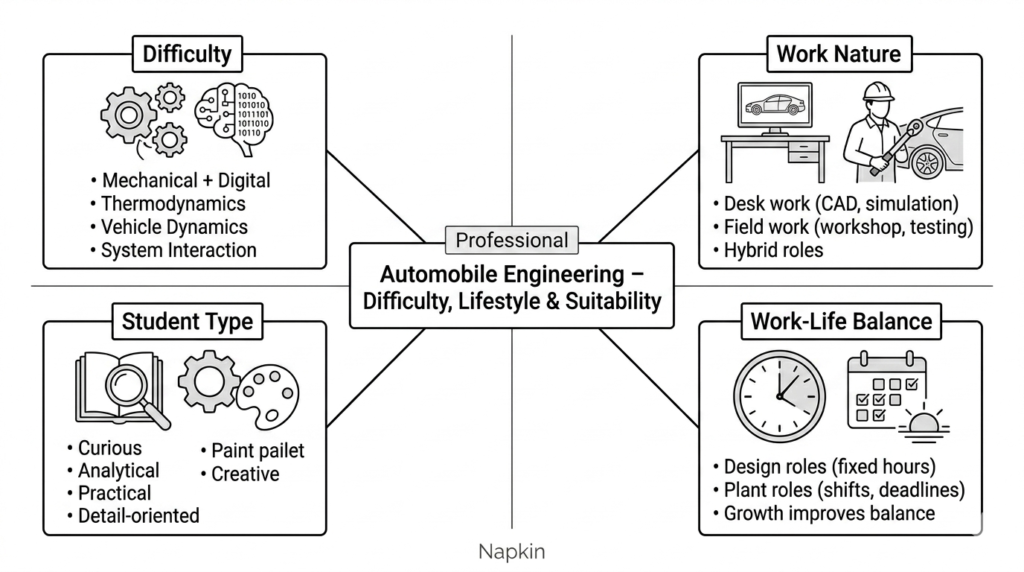
From my experience, Automobile Engineering is considered moderately challenging compared with other engineering branches because it combines mechanical fundamentals with modern electronics and software systems. Many students initially think it is only about learning engines and vehicles, but the field actually requires understanding thermodynamics, machine design, vehicle dynamics, manufacturing, and increasingly digital control systems. I have noticed that students who underestimate the academic depth of the branch often struggle later when subjects become more analytical. Compared with branches like pure computer science, it may involve less intensive coding, but compared with general mechanical engineering, it can feel more specialized because every concept must be applied to real vehicle performance. In my view, the difficulty does not come only from theory but from learning how multiple systems interact inside a single automobile under constantly changing conditions.
What type of students excel in this field?
From what I have observed, the students who excel most in Automobile Engineering are those who naturally feel curious about how machines move and how mechanical systems work together. Students who enjoy understanding engines, motion, design, and performance usually feel more connected to this branch. I have seen that those who combine strong analytical thinking with practical interest often perform better because the field demands both technical understanding and real-world application. Detail-oriented students also tend to do well because even small design errors can affect safety or performance. Creativity can be surprisingly important because improving vehicle systems often requires innovative thinking rather than only following standard methods. In my experience, students who genuinely enjoy transportation technology rather than choosing the field only because of passion for cars usually build stronger long-term careers.
Does it require fieldwork, desk work, or both?
From my experience, Automobile Engineering usually involves a healthy combination of both desk work and field-based work, depending on the role. In design and research positions, engineers spend a lot of time at a desk using software for modeling, simulation, and technical analysis. However, in manufacturing, testing, and service roles, there is often significant time spent in workshops, testing facilities, or production plants. I have seen engineers move between computers and actual vehicle systems in the same day because understanding the physical machine remains essential. Testing roles may involve track evaluation, diagnostics, or plant inspections, while design roles may remain more office-centered. From what I have observed, this branch suits people who enjoy balancing technical computer work with occasional hands-on engineering exposure.
What is the typical work-life balance?
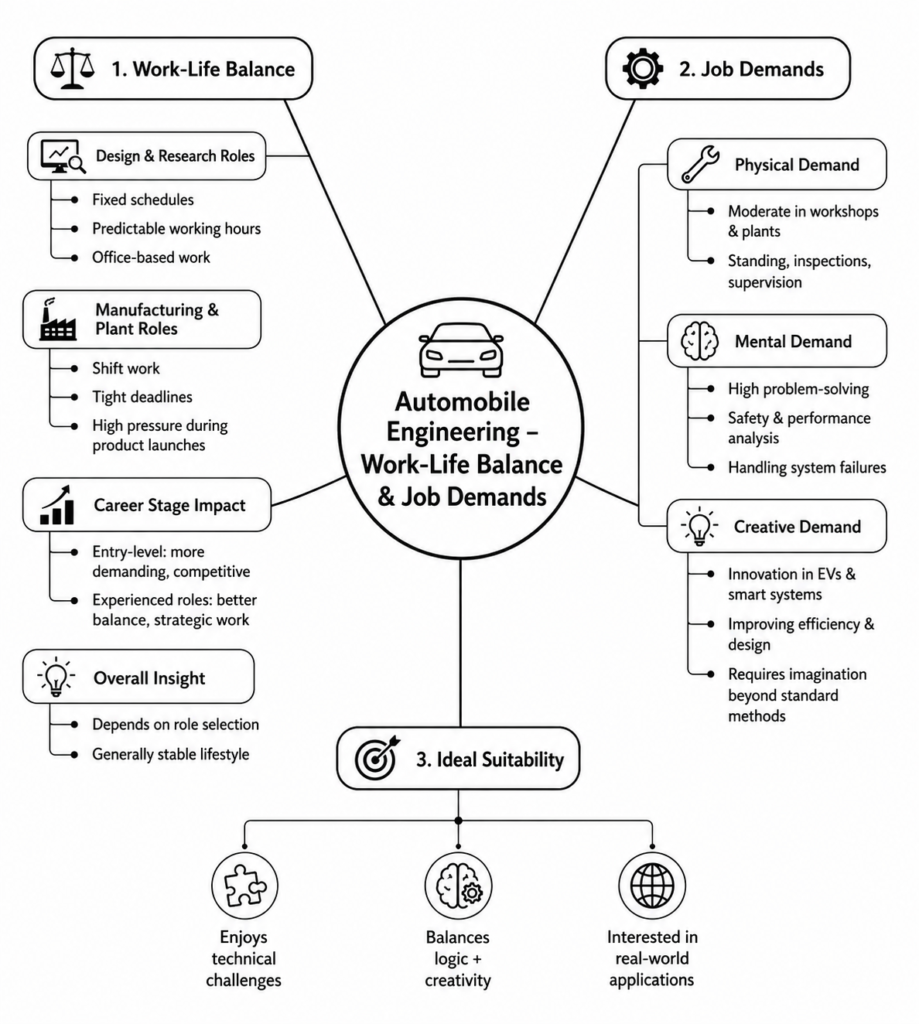
From what I have seen, the work-life balance in Automobile Engineering can vary quite a bit depending on the sector and the specific position. Engineers in design offices, research centers, or corporate technical roles often have relatively structured schedules with predictable working hours. On the other hand, engineers working in manufacturing plants or production management may experience shift work, tighter deadlines, and occasional pressure during product launches. I have noticed that entry-level roles can sometimes be more demanding because young engineers often need to prove themselves in competitive environments. However, as professionals gain experience, work-life balance often improves because responsibilities become more strategic and less physically intensive. In my experience, the branch can offer a stable lifestyle, but the balance depends greatly on whether a person chooses plant operations, design, research, or management.
Does it involve high physical, mental, or creative demand?
From my perspective, Automobile Engineering involves all three forms of demand, but the balance depends on the career path chosen. Physical demand can be moderate in plant, workshop, or testing roles where engineers may spend long hours standing, inspecting vehicles, or supervising production. Mental demand is consistently high because engineers must solve performance issues, safety concerns, and system failures under practical constraints. I have also found that creative demand is growing because modern automotive development increasingly requires innovation in electric mobility, lightweight materials, and intelligent systems. Some people assume the field is purely mechanical, but in my experience, successful engineers often need imagination to improve efficiency and solve problems that standard solutions cannot fully address. The branch is best suited for people who enjoy technical challenges while still appreciating the creative side of engineering design.
Conclusion:
Automobile Engineering is moderately challenging, requiring a mix of analytical thinking, practical interest, and creativity, with a balance of desk and hands-on work and a lifestyle that varies by role (design vs. plant).
CTA:
Choose this branch if you enjoy how machines work, stay consistent with fundamentals, and be ready to balance theory, practical work, and problem-solving to succeed.