
Q1. How difficult is this branch compared to others?
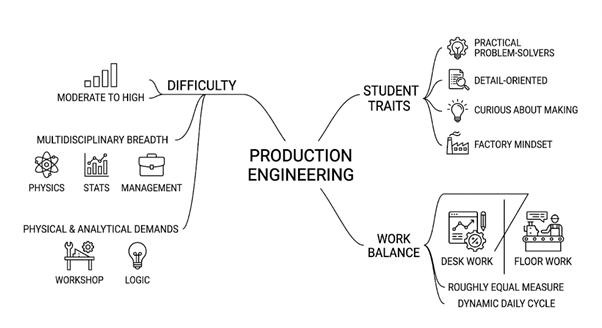
Production Engineering sits at a moderate-to-high difficulty level. It is not as mathematically abstract as Electrical Engineering or as chemistry-heavy as Chemical Engineering, but it demands a unique breadth: you must be comfortable with machining physics, quality statistics, supply chain logic, CAD software, and management principles — all simultaneously. The workshop components require physical stamina and manual dexterity. The planning and control subjects require analytical thinking. The quality and statistics subjects require patience and precision. The overall difficulty is manageable if you engage actively with both the theory and the lab work. Students who only study from textbooks without touching machines will struggle badly in this branch.
Q2. What type of students excel in this field?
Students who thrive in Production Engineering share certain traits. They are curious about how things are made — they instinctively take apart gadgets to see how they work. They are problem-solvers who prefer finding practical solutions over theoretical debates. They have attention to detail — a 0.01 mm error in a tolerance can mean the difference between a functioning assembly and a rejected part. They are comfortable with ambiguity and can manage the complexity of a real factory where nothing ever goes exactly as planned. They enjoy both desk work (planning, analysis, design) and floor work (machine operation, inspection, line supervision). They have a manufacturing mindset — they think in terms of time, cost, quality, and scale simultaneously.
Q3. Does it require fieldwork, desk work, or both?
Both — and in roughly equal measure, especially in the early years. A production engineer’s typical day might start with a morning floor walk to check machine status, OEE, and quality alerts (fieldwork). Then move to a desk for process planning, scheduling updates, or analysing SPC data (desk work). Then back to the floor to investigate a quality issue or trial a new cutting parameter. Then a meeting with the supply chain team to align on material availability. Then writing an improvement report. This variety is one of the most attractive aspects of the job for energetic, dynamic individuals. If you want a purely desk-based career, there are niches (production planning analyst, quality systems engineer), but the most impactful and rewarding production engineering roles will always keep you connected to the factory floor.
Q4. What is the typical work-life balance?
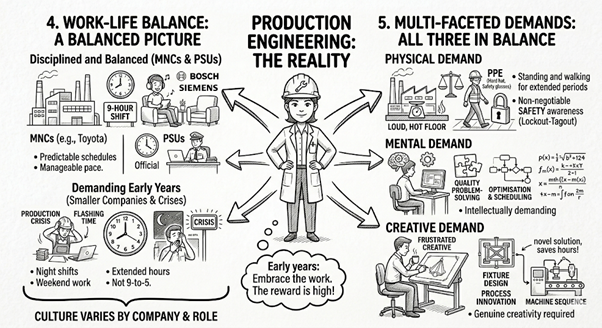
This varies significantly by company, role, and level. In large, well-managed MNCs (Bosch, Siemens, Toyota), the work culture tends to be disciplined and balanced — typically 9-hour shifts with predictable schedules. In Indian public sector units, the pace is generally manageable. However, in smaller companies or during production crises, night shifts, weekend work, and extended hours are common. Production Engineering is not a 9-to-5, Monday-to-Friday career in its early years. This is the honest truth. But the compensation — both financial and in terms of career growth — more than compensates for those who embrace it.
Q5. Does it involve high physical, mental, or creative demand?
All three, in balanced doses. Physically: factory floors are loud, sometimes hot, and require you to stand and walk for extended periods. Safety awareness — wearing PPE, following lockout-tagout procedures — is non-negotiable. Mentally: process optimisation, quality problem-solving, and scheduling under constraints are intellectually demanding. Creatively: fixture design, process innovation, and finding novel solutions to manufacturing challenges require genuine creativity. Many production engineers are frustrated creatives who find enormous satisfaction in designing an elegant fixture or a brilliant process sequence that saves hours of production time.
Conclusion:
Production Engineering can be challenging due to technical concepts and practical work, but it becomes easier with consistent learning and practice.
CTA:
Stay focused and keep improving your skills. Move to Day 8 to explore the latest industry trends in production engineering.