
🔹 How difficult is this branch compared to others?
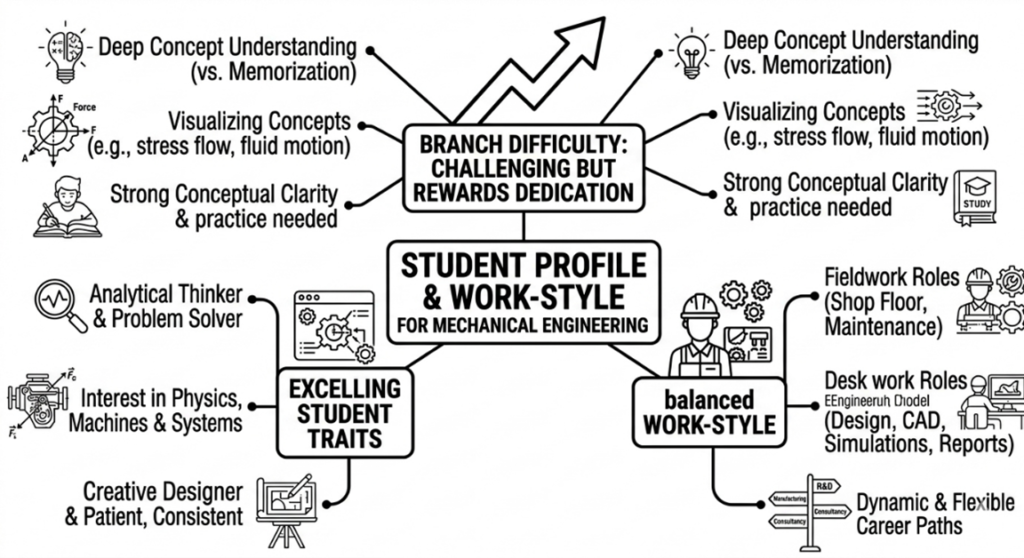
Mechanical Engineering is considered moderately to highly difficult because it combines theory, mathematics, and practical application. Students must understand subjects like thermodynamics, fluid mechanics, and machine design, which require strong conceptual clarity. Unlike some branches where memorization is enough, mechanical engineering requires deep understanding and application. For example, solving a thermodynamics problem involves both formulas and logical reasoning about energy flow. Visualization of concepts, such as stress distribution or fluid motion, can be challenging initially. The difficulty also increases when students must apply theory in real-life situations. However, with regular practice and clear understanding, the subject becomes manageable. Lab work and projects help simplify complex concepts. Compared to purely software-based branches, it demands more effort in both theory and practical learning. Overall, it is challenging but rewarding for dedicated students.
🔹 What type of students excel in this field?
Students who excel in mechanical engineering usually have a strong interest in physics, machines, and how things work. Analytical thinkers who enjoy solving problems perform well in this field. For example, a student who likes understanding how an engine works will find this branch engaging. Practical learners who enjoy experiments and hands-on work also succeed. Attention to detail is important, especially in design and analysis tasks. Students with patience and consistency can handle complex topics effectively. Creativity is useful in designing new systems and improving existing ones. Those who are curious and willing to explore real-world applications perform better. Good mathematical understanding also supports learning. Students who combine interest, discipline, and curiosity tend to excel in mechanical engineering.
🔹 Does it require fieldwork, desk work, or both?
Mechanical engineering involves a combination of fieldwork and desk work, making it a balanced career. Fieldwork is common in industries such as manufacturing plants, where engineers monitor machines and production processes. For example, a production engineer may spend time on the shop floor supervising operations. Desk work includes design, analysis, and documentation tasks. Engineers use software tools to create models, run simulations, and prepare reports. Research and development roles involve more desk-based work, focusing on innovation and design. Maintenance roles involve more fieldwork, dealing with machines directly. This combination allows engineers to gain both practical and analytical experience. It also makes the job dynamic and less repetitive. Engineers can choose roles based on their preferences. Therefore, the branch offers flexibility in work style.
🔹 What is the typical work-life balance?
Work-life balance in mechanical engineering depends on the type of job and industry. In production and manufacturing roles, engineers may work in shifts or longer hours, especially in the early stages of their careers. For example, factory operations often run 24/7, requiring engineers to manage shifts. However, roles in design, research, and corporate sectors offer more stable working hours. Office-based jobs usually follow a regular schedule, providing better work-life balance. With experience, engineers can move into managerial or strategic roles with improved flexibility. Time management skills help maintain a healthy balance between work and personal life. Compared to some high-pressure industries, mechanical engineering offers moderate balance. Choosing the right role and industry is important for comfort. Overall, work-life balance improves with experience and career growth.
🔹 Does it involve high physical, mental, or creative demand?
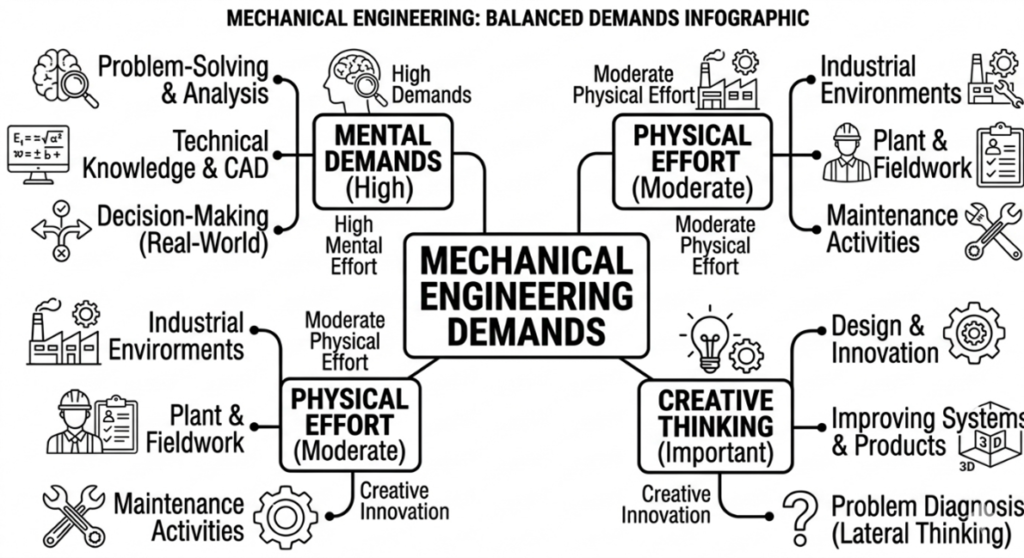
Mechanical engineering involves a combination of mental, physical, and creative demands. The mental demand is high because engineers must analyze complex systems and solve technical problems. For example, diagnosing a machine failure requires logical thinking and technical knowledge. Physical effort is moderate and depends on the role—fieldwork and plant jobs may require working in industrial environments. Creative thinking is important for designing new products and improving systems. Engineers must innovate to make machines more efficient and cost-effective. Decision-making skills are also critical in handling real-world challenges. Different roles emphasize different demands—research roles are more creative, while production roles involve more physical activity. Overall, it is a well-balanced but demanding profession. Engineers must be adaptable and focused to succeed.
CONCLUSION
Mechanical Engineering is a challenging but practical and rewarding branch.
✔ Requires strong concepts and consistent effort
✔ Suitable for students interested in machines and problem-solving
✔ Offers both field and desk work
✔ Work-life balance depends on role and experience
✔ Involves mental, physical, and creative effort
If you are curious, disciplined, and willing to learn, this branch can provide a fulfilling and successful career.