
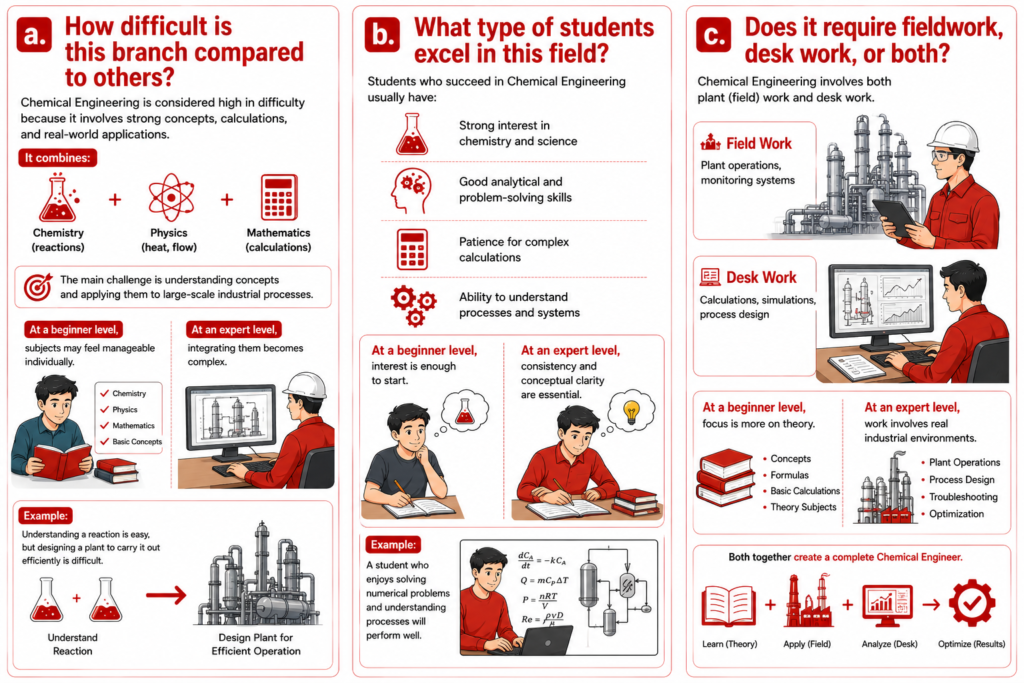
a. How difficult is this branch compared to others?
Chemical Engineering is generally considered one of the more challenging engineering disciplines because it requires a strong understanding of chemistry, physics, mathematics, and engineering principles, along with the ability to apply these concepts to real-world industrial processes. Unlike some branches that focus primarily on a single area, Chemical Engineering combines multiple scientific disciplines and requires students to understand how they interact in large-scale manufacturing systems.
The difficulty of the branch comes not only from learning individual subjects but also from integrating them to solve complex industrial problems involving safety, efficiency, economics, and sustainability.
Why Is Chemical Engineering Considered Difficult?
Chemical Engineering sits at the intersection of science and engineering. Students must learn both theoretical concepts and practical applications.
It Combines:
1. Chemistry
Chemical engineers must understand:
- Chemical reactions
- Reaction kinetics
- Organic chemistry
- Physical chemistry
- Material properties
Chemistry forms the foundation for understanding how raw materials are transformed into useful products.
Example:
Understanding how reactants convert into products inside a chemical reactor.
b. What type of students excel in this field?
Chemical Engineering is a branch that combines chemistry, physics, mathematics, and engineering principles to solve real-world industrial problems. It is a field that requires both scientific understanding and practical problem-solving abilities. While anyone with dedication and hard work can succeed in Chemical Engineering, certain qualities and interests can make the learning process smoother and more enjoyable.
Students who excel in Chemical Engineering are usually curious about how things are made, enjoy understanding scientific processes, and are comfortable working with calculations and analytical thinking. They are interested not only in learning theories but also in applying those theories to improve industrial systems and solve practical challenges.
1. Students with a Strong Interest in Chemistry and Science
Chemistry is one of the foundations of Chemical Engineering. Students who enjoy learning about chemical reactions, materials, and how substances interact often find the subject more engaging.
A strong interest in science helps students understand:
- Chemical reactions
- Material properties
- Industrial processes
- Environmental systems
- Energy transformations
However, Chemical Engineering is not pure chemistry. It focuses on applying scientific principles to large-scale production and manufacturing systems.
Example:
A student who enjoys understanding how crude oil is converted into fuels, how medicines are manufactured, or how fertilizers are produced will likely find Chemical Engineering interesting.
c. Does it require fieldwork, desk work, or both?
Chemical Engineering is a unique engineering discipline because it combines both fieldwork and desk work. Unlike some careers that are primarily office-based or entirely site-based, Chemical Engineers often divide their time between industrial facilities and technical work environments. The exact balance depends on the job role, industry, experience level, and career path.
In practice, Chemical Engineers use desk work to design, analyze, and optimize processes, while fieldwork helps them understand how those processes operate in real industrial conditions. This combination makes the profession dynamic and allows engineers to connect theoretical knowledge with practical applications.
Why Both Fieldwork and Desk Work Are Important
Chemical Engineering deals with large-scale industrial processes used to manufacture products such as:
- Fuels
- Pharmaceuticals
- Fertilizers
- Food products
- Plastics
- Specialty chemicals
- Renewable energy products
Designing and operating these systems requires both technical analysis and practical observation.
Desk Work Helps Engineers:
- Perform calculations
- Design processes
- Analyze data
- Create simulations
- Develop optimization strategies
Fieldwork Helps Engineers:
- Monitor plant operations
- Inspect equipment
- Troubleshoot problems
- Ensure safety compliance
- Understand real-world process behavior
Both aspects complement each other and are essential for successful engineering practice.
Fieldwork in Chemical Engineering
Fieldwork usually takes place in industrial facilities such as:
- Chemical plants
- Oil refineries
- Pharmaceutical manufacturing units
- Food processing plants
- Fertilizer factories
- Power plants
- Water treatment facilities
Chemical Engineers working in these environments spend time directly interacting with industrial equipment and production systems.
d. What is the typical work-life balance?
Work-life balance in Chemical Engineering depends largely on the industry, job role, company culture, and career stage. Unlike some professions that follow a standard office schedule, Chemical Engineering offers a variety of work environments ranging from manufacturing plants and refineries to research laboratories and design offices. As a result, the work-life balance can vary significantly from one role to another.
In general, Chemical Engineering provides a stable and rewarding career, but certain positions may require shift work, on-site presence, or emergency response responsibilities. As engineers gain experience and move into senior or managerial roles, work schedules often become more structured and predictable.
Why Work-Life Balance Varies in Chemical Engineering
Chemical Engineers work in industries that often operate continuously. Many manufacturing facilities run 24 hours a day, 7 days a week, because shutting down production can be expensive and technically challenging.
Examples of such industries include:
- Oil and gas refineries
- Petrochemical plants
- Fertilizer manufacturing
- Power plants
- Pharmaceutical production facilities
- Food processing industries
Because these facilities operate around the clock, some engineering roles require shift-based schedules to ensure continuous monitoring and operation.
At the same time, many Chemical Engineers work in design, consulting, research, or management positions that follow regular office hours.
e. Does it involve high physical, mental, or creative demand?
Chemical Engineering is a profession that combines science, engineering, technology, and problem-solving to design, operate, and improve industrial processes. Because of the wide range of responsibilities involved, Chemical Engineers face different types of demands throughout their careers. These demands can be classified into physical demand, mental demand, and creative demand.
Among these three, mental demand is the highest, as Chemical Engineers constantly analyze complex systems, solve technical problems, make important decisions, and optimize industrial processes. Physical demand is generally moderate and depends on the work environment, while creative demand becomes increasingly important as engineers move into design, innovation, and leadership roles.
The exact balance of these demands varies depending on the industry, job position, and level of experience.
1. Mental Demand: Very High
Chemical Engineering is widely considered one of the most intellectually demanding engineering disciplines. Engineers must understand and apply concepts from chemistry, physics, mathematics, biology, economics, and computer-based technologies.
They are responsible for ensuring that industrial processes operate efficiently, safely, and profitably. This requires continuous analytical thinking and decision-making.
Why Mental Demand Is High
Chemical Engineers frequently work on problems involving:
- Chemical reactions
- Heat transfer
- Fluid flow
- Mass transfer
- Process optimization
- Energy management
- Safety systems
- Environmental compliance
Many industrial processes involve hundreds of variables that interact with one another. Engineers must understand these interactions and make decisions that affect production, safety, and costs.
Examples of Mentally Demanding Tasks
Process Analysis
Engineers must evaluate large amounts of operational data to identify problems and opportunities for improvement.
Example:
If production efficiency suddenly decreases, an engineer may need to analyze temperature profiles, pressure readings, flow rates, and product quality data to find the root cause.
Problem Solving
Unexpected issues often occur in industrial facilities.
Examples include:
- Equipment failures
- Product quality deviations
- Energy losses
- Production bottlenecks
Engineers must quickly identify causes and implement solutions.
Decision Making
Many decisions involve significant financial and safety consequences.
Example:
Choosing whether to modify a process, replace equipment, or shut down production for maintenance requires careful evaluation.

CONCLUSION:
Chemical Engineering is a challenging but rewarding branch that requires strong analytical skills and conceptual understanding. It is best suited for students who enjoy chemistry, problem-solving, and working with real-world industrial processes. With dedication and practical exposure, it offers a stable and impactful career.