
a. How difficult is this branch compared to others?
Mechatronics Engineering is considered moderate to high in difficulty because it combines multiple domains:
- Mechanical systems
- Electronics and circuits
- Programming and control
The challenge is not just learning each subject, but integrating them into one working system.
At a beginner level, subjects may feel manageable individually.
At an advanced level, combining them into real applications becomes challenging.
Example:
Designing a motor is one task.
Programming a controller is another.
But making both work together smoothly in real-time is the real difficulty.
b. What type of students excel in this field?
Students who perform well in Mechatronics usually have:
- Interest in machines and technology
- Logical and analytical thinking
- Curiosity to understand how systems work
- Willingness to experiment and learn from mistakes
- Ability to handle both hardware and software
At a beginner level, interest is enough to start.
At an expert level, consistency and practical learning matter most.
Example:
A student who enjoys building small electronic projects and coding simple programs will naturally excel.
c. Does it require fieldwork, desk work, or both?
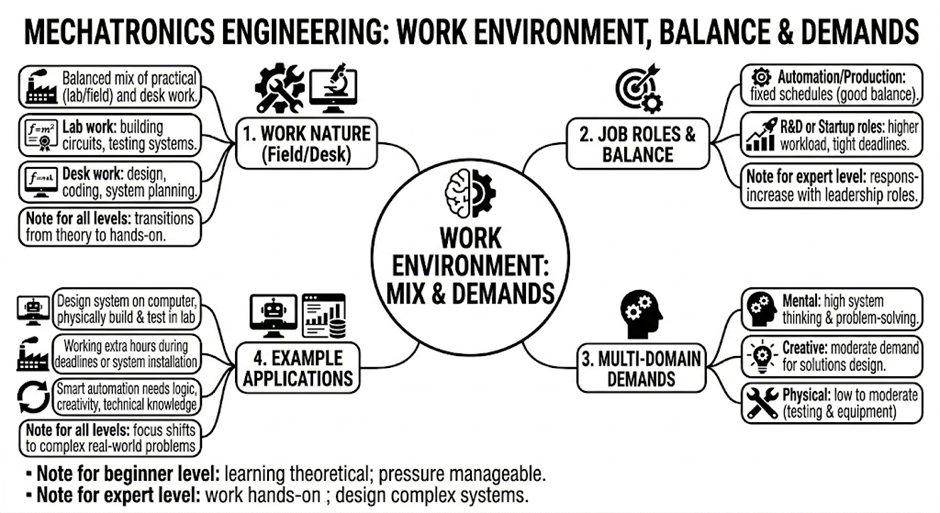
Mechatronics involves a balanced mix of both practical (lab/field) and desk work.
- Lab work → building circuits, testing systems, working with machines
- Desk work → designing, coding, and system planning
At a beginner level, learning is more theoretical.
At an expert level, most work involves hands-on system development.
Example:
You may design a system on a computer and then physically build and test it in a lab.
d. What is the typical work-life balance?
Work-life balance in Mechatronics is generally moderate to good, depending on the role.
- Automation/production roles → fixed schedules (better balance)
- R&D or startup roles → higher workload during projects
At a beginner level, work pressure is manageable.
At an expert level, responsibilities increase with leadership roles.
Example:
During system installation or project deadlines, engineers may work extra hours.
e. Does it involve high physical, mental, or creative demand?
Mechatronics Engineering involves:
- High mental demand : system thinking and problem-solving
- Moderate creative demand : designing solutions
- Low to moderate physical demand : handling equipment and testing
At a beginner level, focus is on understanding concepts.
At an expert level, focus is on solving complex real-world problems.
Example:
Designing a smart automation system requires logical thinking, creativity, and technical knowledge.
Conclusion :
Mechatronics Engineering is a moderately challenging field that requires the ability to integrate multiple skills like mechanics, electronics, and programming. It is best suited for students who enjoy practical learning, problem-solving, and working with both hardware and software. With consistency and hands-on practice, itbecomes highly rewarding.
CTA (Call To Action):
- Evaluate your interest in both hardware and coding before choosing this branch.
- Start experimenting with small automation projects to build confidence and clarity.