
1. What are the current industry trends?
If you look at today’s Civil Engineering industry, it’s no longer just about constructing buildings and roads—it’s about building smarter, faster, and more sustainably. One of the biggest trends is the adoption of digital construction technologies, especially Building Information Modeling (BIM). Tools like Autodesk Revit are transforming how projects are planned, designed, and executed by integrating all data into a single digital model.
Another major trend is sustainable and green construction. There is increasing focus on energy-efficient buildings, eco-friendly materials, and reducing environmental impact. Concepts like green buildings and smart cities are becoming mainstream rather than optional.
You’ll also notice the rise of prefabrication and modular construction, where components are manufactured off-site and assembled on-site. This reduces construction time and improves quality control.
Additionally, technologies like drones for surveying, AI for project management, and IoT-based monitoring systems are becoming part of modern infrastructure projects. From what I’ve seen, the industry is slowly shifting from traditional manual practices to a more technology-driven and data-oriented approach.
2. Which sectors are growing or declining?
In Civil Engineering, growth is strongly tied to how a country develops its infrastructure. Currently, sectors like transportation infrastructure (highways, metro systems, railways) are growing rapidly, especially in developing countries like India. Urban expansion is driving demand for residential and commercial construction, making real estate another active sector.
There is also strong growth in water resource management, including water supply systems, sewage treatment, and flood control projects. With increasing environmental concerns, sustainable construction and renewable energy infrastructure are also expanding areas.
On the other hand, some traditional segments of construction that rely on outdated methods or low-cost labor without innovation may see slower growth. The shift is not exactly a decline in Civil Engineering itself, but rather a transition from traditional practices to modern, efficient, and sustainable approaches.
From my perspective, the sectors that combine technology, sustainability, and large-scale infrastructure will see the most growth in the coming years.
3. What are the major challenges faced in this field?
Civil Engineering might look straightforward from the outside, but in reality, it faces several complex challenges. One of the biggest is project delays and cost overruns. Many construction projects exceed their timelines and budgets due to planning issues, unexpected site conditions, or coordination problems.
Another major challenge is quality control and safety. Ensuring that materials and construction processes meet standards is critical, because any compromise can lead to serious risks. Safety on construction sites is also a constant concern, especially in large-scale projects.
There are also challenges related to environmental impact, such as pollution, resource consumption, and sustainability concerns. Engineers are now expected to design solutions that minimize environmental damage while still being cost-effective.
Additionally, the industry sometimes struggles with skill gaps, where fresh graduates lack practical exposure and companies need to invest time in training them. From what I’ve observed, Civil Engineering is not just about solving technical problems—it’s about managing uncertainty, resources, and real-world constraints.
4. Are there government initiatives supporting this branch?
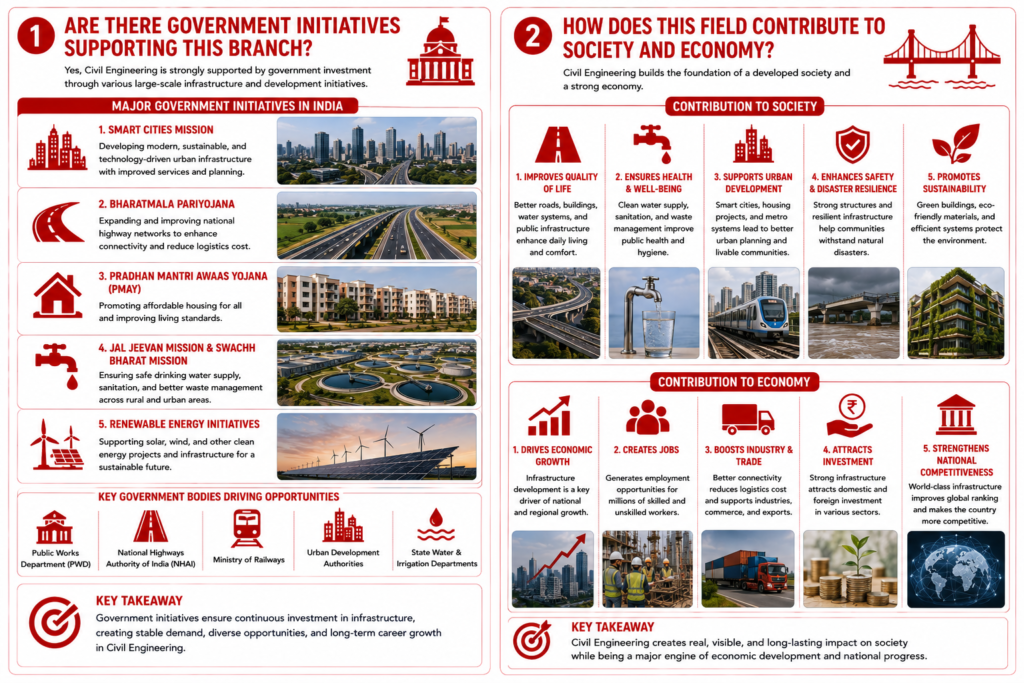
Yes, and this is one of the strongest advantages of Civil Engineering—it is heavily supported by government investment, especially in a developing country like India. Large-scale infrastructure projects are often driven by government initiatives.
Programs like Smart Cities Mission focus on developing modern urban infrastructure with better planning, technology, and sustainability. Similarly, projects like Bharatmala Pariyojana aim to expand and improve road networks across the country.
There are also initiatives related to housing, water supply, sanitation, and renewable energy, all of which require Civil Engineering expertise. Government bodies like the Public Works Department (PWD), National Highways Authority of India (NHAI), and various urban development authorities continuously generate employment and project opportunities.
From what I’ve seen, government involvement ensures that Civil Engineering remains a stable and continuously evolving field, with consistent demand for professionals.
5. How does this field contribute to society and economy?
Civil Engineering is one of the most directly impactful branches when it comes to society and economic development. Every road, bridge, building, water system, or public infrastructure project is a result of civil engineering work.
From a societal perspective, it improves quality of life—better roads reduce travel time, efficient water systems improve health, and well-planned cities enhance living conditions. Infrastructure also plays a key role in disaster management and resilience, helping communities withstand natural events like floods or earthquakes.
Economically, Civil Engineering is a major driver of growth. Infrastructure development creates jobs, supports industries, and enables trade and transportation. A country’s economic progress is often closely linked to the strength of its infrastructure.
From my perspective, this field gives you something unique—you’re not just building a career, you’re contributing to visible, long-lasting systems that people use every day. That sense of impact is something not every branch can offer.