

a. What are the current industry trends?
Mechatronics is at the center of modern industry transformation, especially with automation and smart systems.
Major trends include:
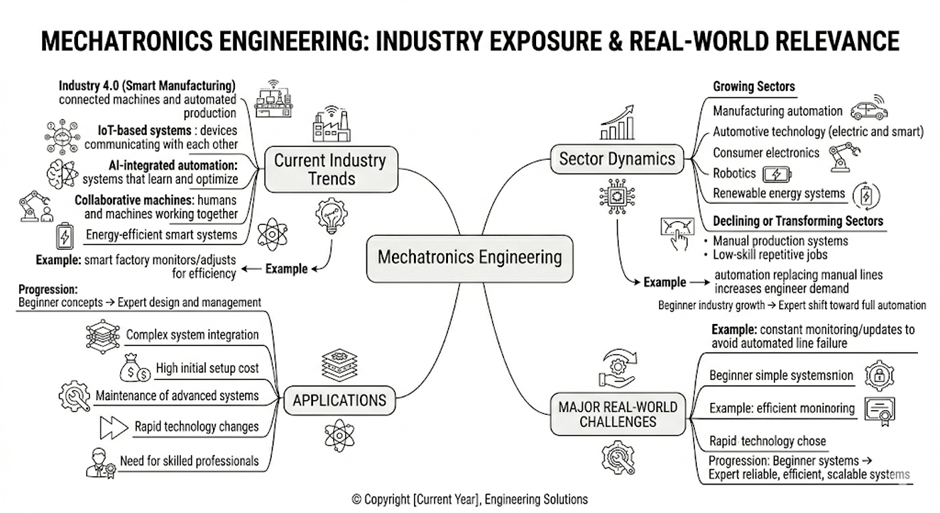
- Industry 4.0 (Smart Manufacturing): Connected machines and automated production
- IoT-based systems: Devices communicating with each other
- AI-integrated automation: Systems that learn and optimize performance
- Collaborative machines: Humans and machines working together
- Energy-efficient smart systems
At a beginner level, these may seem like concepts.
At an expert level, engineers design and manage these systems.
Example:
A smart factory uses sensors to monitor machines and automatically adjusts operations to improve efficiency.
b. Which sectors are growing or declining?
Understanding this helps in making better career decisions.
Growing sectors:
- Manufacturing automation
- Automotive technology (electric and smart vehicles)
- Consumer electronics
- Robotics and smart devices
- Renewable energy systems
Declining or transforming sectors:
- Manual production systems
- Low-skill repetitive jobs
At a beginner level, growth is seen in industries.
At an expert level, it is seenas a shift toward full automation.
Example:
Factories replacing manual assembly lines with automated systems increase demand for mechatronics engineers.
c. What are the major challenges faced in this field?
Real-world challenges in Mechatronics include:
- Complex system integration
- High initial setup cost
- Maintenance of advanced systems
- Rapid technology changes
- Need for skilled professionals
At a beginner level, systems are simple.
At an expert level, systems must be reliable, efficient, and scalable.
Example:
A fully automated production line requires constant monitoring and updates to avoid system failures.
d. Are there goavernment initiatives supporting this branch?
Yes, governments are actively supporting automation and manufacturing.
Important initiatives include:
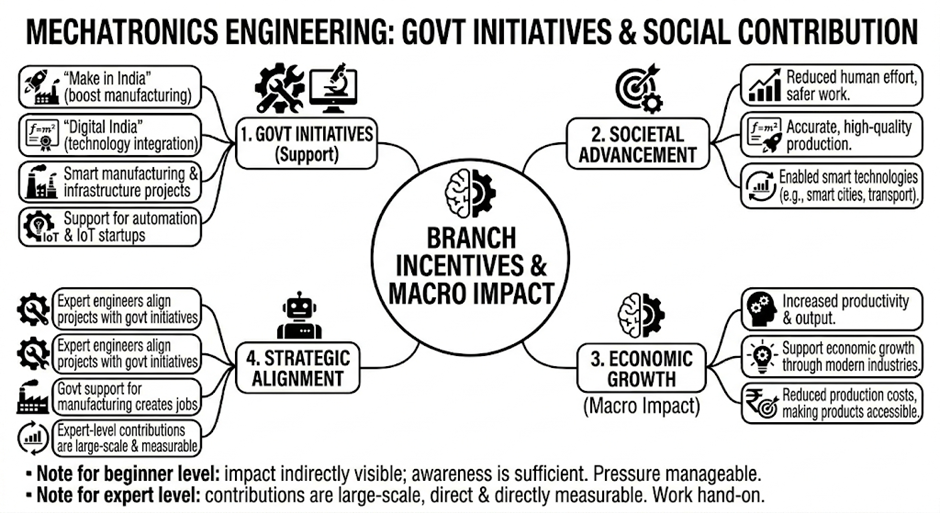
- Make in India (boosting manufacturing)
- Digital India (technology integration)
- Smart manufacturing and infrastructure projects
- Support for startups in automationand IoT
At a beginner level, awareness is enough.
At an expert level, engineers align projects with these initiatives.
Example:
Government support for manufacturing increases job opportunitiesin automation and mechatronics.
e. How does this field contribute to society and the economy?
Mechatronics plays a key role in improving efficiency and quality of life.
It contributes by:
- Increasing productivity
- Reducing human effort
- Improving accuracy and quality
- Enabling smart technologies
- Supporting economic growth
At a beginner level, impact may seem indirect.
At an expert level, it is large-scale and measurable.
Example:
Automated systems reduce production cost, making products cheaper and more accessible.
Conclusion :
Mechatronics Engineering has strong real-world relevance as it drives automation, smart manufacturing, and modern technological advancements. It plays a crucial role in improving productivity, efficiency, and quality across industries. As industries evolve, mechatronics continues to be a key contributor to economic growth and innovation.
CTA (Call To Action):
- Stay updated with trends like Industry 4.0, IoT, and smart automation systems.
- Gain practical exposure through internships and real-world projects to build industry-ready skills.