

Q1. What are the current industry trends?
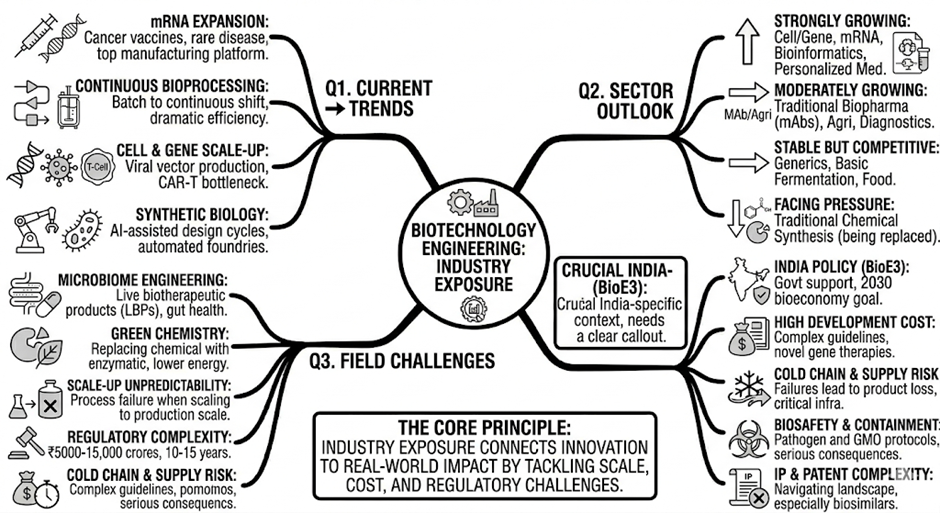
- mRNA Technology Expansion: Post-COVID, mRNA platforms are being applied to cancer vaccines (Moderna’s mRNA-4157 melanoma vaccine is in Phase III trials), HIV vaccines, and rare genetic diseases. This is the most exciting manufacturing platform of the decade.
- Continuous Bioprocessing: The industry is shifting from batch fermentation to continuous manufacturing — keeping bioreactors running for weeks or months instead of discrete batch cycles. This dramatically increases efficiency and reduces cost of goods.
- Cell and Gene Therapy Scale-Up: The bottleneck in cell and gene therapy is manufacturing. Biotech engineers who understand viral vector production (AAV, lentiviral vectors) and cell therapy manufacturing (T-cell expansion, CAR-T processes) are among the most sought-after professionals globally.
- Synthetic Biology and Biofoundries: Automated, AI-assisted design-build-test-learn cycles for engineering microorganisms. The UK’s National Biodesign Centre and Ginkgo Bioworks’ Bioworks model are redefining how biotechnology is practiced.
- Microbiome Engineering: The human gut microbiome contains over 100 trillion organisms. Companies are developing live biotherapeutic products (LBPs) — engineered microbes delivered as drugs to treat diseases from Crohn’s disease to depression.
- Green Chemistry and Biocatalysis: Replacing chemical synthesis steps with enzymatic reactions — reducing hazardous solvent use, lowering energy consumption, and improving product selectivity.
Q2. Which sectors are growing or declining?
Strongly Growing: Cell and gene therapy manufacturing, mRNA platforms, bioinformatics and AI drug discovery, environmental biotech (biofuels, bioremediation), synthetic biology, personalized medicine.
Moderately Growing: Traditional biopharmaceuticals (monoclonal antibodies remain dominant), agricultural biotech, diagnostics.
Stable but Competitive: Generic pharmaceutical manufacturing, basic fermentation (industrial enzymes, vitamins), food biotechnology.
Facing Pressure: Traditional chemical synthesis (being replaced by biocatalysis), basic QC analytical roles (being partially automated).
India-specific growth: The Indian government’s BioE3 Policy (2023) explicitly targets ₹300 billion bioeconomy by 2030. Sectors receiving government support include biopharmaceuticals, agri-biotech, industrial enzymes, and biorenewable chemicals. This policy support is creating substantial career opportunities in India specifically.
Q3. What are the major challenges faced in this field?
- Scale-Up Unpredictability: Biological systems do not scale linearly. A process that works in a 10-litre fermenter may fail in a 10,000-litre industrial vessel due to mixing gradients, dissolved oxygen limitations, and shear stress on cells. This remains a fundamental challenge.
- Regulatory Complexity: Biopharmaceuticals face some of the most stringent regulatory requirements of any product category. Navigating FDA and EMA guidelines for biological products — particularly novel gene therapies — is extraordinarily complex and slow.
- High Development Costs: Developing a new biopharmaceutical from molecule to market can cost ₹5,000–15,000 crores and take 10–15 years. This makes the field high-stakes and high-attrition.
- Cold Chain and Supply Chain: Biological products (vaccines, mAbs, cell therapies) require strict cold chain management — failures lead to product loss and patient safety risks. India’s cold chain infrastructure, while improving, remains a challenge.
- Biosafety and Containment: Working with genetically modified organisms and pathogens requires strict containment protocols. Lapses can have serious regulatory and safety consequences.
- Intellectual Property and Patent Complexity: Biotech innovations are heavily patent-protected. Navigating the IP landscape — particularly for biosimilars — is a constant challenge for Indian companies.
Q4. Are there government initiatives supporting this branch?
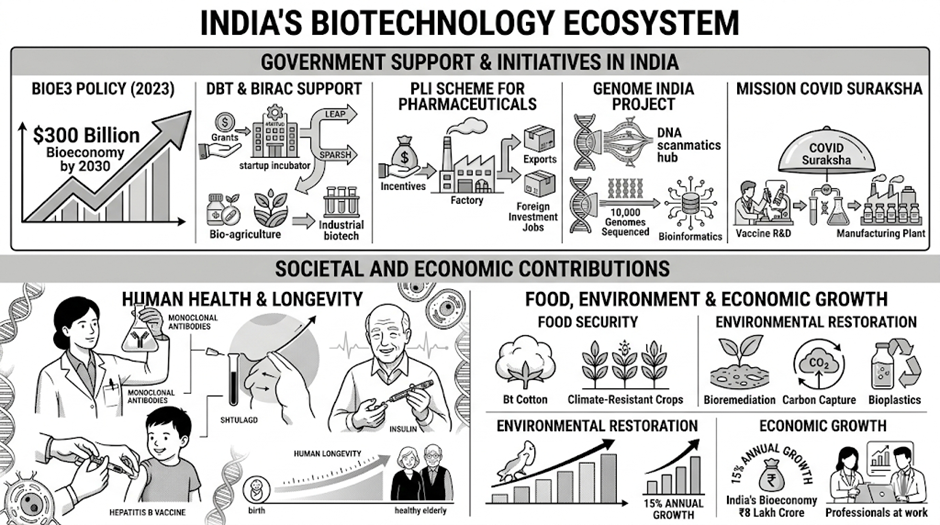
- BioE3 Policy (2023): India’s flagship biotech policy targeting a $300 billion bioeconomy by 2030. Covers biopharmaceuticals, bio-agriculture, bio-energy, and industrial biotech.
- DBT (Department of Biotechnology): Funds research grants, startup incubation (Biotechnology Industry Research Assistance Council — BIRAC), and national biotech missions.
- BIRAC’s LEAP and SPARSH Programs: Specifically fund student innovation and startup development in biotech.
- PLI Scheme for Pharmaceuticals: Production-linked incentives for pharma manufacturing are attracting foreign investment and creating manufacturing jobs.
- Genome India Project: A national genomics initiative to sequence 10,000 Indian genomes, creating opportunities for bioinformatics professionals.
- Mission COVID Suraksha: The National Biopharmaceutical Mission — has invested significantly in building vaccine development and manufacturing capacity in India.
- CSIR’s OSDD (Open Source Drug Discovery): A ₹50-crore platform enabling open, collaborative drug discovery for neglected diseases — provides research opportunities for students and early-career scientists.
Q5. How does this field contribute to society and economy?
After 50 years in this field, this is the question that still moves me most deeply. Biotechnology Engineering is not just an economic activity — it is a moral one.
- Human Health: The insulin that keeps a diabetic alive, the hepatitis B vaccine that has protected hundreds of millions, the cancer monoclonal antibodies that have extended millions of lives — all are direct products of biotechnology engineering. Every engineer in this field contributes to human longevity and quality of life.
- Food Security: In a world facing climate-driven agricultural disruption, biotech-developed drought-resistant and pest-resistant crops will feed billions. India’s cotton productivity revolution driven by Bt cotton is one of the most significant agricultural events of the late 20th century.
- Environmental Restoration: Bioremediation technologies have cleaned contaminated industrial sites. Algae-based carbon capture, bioplastics replacing petroleum plastics, and biogas from organic waste — all contribute to India’s sustainability goals.
- Economic Growth: India’s bioeconomy was valued at approximately ₹8 lakh crore in 2022 and is growing at 15% annually. This growth creates wealth, employment, and export revenue — biotechnology engineering professionals are at the center of this value creation.
Conclusion:
The biotechnology industry is evolving rapidly with innovations like gene editing, personalized medicine, and sustainable solutions. These trends are creating new opportunities for engineers.
CTA:
Stay updated with new technologies and industry changes. Don’t miss Day 9 to explore specialization options in biotechnology engineering.