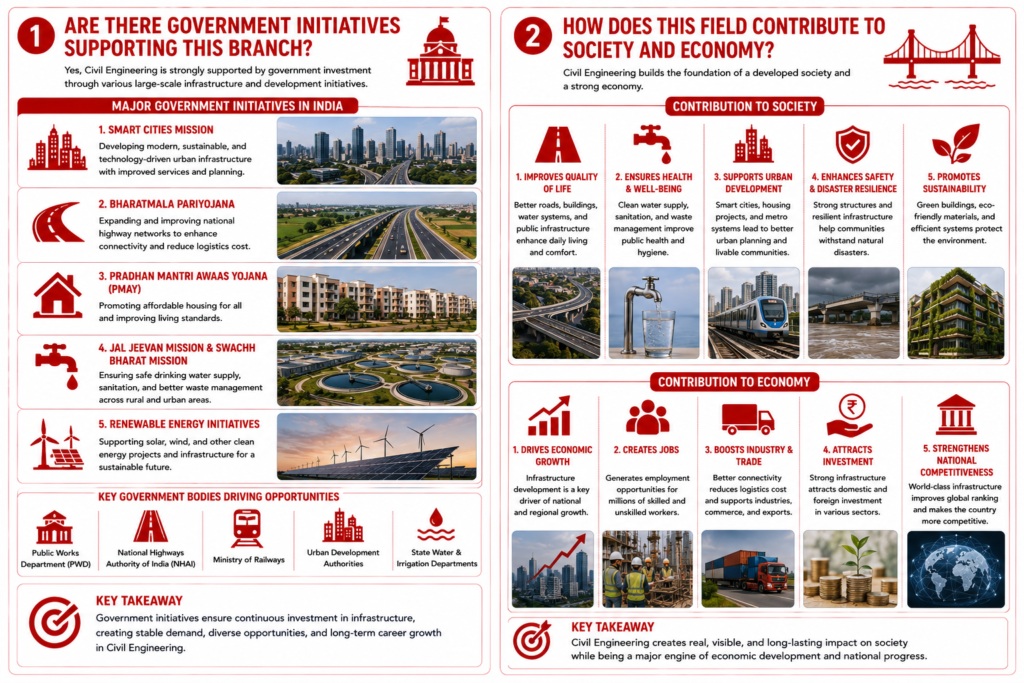

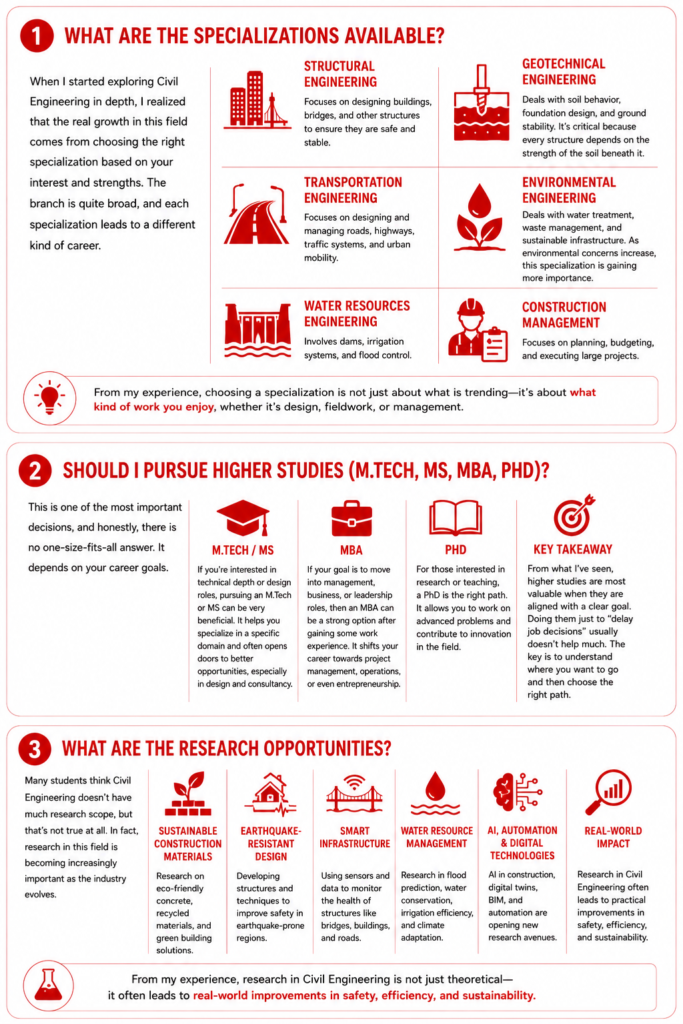
1. What are the specializations available?
When I started exploring Civil Engineering in depth, I realized that the real growth in this field comes from choosing the right specialization based on your interest and strengths. The branch is quite broad, and each specialization leads to a different kind of career.
One of the most popular areas is Structural Engineering, where you focus on designing buildings, bridges, and other structures to ensure they are safe and stable. This field is highly technical and requires strong understanding of analysis and design principles.
Then there’s Geotechnical Engineering, which deals with soil behavior, foundation design, and ground stability. It’s critical because every structure depends on the strength of the soil beneath it.
Transportation Engineering focuses on designing and managing roads, highways, traffic systems, and urban mobility. With the growth of cities, this field is becoming increasingly important.
Environmental Engineering is another growing area, dealing with water treatment, waste management, and sustainable infrastructure. As environmental concerns increase, this specialization is gaining more importance.
You also have Water Resources Engineering, which involves dams, irrigation systems, and flood control, and Construction Management, which focuses on planning, budgeting, and executing large projects.
From my experience, choosing a specialization is not just about what is trending—it’s about what kind of work you enjoy, whether it’s design, fieldwork, or management.
2. Should I pursue higher studies (M.Tech, MS, MBA, PhD)?
This is one of the most important decisions, and honestly, there is no one-size-fits-all answer. It depends on your career goals.
If you’re interested in technical depth or design roles, pursuing an M.Tech or MS can be very beneficial. It helps you specialize in a specific domain and often opens doors to better opportunities, especially in design and consultancy.
If your goal is to move into management, business, or leadership roles, then an MBA can be a strong option after gaining some work experience. It shifts your career towards project management, operations, or even entrepreneurship.
For those interested in research or teaching, a PhD is the right path. It allows you to work on advanced problems and contribute to innovation in the field.
From what I’ve seen, higher studies are most valuable when they are aligned with a clear goal. Doing them just to “delay job decisions” usually doesn’t help much. The key is to understand where you want to go and then choose the right path.
3. What are the research opportunities?
Many students think Civil Engineering doesn’t have much research scope, but that’s not true at all. In fact, research in this field is becoming increasingly important as the industry evolves.
Some major research areas include sustainable construction materials, such as eco-friendly concrete and recycled materials. There’s also significant work happening in earthquake-resistant design, which is critical for safety in many regions.
Another important area is smart infrastructure, where sensors and data are used to monitor the health of structures like bridges and buildings. Research is also being done in water resource management, especially in areas like flood prediction, water conservation, and climate adaptation.
With the rise of technology, fields like AI in construction, digital twins, and automation are also opening new research opportunities. From my experience, research in Civil Engineering is not just theoretical—it often leads to real-world improvements in safety, efficiency, and sustainability.
4. What global opportunities exist in this field?
Civil Engineering is one of the few branches that has strong global demand, because infrastructure is needed everywhere. Countries like the USA, Canada, UAE, Australia, and parts of Europe have well-developed construction and infrastructure industries, offering opportunities for skilled engineers.
In regions like the Middle East, there is continuous demand due to large-scale construction and infrastructure projects. Developed countries often look for engineers with specialized skills, especially in areas like structural design, project management, and sustainable construction.
However, what I’ve noticed is that global opportunities often require additional qualifications, certifications, or experience, depending on the country. You may need to meet licensing requirements or adapt to local standards.
From my perspective, Civil Engineering gives you the flexibility to work internationally, but you need to build strong technical skills and understand global practices to take advantage of these opportunities.
5. How can I become a top 1% expert in this domain?
Reaching the top level in Civil Engineering is not about doing one thing exceptionally—it’s about consistently improving across multiple areas. From what I’ve observed, the first step is building strong fundamentals. If your basics are clear, you can adapt to any specialization or technology.
The next step is gaining real-world experience. This field rewards practical knowledge, so the more exposure you have to actual projects, the better your understanding becomes.
You should also focus on continuous learning. The industry is evolving, with new tools, materials, and methods being introduced. Staying updated gives you a competitive edge. Learning advanced tools like BIM software such as Autodesk Revit can significantly improve your profile.
Another important factor is developing problem-solving ability and decision-making skills. Top engineers are not just technically strong—they can handle complex situations and make effective decisions under pressure.
Finally, networking and communication play a big role. Building connections, learning from experienced professionals, and understanding how projects work at a larger scale can accelerate your growth.
From my experience, becoming a top 1% expert is not about quick success—it’s about consistent effort, real-world learning, and adapting to change over time.