
Q1. What are the specialisations available?
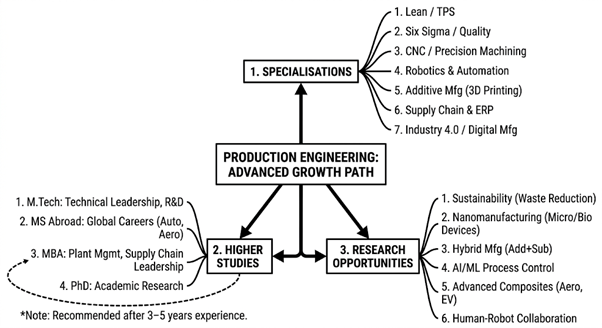
Production Engineering offers multiple deep specialisation paths. Lean Manufacturing and Toyota Production System (TPS) — becoming a Lean Expert or Sensei is a lifelong journey and commands tremendous respect and compensation globally. Six Sigma and Advanced Quality Engineering — moving from Green Belt to Black Belt to Master Black Belt opens up roles as Quality Director or Operations Excellence Head. CNC and Advanced Machining Technology — specialising in multi-axis machining, high-speed machining, and precision engineering for aerospace or medical devices. Robotics and Automation — PLC programming, robot integration, and collaborative robot (cobot) deployment. Additive Manufacturing — specialising in metal 3D printing (SLM, DMLS, EBM) for aerospace, defence, and medical implants. Supply Chain and Production Planning — moving into integrated supply chain management with ERP systems expertise. Industry 4.0 and Digital Manufacturing — becoming a Smart Factory specialist who designs and implements connected, intelligent production systems.
Q2. Should I pursue higher studies (M.Tech, MS, MBA, PhD)?
This depends entirely on your goals. An M.Tech in Manufacturing Engineering, Industrial Engineering, or Mechatronics from a reputed IIT, NIT, or NITIE adds significant value if you want to enter research, academia, or senior technical roles in MNCs. It is also the gateway to a PhD if you want to pursue academic research. An MS abroad (USA, Germany, Japan, UK) opens global career opportunities, particularly in automotive and aerospace MNCs. An MBA — especially with operations or supply chain specialisation — is ideal if you want to transition into general management, plant management, or supply chain leadership. A PhD is for those passionate about advancing the frontiers of manufacturing science — developing new materials, processes, or manufacturing systems. In my experience, the best time to pursue higher education is after 3 to 5 years of industry experience, when you have specific problems and questions that academic research can help you answer.
Q3. What are the research opportunities?
Production Engineering research is funded globally and covers exciting areas: Sustainable manufacturing — reducing energy and material waste in production processes. Nano-manufacturing — machining and forming at the micron and nano scale for MEMS and biomedical devices. Hybrid manufacturing — combining additive and subtractive processes in a single machine. AI and ML in process control — real-time adaptive machining that adjusts cutting parameters based on sensor feedback. Advanced composite manufacturing — production processes for CFRP (Carbon Fibre Reinforced Polymer) structures used in aerospace and EVs. Human-robot collaboration in manufacturing — designing safe and efficient shared workspaces. In India, IIT Bombay, IIT Madras, IIT Delhi, NIT Trichy, NITIE Mumbai, and CMTI Bangalore are the leading research centres in this space.
Q4. What global opportunities exist in this field?
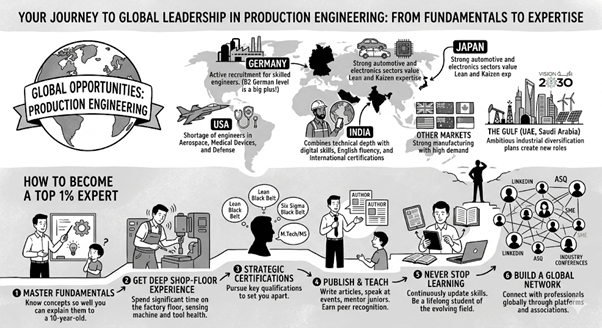
Global demand for production engineers with strong technical and digital skills is very high. Germany is the world’s manufacturing powerhouse and actively recruits skilled production engineers — German language skills (B2 level) dramatically increase your chances. Japan’s automotive and electronics industries value Lean and Kaizen practitioners deeply. The USA has a shortage of manufacturing engineers, especially in aerospace, medical devices, and defence. The UK, Australia, Canada, and Singapore are also strong markets. The Gulf countries (UAE, Saudi Arabia) have ambitious industrial diversification plans under Vision 2030 and similar initiatives. Indian production engineers who combine technical depth with digital skills, English fluency, and international certification (Six Sigma, Lean, PMP) are globally competitive.
Q5.How can I become a top 1% expert in this domain?
After 50 years in this field, here is my honest roadmap to the top 1%: Master the fundamentals completely — not just to pass exams, but to the level where you can explain any concept to a 10-year-old. Get deep shop-floor experience — the top experts in this field have all spent significant time on the factory floor. They know what it feels like when a machine vibrates differently, what a tool-wear pattern looks like, what the smell of an overheating bearing is. Pursue certifications strategically — Lean Black Belt, Six Sigma Black Belt, and a relevant M.Tech or MS will set you apart. Publish and teach — write articles, speak at industry events, mentor juniors. Expertise recognised by peers is the definition of being in the top 1%. Never stop learning — the field evolves continuously. The top 1% are lifelong students. Build a global network through LinkedIn, ASQ, SME, and industry conferences
Conclusion:
Specializations like quality control, supply chain management, and operations management help you focus your career in production engineering.
CTA:
Choose your specialization based on your interests and career goals. Move to Day 10 for final insights before making your decision.