
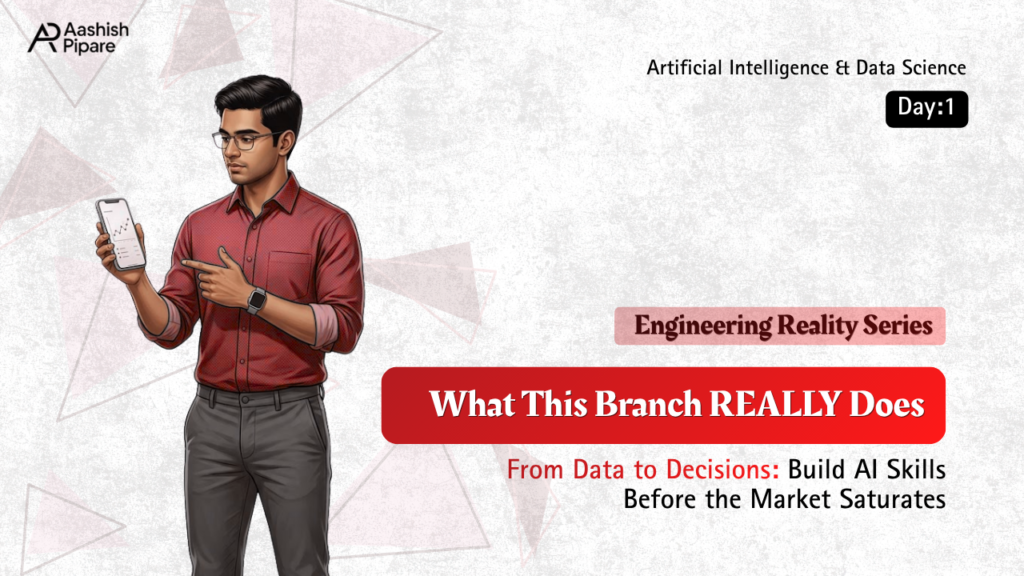
➤What is the core problem domain this branch solves?
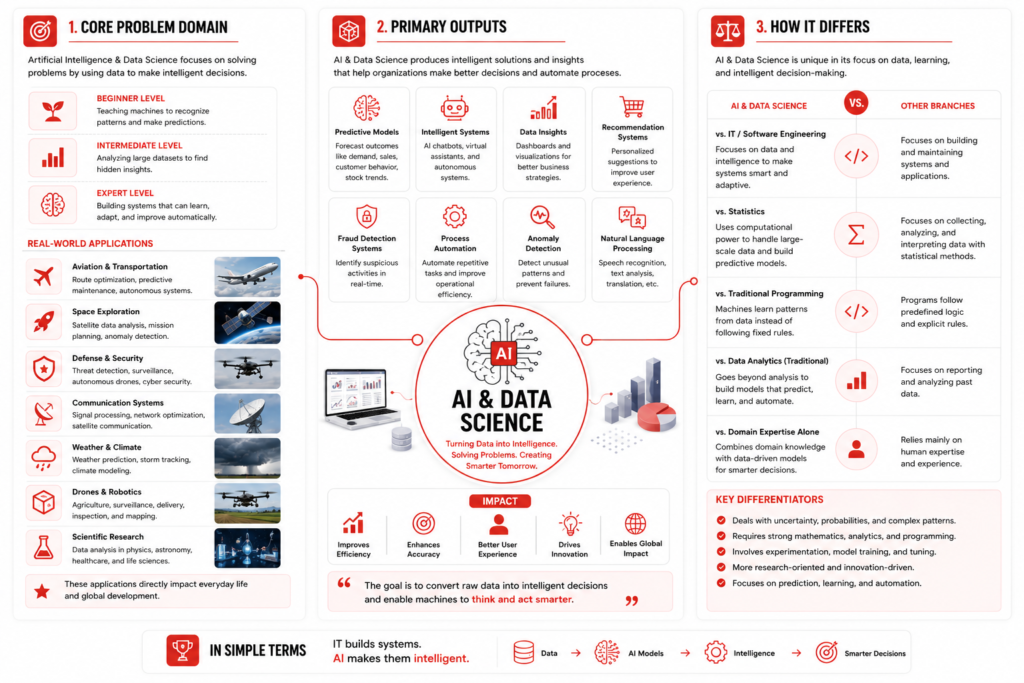
Artificial Intelligence & Data Science focuses on solving problems by using data to make intelligent decisions. At a beginner level, it means teaching machines to recognize patterns and make predictions. At an intermediate level, it involves analyzing large datasets to find hidden insights. At an expert level, it is about building systems that can learn, adapt, and improve automatically. For example, recommendation systems used by Netflix suggest movies based on user behavior. This branch solves problems like prediction, automation, and optimization. It deals with uncertainty and probabilities rather than fixed rules. AI models can handle tasks like speech recognition and fraud detection. The goal is to convert raw data into intelligent decisions. Ultimately, it enables machines to think and act smarter.
➤What are the primary outputs of this field?
The main outputs of AI & Data Science include predictive models, intelligent systems, and data insights. These outputs help organizations make better decisions and automate processes. For example, e-commerce platforms like Amazon use recommendation systems to increase sales. Data dashboards provide visual insights for business strategies. AI chatbots automate customer service interactions. Fraud detection systems identify suspicious activities in real-time. Machine learning models predict outcomes like customer behavior or stock trends. These outputs are often invisible but critical to operations. They improve efficiency, accuracy, and user experience. The field transforms data into actionable knowledge. Overall, outputs are designed to solve real-world problems intelligently.
➤How is this branch different from closely related branches?
AI & Data Science differs from IT and software engineering in its focus on data and intelligence. While IT builds systems, AI makes those systems smart and adaptive. Compared to statistics, AI uses computational power to handle large-scale data. Unlike traditional programming, AI systems learn patterns instead of following fixed rules. For example, spam filters learn from email data instead of predefined conditions. AI requires stronger mathematical and analytical skills. It also involves experimentation and model tuning. This branch is more research-oriented compared to general IT. It focuses on prediction, learning, and automation. In simple terms, IT builds systems, AI makes them intelligent.
➤What are the real-world applications of this field?
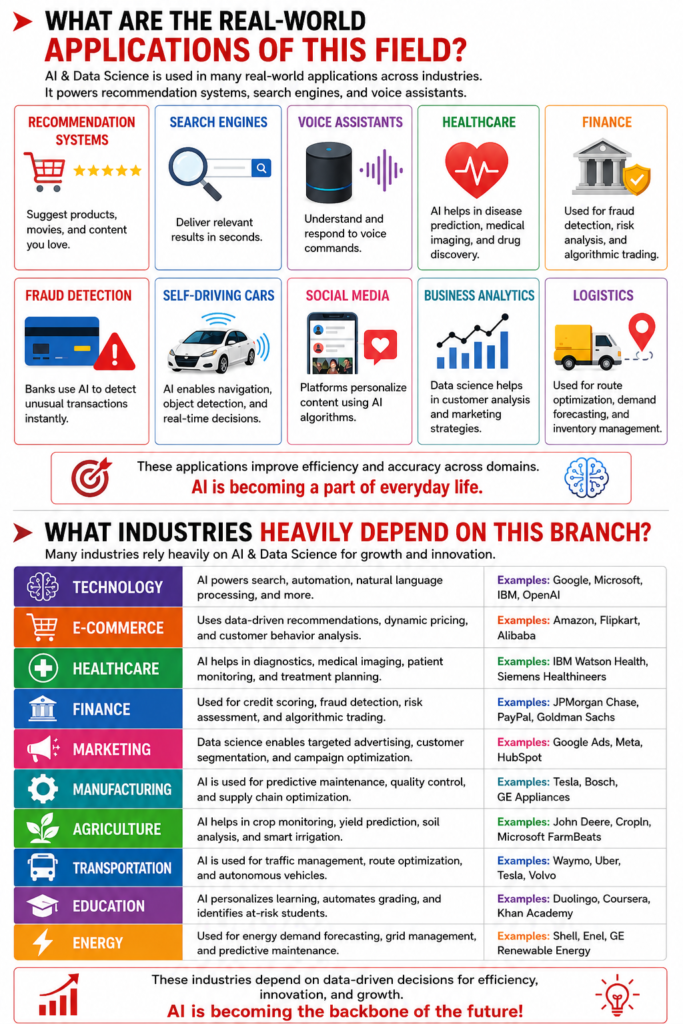
AI & Data Science is used in many real-world applications across industries. It powers recommendation systems, search engines, and voice assistants. Healthcare uses AI for disease prediction and medical imaging. Finance uses it for fraud detection and risk analysis. For example, banks use AI to detect unusual transactions instantly. Self-driving cars use AI for navigation and decision-making. Social media platforms personalize content using AI algorithms. Businesses use data science for customer analysis and marketing strategies. Logistics companies use it for route optimization. These applications improve efficiency and accuracy. AI is becoming a part of everyday life.
➤What industries heavily depend on this branch?
Many industries rely heavily on AI & Data Science for growth and innovation. Technology companies like Google use AI for search and automation. E-commerce companies like Amazon depend on data-driven recommendations. Healthcare uses AI for diagnostics and treatment planning. Finance uses it for credit scoring and fraud detection. Marketing uses data science for targeted advertising. Manufacturing uses AI for predictive maintenance. Agriculture uses AI for smart farming techniques. Transportation uses it for traffic management and autonomous vehicles. These industries depend on data-driven decisions. AI is becoming essential for modern business operations.
Conclusion
Understanding the fundamentals of AI & Data Science is the first and most important step in this journey. This branch is not just about coding but about solving real-world problems using data and intelligent systems. A clear conceptual foundation helps you grasp advanced topics more easily. Since AI is used across industries, its relevance is continuously growing. Building strong basics at the beginner stage sets the direction for long-term success. Clarity at this level makes the entire learning process smoother.