
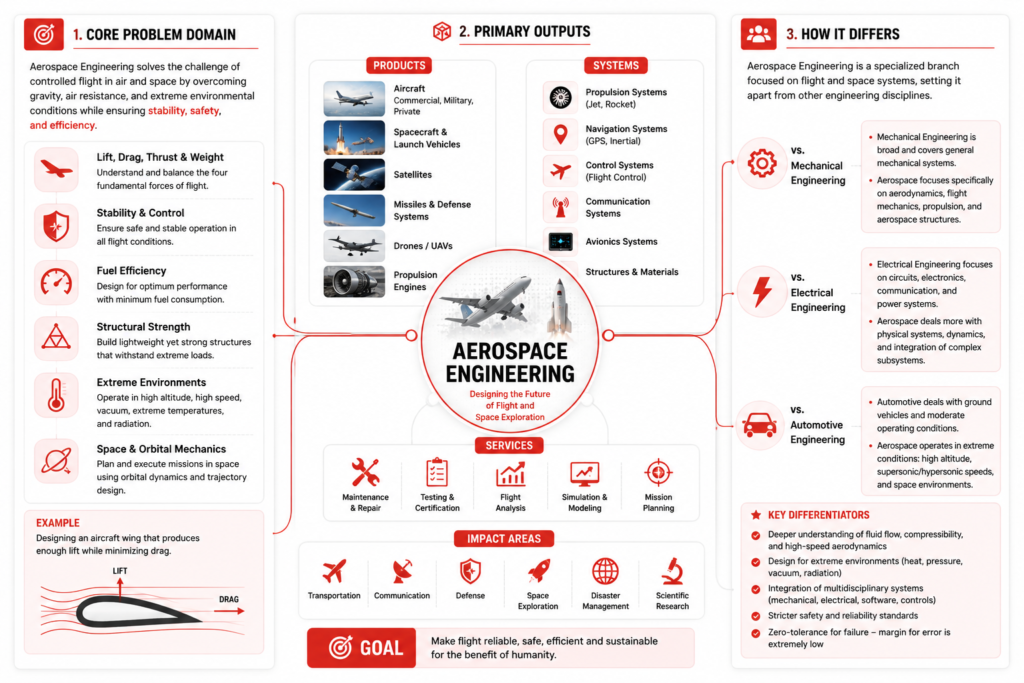
➤What is the core problem domain this branch solves?
Aerospace Engineering focuses on solving the challenge of controlled flight in air and space. It deals with how to design systems that can overcome gravity, air resistance, and extreme environmental conditions. Engineers must ensure stability, safety, and efficiency of flying vehicles. This includes understanding lift, drag, thrust, and weight. The branch also addresses challenges like fuel efficiency and structural strength. For example, designing an aircraft wing that produces enough lift while minimizing drag is a core problem. In space, it involves vacuum conditions and orbital mechanics. The goal is to make flight reliable and sustainable. It requires deep integration of physics and engineering. Every design must meet strict safety standards.
➤What are the primary outputs of this field (products, systems, services)?
The primary outputs include aircraft, spacecraft, satellites, missiles, and drones. It also produces systems like propulsion engines, navigation systems, and control systems. Aerospace engineers design both physical products and software-based systems. Services include maintenance, testing, and flight analysis. For example, a commercial airplane like a passenger jet is a major output. Satellites used for GPS and weather forecasting are also key outputs. Defense systems like fighter jets and missiles are critical products. Engineers also develop simulation models and testing frameworks. These outputs impact transportation, communication, and defense sectors. The field contributes to both civilian and military applications.
➤How is this branch different from closely related branches?
Aerospace Engineering differs from Mechanical Engineering by focusing specifically on flight and high-speed systems. It includes specialized topics like aerodynamics and flight mechanics. Unlike Electrical Engineering, it deals more with physical systems rather than circuits. It also differs from Automotive Engineering due to extreme operating conditions like high altitude and supersonic speeds. For example, designing a car engine is different from designing a jet engine due to pressure and temperature differences. Aerospace requires deeper understanding of fluid flow and compressibility. It also involves stricter safety standards. The margin for error is extremely low. This specialization makes it more complex and niche.
➤What are the real-world applications of this field?
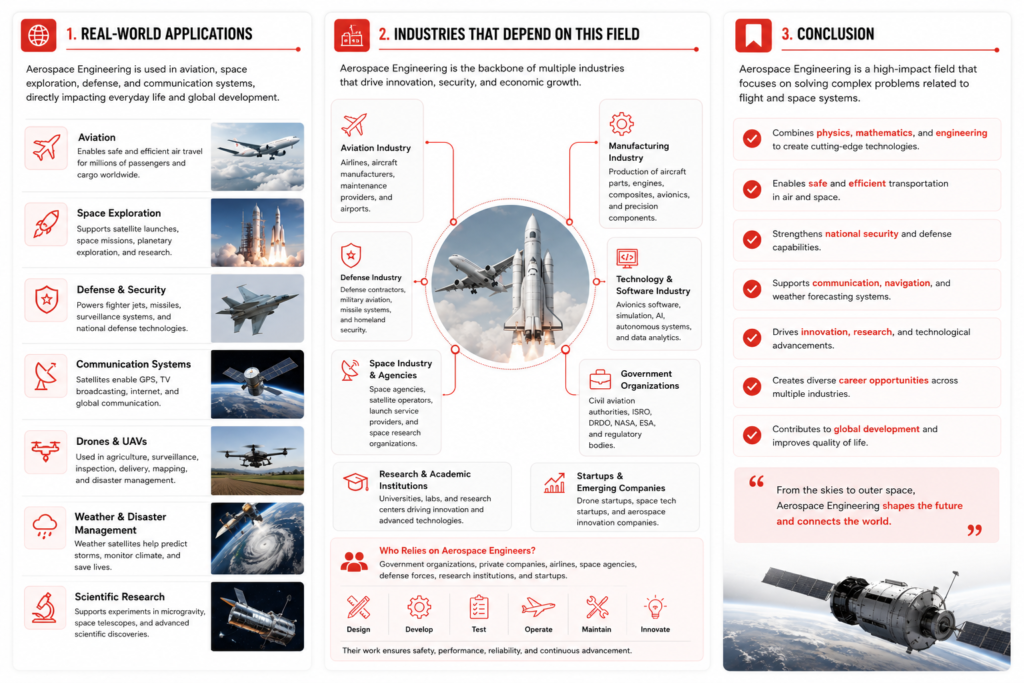
Aerospace Engineering is used in aviation, space exploration, defense, and communication systems. Commercial airlines rely on aerospace for passenger transport. Space missions use it for launching satellites and exploration vehicles. Defense uses it for fighter jets and missile systems. For example, weather satellites help predict storms and save lives. GPS systems depend on satellite technology. Drones are used in agriculture, surveillance, and delivery. Aerospace also contributes to scientific research in space. It improves global connectivity and travel efficiency. The applications directly impact everyday life and global development.
➤What industries heavily depend on this branch?
Industries include aviation, defense, space research, and manufacturing. Government organizations and private companies both rely on aerospace engineers. Airlines depend on aircraft design and maintenance. Space agencies use aerospace for missions and satellite launches. Defense industries require advanced aircraft and missile systems. For example, drone startups are growing rapidly in India. Manufacturing industries produce aircraft components and systems. Research organizations focus on innovation and development. These industries offer both technical and managerial roles. Aerospace plays a key role in national and global development.
Conclusion
Aerospace Engineering is a high-impact field that focuses on solving complex problems related to flight and space systems. It combines theory and real-world applications to create technologies that shape modern transportation, defense, and communication.