

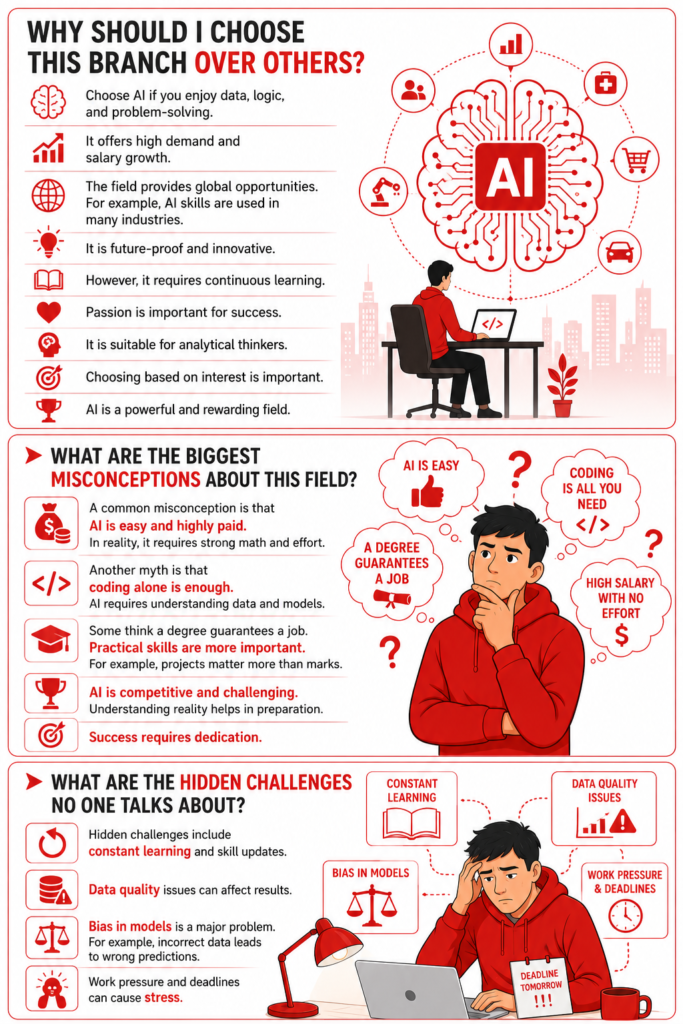
➤Why should I choose this branch over others?
Artificial Intelligence (AI) has emerged as one of the most promising, impactful, and transformative fields of the 21st century. Unlike many traditional engineering specializations that focus on a specific domain, AI is a multidisciplinary field that combines computer science, mathematics, statistics, data analysis, and human intelligence to create systems capable of learning, reasoning, and making decisions. AI is no longer a futuristic concept—it is already influencing almost every aspect of modern life.
From healthcare and education to banking, transportation, agriculture, and entertainment, AI is revolutionizing industries and creating opportunities that did not exist a decade ago. Choosing AI as your branch means becoming part of a technological revolution that is shaping the future of the world.
However, selecting AI should not be based only on trends, social media hype, or stories of high salaries. The right choice depends on your interests, aptitude, career aspirations, and willingness to continuously learn and adapt. If you are passionate about technology, enjoy solving complex problems, and want to build innovative solutions that can impact millions of people, AI can be an excellent career path.
➤What are the biggest misconceptions about this field?
Artificial Intelligence (AI) has become one of the most popular and widely discussed fields in the world. Every day, we hear about AI-powered chatbots, self-driving cars, smart assistants, robotic automation, and groundbreaking discoveries made possible by machine learning. News articles, social media influencers, movies, and technology companies often portray AI as a magical technology that can solve almost every problem. While AI is undoubtedly one of the most transformative technologies of our time, there are many misconceptions surrounding the field.
These misconceptions often create unrealistic expectations among students and professionals. Some people enter the field expecting instant success, high salaries, and easy learning, only to discover that AI requires significant effort, patience, and continuous improvement. Understanding these myths is important because it helps students make informed career decisions and prepares them for the realities of working in AI.
The truth is that AI offers tremendous opportunities, but success in this field depends on strong fundamentals, practical experience, problem-solving abilities, and a commitment to lifelong learning.
➤What are the hidden challenges no one talks about?
Artificial Intelligence (AI) is often presented as one of the most exciting and rewarding career fields in the world. Social media, advertisements, success stories, and news articles frequently highlight high salaries, groundbreaking innovations, and impressive achievements. While these benefits are real, there are many hidden challenges that are rarely discussed openly.
Most students hear about the opportunities in AI, but very few are informed about the difficulties professionals face every day. Understanding these challenges is important because it helps students enter the field with realistic expectations and prepares them for long-term success.
The reality is that AI is not just about building intelligent systems—it is also about dealing with uncertainty, constant change, pressure, competition, and complex technical problems. Those who understand these challenges early are often better prepared to overcome them.
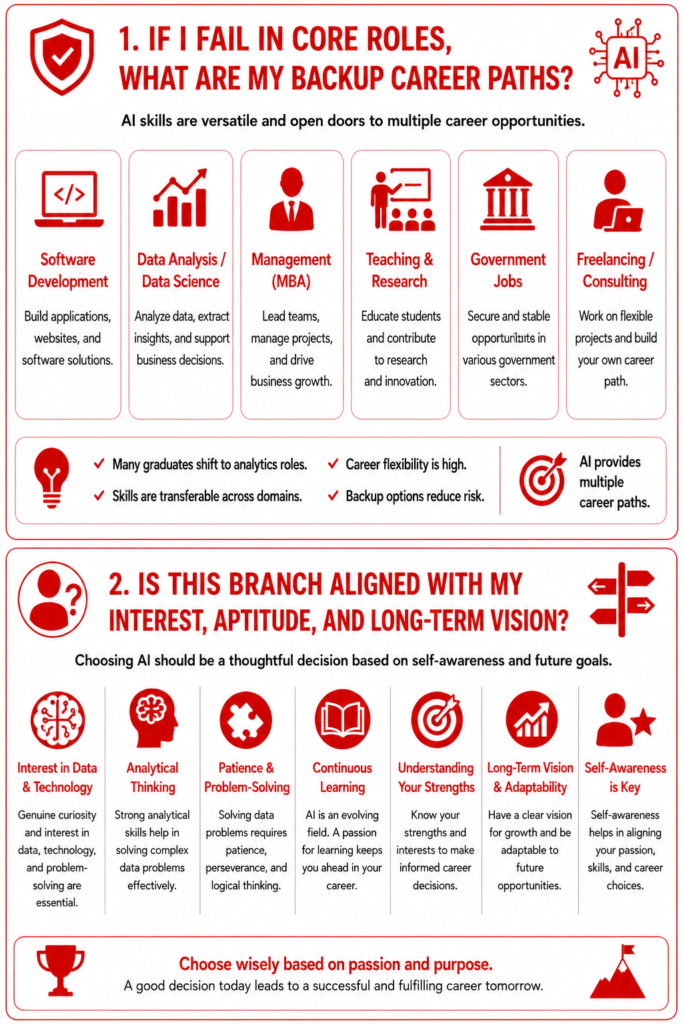
➤If I fail in core roles, what are my backup career paths?
One of the biggest concerns students have when choosing Artificial Intelligence (AI) as a branch is: “What if I don’t get an AI job after graduation?” This is a valid question because AI is a competitive field, and not every graduate will immediately secure a role as an AI Engineer, Machine Learning Engineer, or Data Scientist.
The good news is that AI is built on a strong foundation of programming, mathematics, data analysis, and problem-solving. These skills are highly transferable and valuable across many industries. Unlike some specialized fields where career options may be limited, AI graduates have a wide range of alternative career paths available to them.
In fact, many successful professionals who studied AI eventually built rewarding careers in software development, analytics, management, consulting, research, entrepreneurship, and many other domains. Therefore, choosing AI does not mean placing all your hopes on a single career option. It provides flexibility and multiple pathways for professional growth.
➤Is this branch aligned with my interest, aptitude, and long-term vision?
Choosing a branch is one of the most important decisions in a student’s academic and professional journey. While factors such as salary, job demand, and industry trends are important, they should not be the only reasons for selecting a field. The most successful professionals are usually those whose careers align with their interests, natural abilities, and long-term goals.
When considering Artificial Intelligence (AI) as a branch, it is important to ask yourself a simple but powerful question:
“Does AI match who I am, what I enjoy, and where I want to be in the future?”
The answer requires honest self-evaluation rather than following popular trends or external pressure.
Conclusion
AI may seem attractive, but it requires real effort and commitment. Misconceptions should be avoided to make informed decisions. Challenges like competition and continuous learning must be accepted. Having backup options is important, but focus should remain clear. This field is best suited for those with genuine interest in data and problem-solving. A well-informed choice leads to a successful career