
➤What are the key subjects I must master in this branch?
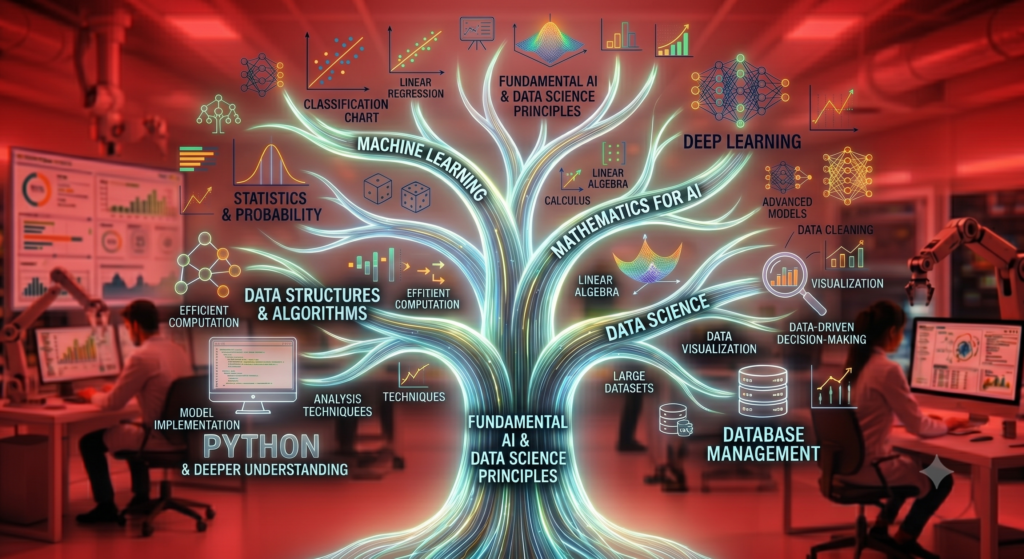
Key subjects include machine learning, statistics, and programming fundamentals. Data structures and algorithms are important for efficient computation. Linear algebra and probability form the mathematical base. Data science involves data cleaning, visualization, and analysis techniques. Deep learning focuses on neural networks and advanced AI models. For example, regression and classification are fundamental machine learning methods. Database management is required for handling large datasets. Python is widely used for implementing models and analysis. Understanding these subjects helps in building intelligent systems. Strong fundamentals make advanced concepts easier. Mastery of these areas is essential for success.
➤What level of mathematics is required?
Mathematics plays a critical role in AI & Data Science. Linear algebra is used for handling vectors and matrices in models. Probability and statistics help in understanding data patterns and uncertainty. Calculus is used in optimization techniques like gradient descent. For example, training a neural network involves minimizing error using calculus. Compared to IT, AI requires deeper mathematical understanding. However, tools and libraries simplify complex calculations. Conceptual clarity is more important than memorization. Mathematics helps in building accurate and efficient models. Strong math skills improve problem-solving ability. It is a key requirement for mastering AI.
➤Which scientific principles are fundamental here?
AI & Data Science is based on principles of statistics, probability, and computation. Machine learning relies on pattern recognition and optimization. Data science uses statistical methods to analyze data. Neural networks are inspired by the human brain’s structure. For example, classification algorithms group data based on similarities. Scientific methods are used to test and validate models. Data-driven decision-making is a core principle. Algorithms are evaluated based on accuracy and efficiency. These principles ensure reliable and scalable solutions. Understanding them is essential for building intelligent systems.
➤What are the most difficult concepts students struggle with?
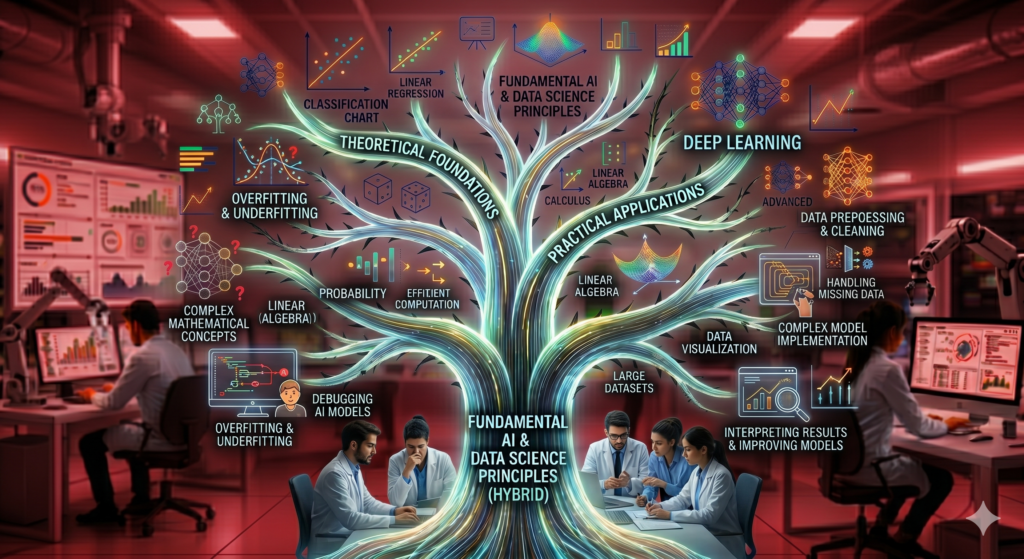
Students often struggle with mathematical concepts like probability and linear algebra. Machine learning algorithms can be difficult to understand initially. Concepts like overfitting and underfitting are confusing. Deep learning and neural networks require advanced understanding. Data preprocessing and cleaning are also challenging tasks. For example, handling missing or noisy data requires careful analysis. Implementing models correctly can be complex. Interpreting results and improving models is another difficulty. Debugging AI models is harder than debugging code. Practice and real-world projects help overcome these challenges.
➤Is this branch more theoretical, practical, or hybrid?
AI & Data Science is a hybrid branch combining theory and practice. Theoretical knowledge is needed to understand algorithms and models. Practical skills are required to implement and deploy solutions. For example, learning regression is theoretical, but applying it to real data is practical. Industry demands strong hands-on experience. Without theory, models may not perform correctly. Without practice, knowledge cannot be applied effectively. A balanced approach is essential for success. Projects and internships improve practical understanding. The best professionals combine both aspects. This makes the field dynamic and impactful.
Conclusion
Core subjects form the backbone of AI & Data Science, especially mathematics and logical thinking. A strong understanding of these concepts makes advanced topics much easier to learn. It is important to focus on understanding rather than memorization. Both theory and practical application must go hand in hand. These fundamentals are essential for solving real-world problems effectively. A solid foundation ensures long-term growth in this field.