
➤What are the key subjects I must master in this branch?
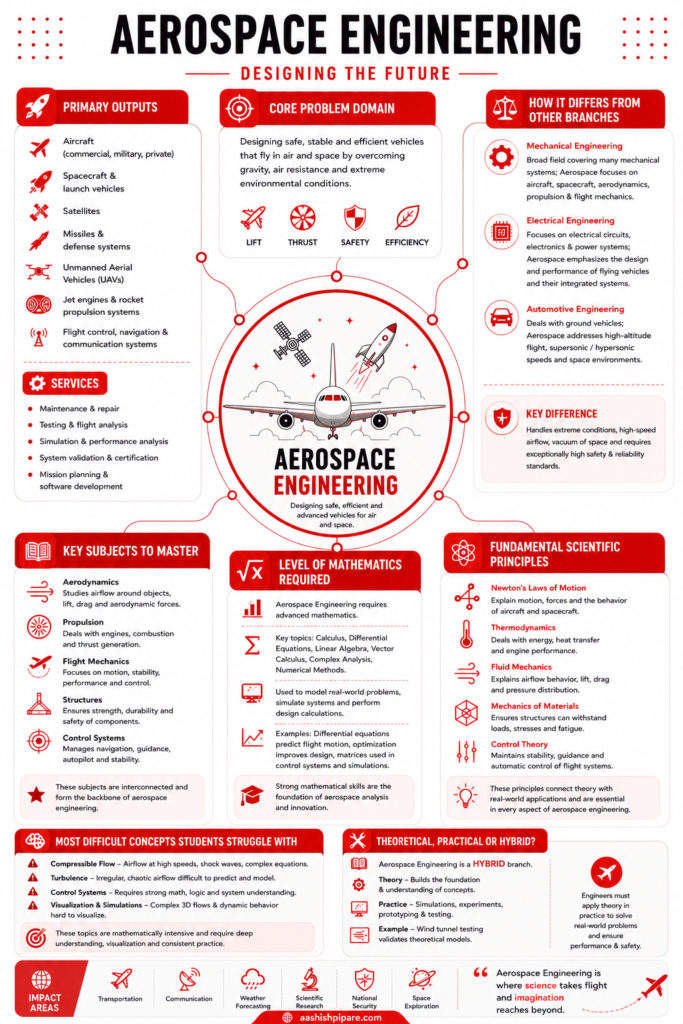
Key subjects include aerodynamics, propulsion, flight mechanics, structures, and control systems. Aerodynamics studies airflow around objects. Propulsion deals with engines and thrust generation. Flight mechanics focuses on motion and stability of aircraft. Structures ensure strength and durability of components. Control systems manage navigation and stability. For example, understanding aerodynamics helps design efficient wings. These subjects form the backbone of aerospace engineering. Each subject is interconnected. Mastery of these is essential for core roles. Strong fundamentals lead to better problem-solving skills.
➤What level of mathematics is required?
Aerospace Engineering requires advanced mathematics. Topics include calculus, differential equations, and linear algebra. These are used to model real-world problems. For example, differential equations are used to predict flight motion. Mathematics helps in simulations and design calculations. Without strong math skills, concepts become difficult. Engineers use math to optimize designs. It is also used in control systems and fluid dynamics. Regular practice is necessary to build confidence. Math is the foundation of aerospace analysis.
➤Which scientific principles are fundamental here?
Fundamental principles include Newton’s laws, thermodynamics, and fluid mechanics. Newton’s laws explain motion and forces. Thermodynamics deals with energy and heat transfer. Fluid mechanics explains airflow behavior. For example, lift is generated due to pressure difference explained by fluid dynamics. These principles are applied in every aerospace system. Understanding them helps in design and analysis. They are the backbone of engineering concepts. Without them, advanced topics cannot be understood. They connect theory with real-world applications.
➤What are the most difficult concepts students struggle with?
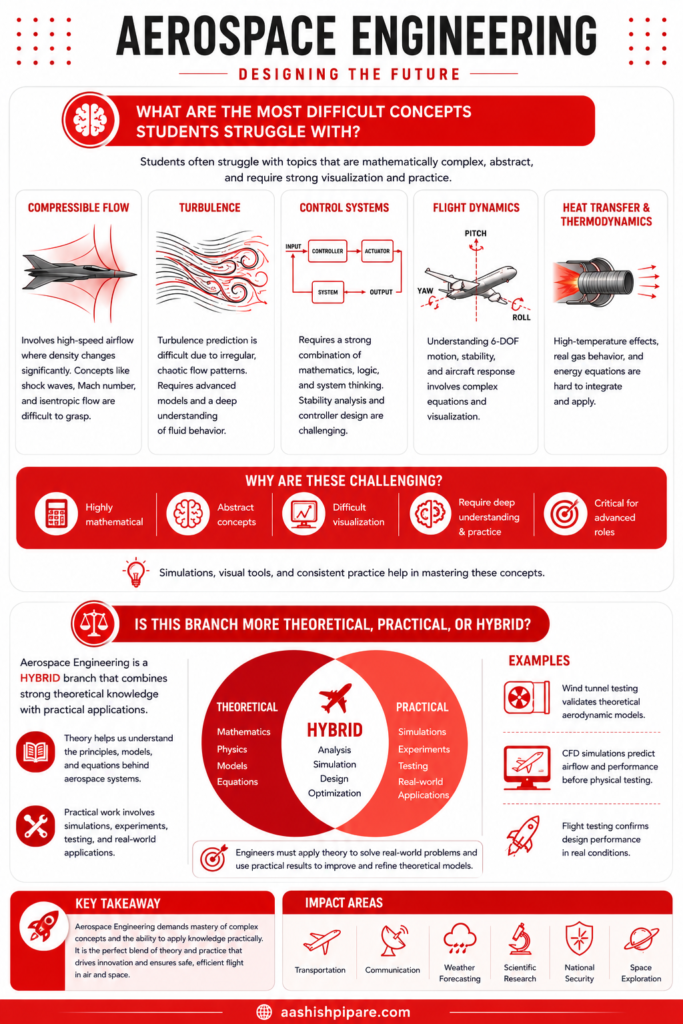
Students often struggle with compressible flow, turbulence, and control systems. These topics are mathematically complex. Understanding airflow at high speeds is challenging. Control systems require both math and logic. For example, turbulence prediction is difficult due to irregular patterns. These concepts require deep understanding and practice. Visualization can also be challenging. Many students find simulations helpful. Consistent study is required to master them. These topics are critical for advanced roles.
➤Is this branch more theoretical, practical, or hybrid?
Aerospace Engineering is a hybrid branch. It combines strong theoretical knowledge with practical applications. Theory is used to understand concepts. Practical work includes simulations and experiments. For example, wind tunnel testing validates theoretical models. Engineers must apply theory to real-world problems. Both aspects are equally important. Industry demands practical skills along with theory. Projects help bridge the gap. A balanced approach is necessary for success.
Conclusion
This branch demands strong fundamentals in math, physics, and core subjects, making it intellectually challenging but highly rewarding for those who build deep conceptual clarity.