
Core Concepts & Academic Foundations
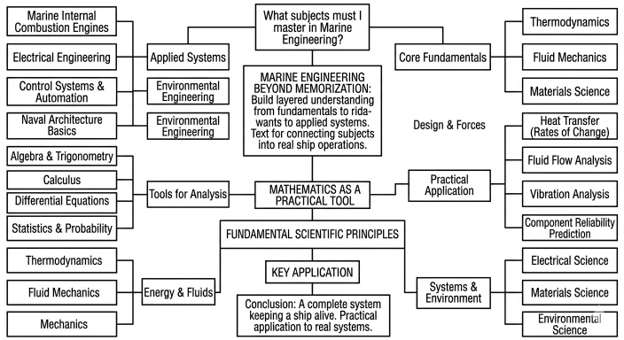
🔹What are the key subjects I must master in this branch ?
To become a strong marine engineer, you must build a layered understanding, starting from fundamentals and progressing to applied systems. This branch is not about memorizing subjects—it’s about connecting them into real ship operations.
At the foundation lies Thermodynamics, which governs how energy is produced, converted, and utilized. Every marine engine—whether diesel or turbine—operates on thermodynamic cycles. You must understand concepts like heat transfer, entropy, efficiency, and energy balance. For example, improving fuel efficiency of a ship engine requires deep knowledge of thermodynamic losses.
Next comes Fluid Mechanics, which is absolutely critical. Ships interact continuously with water, and their propulsion depends on fluid behavior. You will study flow dynamics, pressure variation, turbulence, and boundary layers. This directly applies to pumps, cooling systems, and propellers. For instance, inefficient fluid flow in cooling systems can lead to engine overheating.
Marine Internal Combustion Engines is the heart of the branch. Unlike car engines, marine engines are massive, slow-speed, and designed for continuous operation. You must understand fuel injection, combustion, lubrication, and exhaust systems. A marine engineer is expected to not only understand these systems but also troubleshoot them under real conditions.
Electrical Engineering is equally important because ships are floating power stations. You will study generators, transformers, motors, and power distribution systems. Modern ships rely heavily on electrical automation, making this subject indispensable.
Control Systems and Automation are increasingly vital. Ships today use automated monitoring systems to control engines, fuel usage, and safety mechanisms. Understanding feedback loops, sensors, and control logic helps in managing smart ship operations.
Materials Science is crucial due to the harsh marine environment. Saltwater causes severe corrosion, so engineers must understand material selection, protective coatings, and failure prevention.
Additionally, Naval Architecture basics help you understand ship stability and structure, even though it’s not your primary focus. Without this knowledge, you cannot fully appreciate how machinery interacts with the vessel.
Finally, Environmental Engineering is becoming central due to strict global regulations. Engineers must manage emissions, waste disposal, and pollution control systems.
In short, these subjects are not isolated—they form a complete system that keeps a ship alive.
🔹What level of mathematics is required ?
Mathematics in marine engineering is not just academic—it is a practical problem-solving tool used daily.
At the basic level, algebra and trigonometry are used for calculations involving dimensions, forces, and system design. However, the real strength lies in calculus, which is used extensively in analyzing changing systems.
For example, when studying heat transfer in engines, you deal with rates of change of temperature, which require differential calculus. Similarly, fluid flow analysis involves velocity gradients and pressure variations, all derived using calculus.
Differential equations are one of the most important mathematical tools. They are used to model dynamic systems such as engine performance, vibration analysis, and heat conduction. For instance, predicting how quickly an engine cools down requires solving heat transfer equations.
Statistics and probability are used in reliability analysis and maintenance planning. Marine engineers often deal with failure prediction—understanding when a component might fail based on data trends.
Mathematics is also essential in simulation and optimization. Engineers use mathematical models to improve fuel efficiency, reduce emissions, and optimize performance.
However, unlike pure mathematics fields, marine engineering focuses more on application rather than theory. You don’t need to prove theorems—you need to use formulas effectively.
The key is not complexity, but practical application of math to real systems.
🔹Which scientific principles are fundamental here ?
Marine engineering is built on a strong scientific foundation that explains how systems behave under real conditions.
The most important principle is thermodynamics, which governs energy transformation. Every engine, boiler, and turbine operates based on thermodynamic laws. Understanding efficiency, heat loss, and energy conversion is essential.
Fluid mechanics explains how water and fluids behave around and within the ship. This includes propulsion, cooling systems, and fuel flow. Without understanding fluid behavior, you cannot design or operate marine systems effectively.
Mechanics deals with forces, motion, and structural behavior. It helps in understanding vibrations, stresses, and mechanical failures in machinery.
Electrical science governs power generation and distribution onboard. Ships rely on generators and electrical systems for almost all operations, making this principle critical.
Materials science explains how materials behave under stress, temperature, and corrosion. Marine environments are extremely aggressive, and material failure can lead to serious consequences.
Environmental science is becoming increasingly important. Engineers must understand emissions, pollution control, and sustainability practices.
For example, preventing oil spills or reducing sulfur emissions requires knowledge of environmental chemistry and engineering.
These principles together create a scientific framework that supports every marine system.
🔹What are the most difficult concepts students struggle with ?
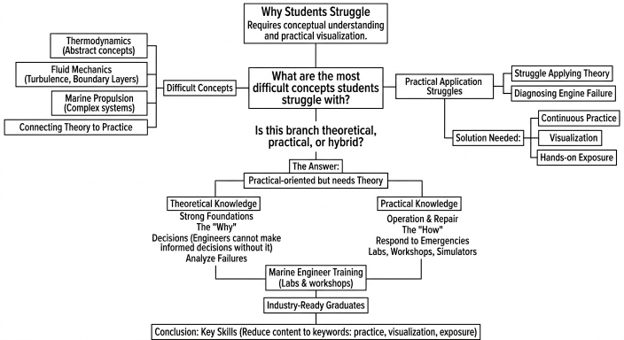
Many students initially struggle because marine engineering requires both conceptual understanding and practical visualization.
One of the most challenging subjects is thermodynamics, mainly because it involves abstract concepts like entropy and energy balance. Students often find it difficult to connect theory with real engines.
Fluid mechanics is another difficult area, especially topics like turbulence and boundary layers. Visualizing how fluids behave inside pipes or around propellers takes time and practice.
Understanding marine engines in detail can also be overwhelming. These are complex systems with multiple subsystems working together. Without hands-on exposure, it becomes difficult to grasp their operation.
Electrical systems onboard ships can be confusing, especially for students with weaker backgrounds in electrical engineering.
Automation and control systems require logical thinking and understanding of feedback mechanisms, which can be challenging initially.
Another major difficulty is practical application. Students may understand theory but struggle to apply it in real-world scenarios, such as diagnosing engine failure.
The solution is simple but demanding:
✔ Continuous practice
✔ Visualization
✔ Hands-on exposure
🔹Is this branch more theoretical, practical, or hybrid ?
Marine engineering is one of the most practical-oriented engineering branches, but it cannot function without strong theoretical foundations.
Theoretical knowledge provides the “why”—why engines work, why failures occur, and why certain materials are used. Without this, engineers cannot make informed decisions.
Practical knowledge provides the “how”—how to operate machinery, how to repair systems, and how to respond to emergencies.
For example, knowing the theory of combustion is important, but being able to adjust fuel injection in a real engine is equally critical.
Training in marine engineering includes labs, workshops, simulators, and onboard experience. This ensures that students are not just academically strong but also industry-ready.
Conclusion
Marine Engineering is a strongly hybrid field that demands both deep theoretical understanding and hands-on practical skills. Core subjects like thermodynamics, fluid mechanics, and marine engines form the backbone, while mathematics and scientific principles help you analyze and improve real systems. The difficulty comes from connecting theory to real-world ship operations, but once understood, it becomes highly logical and application-driven.
Call to Action
Focus on understanding concepts, not just memorizing them. Practice regularly, visualize how systems work, and seek practical exposure through labs, simulations, or internships. Build strong fundamentals early, because they directly decide how confident and capable you will be as a marine engineer.