
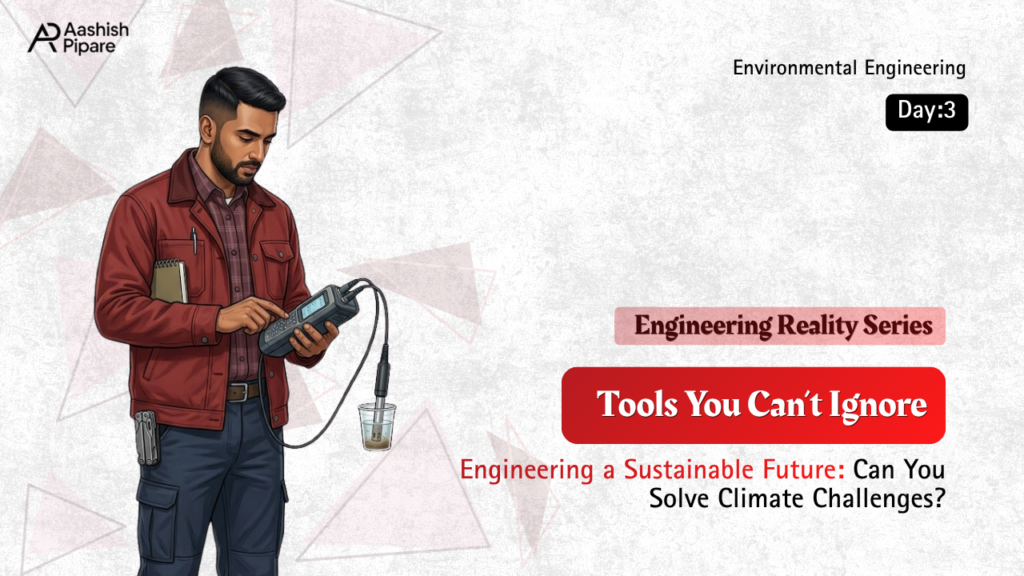
🔹What software tools are essential?
Environmental engineering today is deeply connected with digital tools because real-world environmental problems involve large-scale systems and complex data. Engineers use software not just for design, but also for simulation, prediction, monitoring, and decision-making. One of the most widely used tools is AutoCAD, which helps in creating layouts of water treatment plants, drainage systems, pipelines, and environmental infrastructure. For example, when designing a sewage treatment plant, engineers use AutoCAD to plan tank sizes, pipe routes, and flow directions accurately before construction begins.
Another powerful tool is MATLAB, which is used for solving complex mathematical models. Environmental engineers use MATLAB to simulate pollution dispersion, optimize treatment processes, and analyze environmental data. For instance, predicting how a pollutant spreads in a river over time can be modeled using MATLAB equations.
A highly critical tool in this field is Geographic Information System (GIS). GIS allows engineers to map environmental data geographically. For example, pollution levels in different parts of a city can be visualized on a map to identify high-risk zones. This is extremely useful for urban planning and environmental monitoring.
Specialized software like EPANET is used to design and simulate water distribution networks. Engineers can analyze pressure, flow rate, and water quality across pipelines before implementing the system physically. Similarly, air pollution modeling tools help predict how emissions from factories spread in the atmosphere.
These tools reduce the need for costly trial-and-error experiments and improve accuracy in planning. They also help engineers make data-driven decisions for sustainability. In modern industries, knowledge of these tools is not optional—it is expected. Engineers who can combine theory with software skills are more efficient, productive, and employable.
🔹What hardware or lab exposure is required?
Environmental engineering is not purely theoretical—it is strongly connected to real-world observation and testing. That is why laboratory and field exposure is essential for students. In labs, students work with water testing equipment to measure parameters such as pH, turbidity, dissolved oxygen (DO), biochemical oxygen demand (BOD), and chemical oxygen demand (COD). These parameters indicate the quality of water and whether it is safe for human use.
For example, in a wastewater treatment experiment, students observe how microorganisms break down organic waste. This biological process is the backbone of sewage treatment plants. Understanding it practically helps engineers design better systems.
Air quality monitoring is another important area. Instruments are used to measure pollutants like carbon dioxide (CO₂), sulfur dioxide (SO₂), nitrogen oxides (NOx), and particulate matter (PM2.5 and PM10). For instance, measuring air quality near an industrial area helps determine whether pollution control measures are effective.
Students also gain exposure to soil testing equipment, which is used to analyze contamination levels, moisture content, and nutrient composition. This is important in environmental impact studies and land management.
Fieldwork is equally important. Engineers collect samples from rivers, lakes, industrial discharge points, and urban areas. For example, collecting river water samples upstream and downstream of a factory helps identify pollution sources.
Wastewater treatment setups, filtration units, and sedimentation tanks are commonly used in labs to demonstrate real processes. This hands-on experience helps students understand how theoretical concepts work in real conditions.
Without lab exposure, it is very difficult to work in environmental industries because real-world problems require practical understanding. Therefore, laboratory training builds confidence, improves analytical skills, and prepares students for industrial challenges.
🔹Which programming languages (if any) are needed?
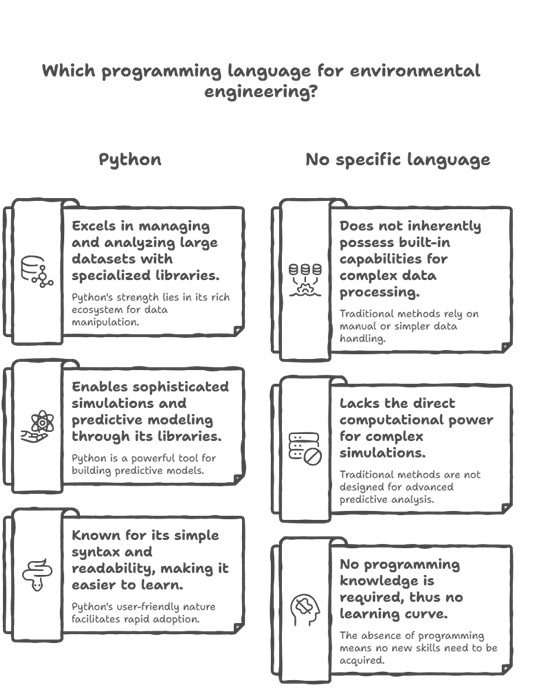
While traditional environmental engineering did not require programming, modern environmental challenges involve large datasets, simulations, and predictive analysis, making programming increasingly important. Among all languages, Python has become the most widely used due to its simplicity and powerful libraries.
Engineers use Python for data analysis, visualization, and environmental modeling. For example, air quality data collected over several years can be analyzed using Python to identify trends and predict future pollution levels. Libraries like Pandas and Matplotlib help in processing and visualizing this data effectively.
Another important tool is MATLAB, which is widely used for solving mathematical equations and simulating environmental systems. For instance, MATLAB can be used to model how contaminants spread in groundwater.
Programming is also used in automation. Environmental monitoring systems often collect real-time data using sensors. Programming helps in processing this data automatically and generating alerts when pollution exceeds safe limits.
In research and advanced applications, programming is used in machine learning and artificial intelligence. For example, AI models can predict water demand in cities or optimize waste management systems.
Although programming is not mandatory for entry-level jobs, it provides a significant advantage. Engineers with coding skills can work in advanced roles such as environmental data analysis, climate modeling, and smart city projects.
Learning programming also improves logical thinking and problem-solving ability. It opens opportunities beyond traditional roles, including interdisciplinary careers. Therefore, even basic knowledge of programming can greatly enhance career growth in environmental engineering.
Visual
🔹What are the must-have technical skills for freshers?
Freshers entering environmental engineering must develop a balanced set of technical, analytical, and practical skills. One of the most important skills is understanding water and wastewater treatment processes. This includes knowledge of filtration, sedimentation, biological treatment, and disinfection methods.
Another key skill is understanding air pollution control techniques, such as electrostatic precipitators, scrubbers, and filters. For example, industries use these systems to reduce harmful emissions before releasing gases into the atmosphere.
Environmental monitoring and data analysis are also critical. Freshers should be able to collect samples, test them, and interpret results. For instance, analyzing whether a water sample meets drinking standards is a basic but essential skill.
Knowledge of environmental laws and regulations is very important. Engineers must ensure that industries comply with government standards. In India, organizations like the Central Pollution Control Board (CPCB) regulate environmental practices.
Problem-solving ability is another crucial skill. Engineers must design solutions for issues like waste disposal, pollution control, and resource management. For example, finding a cost-effective way to treat industrial wastewater requires creativity and technical knowledge.
Basic familiarity with software tools like GIS and AutoCAD is also expected. Communication skills are important for writing reports and presenting findings to stakeholders.
Overall, freshers must be technically strong, practically aware, and environmentally conscious. Continuous learning and adaptability are key to long-term success.
🔹What certifications add value in this domain?
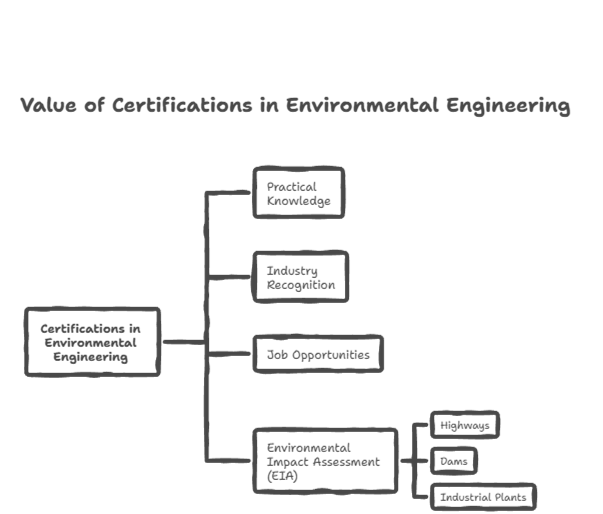
Certifications play a significant role in enhancing the profile of an environmental engineer. They provide practical knowledge, industry recognition, and better job opportunities. One of the most valuable certifications is in Environmental Impact Assessment (EIA), which is required for evaluating the environmental effects of projects like highways, dams, and industrial plants.
Another important certification is ISO 14001, which focuses on environmental management systems. Companies follow this standard to minimize environmental impact and ensure sustainable operations. Engineers with this certification are highly valued in industries.
Certifications in GIS and remote sensing are also very useful. These skills help engineers analyze environmental data and create maps for planning and monitoring. For example, GIS-certified professionals can work on smart city and environmental planning projects.
Courses in water and wastewater treatment technologies provide practical knowledge required in industries. Similarly, certifications in sustainability and climate change are becoming increasingly important.
For example, an engineer with EIA certification can work as an environmental consultant for large infrastructure projects. These certifications demonstrate expertise beyond academic learning.
They also increase chances of higher salary and better job roles. Many companies prefer certified professionals for critical tasks because they require less training.
Therefore, investing time in certifications is a smart decision for career growth. It not only improves technical skills but also enhances credibility in the professional world.
Mindmap
Conclusion
Environmental engineering has evolved into a highly technology-driven field where theoretical knowledge alone is not enough. Mastery of digital tools like AutoCAD, MATLAB, ArcGIS, and EPANET allows engineers to design, simulate, and optimize complex environmental systems with high accuracy. These tools enable data-driven decision-making, which is essential in solving large-scale environmental problems.
At the same time, practical exposure through laboratory work and field studies builds the real-world understanding required to apply these tools effectively. Testing water quality, monitoring air pollution, and analyzing soil conditions help engineers connect theory with reality. This combination of digital expertise and hands-on experience creates a strong technical foundation.
Programming skills, especially in Python, further enhance an engineer’s capability by enabling data analysis, automation, and predictive modeling. Along with this, certifications such as ISO 14001 and Environmental Impact Assessment (EIA) strengthen professional credibility and open doors to advanced career opportunities.
In summary, success in environmental engineering depends on a balanced skill set—software proficiency, practical knowledge, analytical thinking, and continuous learning. Engineers who actively upgrade their skills and adapt to new technologies will lead innovation and remain highly valuable in the industry.
Don’t just study—skill up and stand out.
Learn tools like AutoCAD and ArcGIS, explore programming with Python, and gain hands-on experience.
Start building your technical edge today and become an industry-ready Environmental Engineer.
Call to Action
Start learning at least one software tool like AutoCAD or GIS
Build basic programming skills using Python
Take lab work and field exposure seriously to gain practical understanding
Work on real-world projects related to water, air, or waste management
Consider certifications like EIA or ISO standards to boost your profile
Stay consistent in skill-building, because the right combination of tools and knowledge will make you industry-ready and future-proof