

➤What are some beginner-level projects in this branch?
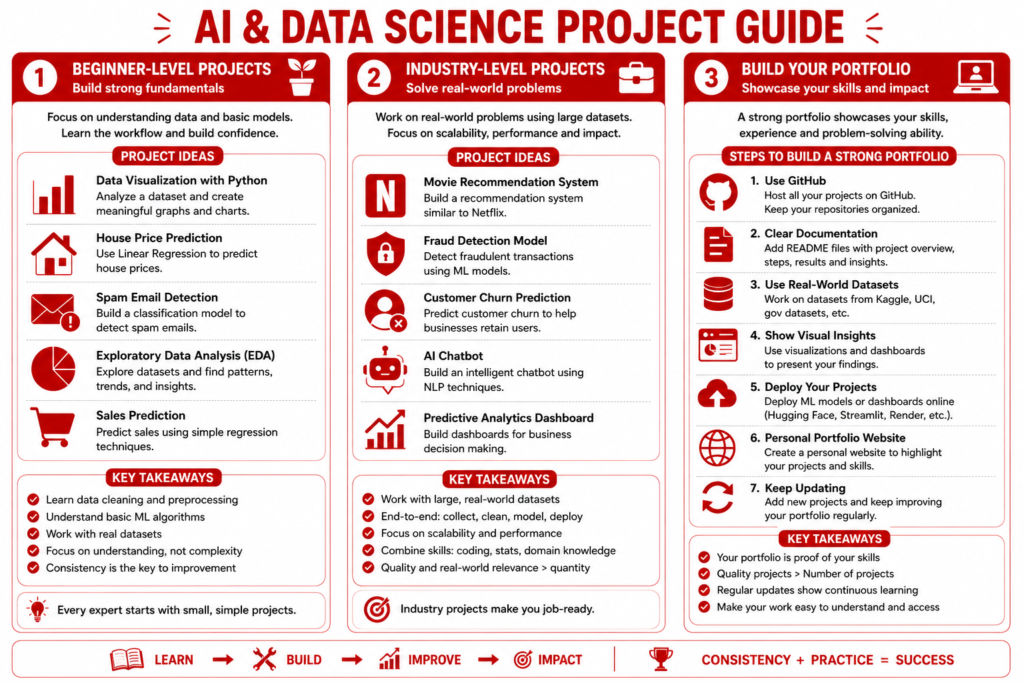
Beginner-level projects in AI & Data Science are designed to help you understand the complete workflow of solving data-driven problems. At this stage, the goal is not to build highly complex AI systems but to learn how to collect data, clean it, analyze patterns, train simple machine learning models, and interpret results. These projects develop problem-solving skills while strengthening your understanding of programming, statistics, and machine learning fundamentals.
One of the best starting projects is data visualization using Python libraries such as Matplotlib and Plotly. By creating bar charts, pie charts, histograms, and line graphs from real datasets, you learn how to identify trends and communicate insights effectively. Another popular beginner project is house price prediction using Linear Regression, where you predict property prices based on features such as area, number of bedrooms, and location.
➤What are industry-level projects I should aim for?
Industry-level projects in AI & Data Science focus on solving real business problems using large, real-world datasets. Unlike beginner projects, these projects require you to build complete end-to-end solutions that include data collection, preprocessing, feature engineering, model development, evaluation, deployment, and monitoring. They demonstrate your ability to apply technical knowledge in practical situations and are highly valued by recruiters.
One of the most popular industry-level projects is a Recommendation System, similar to those used by Netflix, Amazon, or Spotify. These systems analyze user behavior and preferences to recommend movies, products, or songs. Building such a project helps you understand collaborative filtering, content-based filtering, and recommendation algorithms. Another excellent project is Fraud Detection, where machine learning models identify suspicious banking or credit card transactions. These systems are widely used in financial institutions to reduce fraud and improve security.
➤How can I build a portfolio in this domain?
A strong portfolio is one of the most important assets for anyone pursuing a career in AI & Data Science. It serves as practical proof of your knowledge, technical skills, and problem-solving ability. Recruiters often value a well-organized portfolio more than certificates because it demonstrates that you can apply concepts to solve real-world problems. A good portfolio should highlight not only your coding skills but also your ability to analyze data, build machine learning models, communicate insights, and deploy complete solutions.
The best place to host your projects is GitHub, which is considered the industry standard for sharing code. Create a professional GitHub profile with organized repositories, meaningful project names, and clear folder structures. Every project should include a detailed README file explaining the project objective, dataset, technologies used, implementation steps, results, screenshots, and future improvements. Well-documented projects are much easier for recruiters and hiring managers to understand and evaluate.
➤What kind of internships should I target?
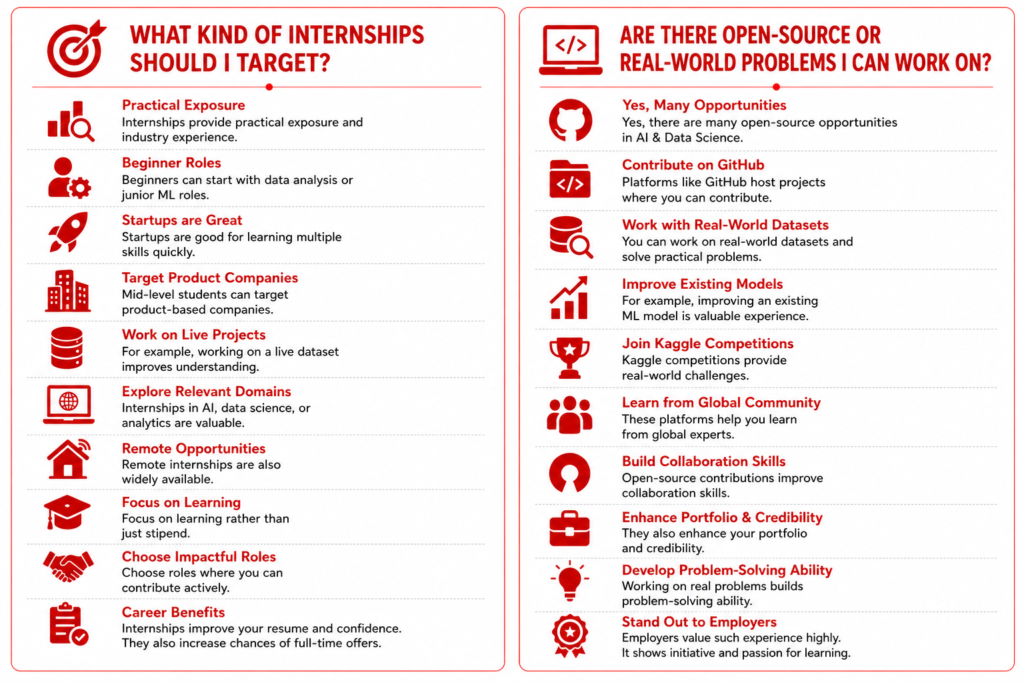
Internships are one of the most important steps in building a successful career in AI & Data Science. They provide practical industry exposure, allowing you to apply classroom concepts to real-world business problems. Through internships, you learn how companies collect, clean, analyze, and use data to make decisions. You also gain experience with industry-standard tools, collaborate with professionals, and understand real project workflows. Employers highly value internship experience because it demonstrates your ability to work in a professional environment.
If you are a beginner, focus on internships that help you build a strong foundation rather than highly specialized roles. Positions such as Data Analyst Intern, Junior Machine Learning Intern, Business Intelligence Intern, Data Engineering Intern, Python Developer Intern, or Research Assistant are excellent starting points. These roles teach essential skills such as data cleaning, visualization, SQL, Python programming, and basic machine learning. They also help you understand the complete data science workflow before moving to more advanced AI projects.
➤Are there open-source or real-world problems I can work on?
Yes, there are numerous open-source projects and real-world problems that AI & Data Science students can work on to gain practical experience. These opportunities allow you to apply your theoretical knowledge to real applications, improve your coding skills, collaborate with developers worldwide, and build a portfolio that stands out to recruiters. In today’s competitive job market, contributing to open-source projects or solving real-world challenges is one of the best ways to demonstrate your technical abilities and passion for continuous learning.
One of the best places to begin is GitHub, where thousands of AI and Data Science projects are openly available. You can contribute by fixing bugs, improving documentation, optimizing machine learning models, adding new features, or developing entirely new modules. Even small contributions help you understand professional software development practices such as version control, code reviews, pull requests, issue tracking, and collaborative programming. These experiences prepare you for working in real development teams.
Conclusion
Projects are the most effective way to learn AI & Data Science. They help you apply theoretical concepts to real-world problems. Starting from simple projects and progressing to advanced ones is essential. A strong portfolio reflects your practical abilities. Recruiters value projects more than academic scores. Consistent hands-on practice builds confidence and expertise.