
Project-Based Learning (Critical for Engineers)
🔹What are some beginner-level projects in this branch?
Beginner-level projects in marine engineering are designed to build fundamental understanding of systems rather than complexity. At this stage, the goal is to visualize how ship machinery works, not to innovate.
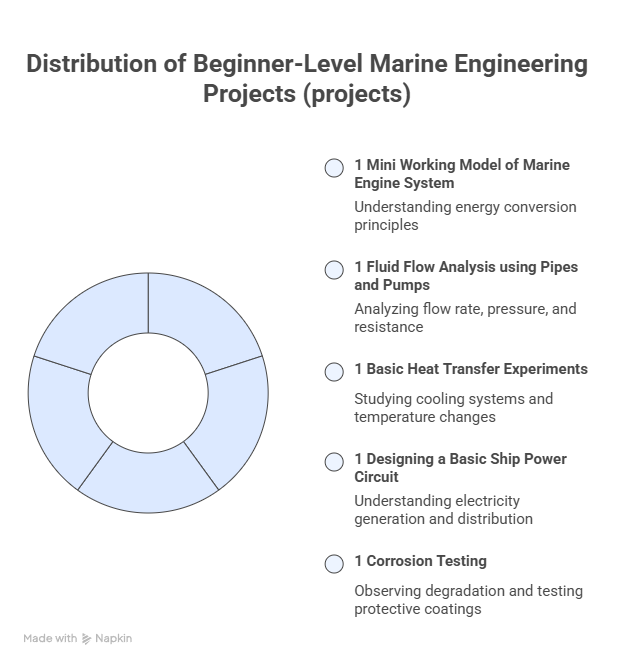
One of the most effective starter projects is creating a mini working model of a marine engine system. This helps students understand the relationship between fuel, combustion, and mechanical output. Even a simplified model demonstrates energy conversion principles clearly.
Another important project is fluid flow analysis using pipes and pumps. Since ships rely heavily on pumping systems (fuel, water, lubrication), understanding how flow rate, pressure, and resistance interact is critical. For example, students can compare flow efficiency in different pipe diameters.
Basic heat transfer experiments are also valuable. These include studying cooling systems by analyzing how temperature changes over time in a controlled setup. This directly connects to engine cooling in real ships.
Electrical mini-projects such as designing a basic ship power circuit help students understand how electricity is generated and distributed onboard.
Corrosion testing is another simple yet powerful project. By exposing metal samples to saltwater, students can observe degradation and test protective coatings. This builds awareness of one of the biggest real-world challenges in marine environments.
These projects may seem simple, but they build the mental models required for advanced engineering thinking.
🔹What are industry-level projects I should aim for?
Industry-level projects shift from learning to problem-solving and optimization, which is what companies actually value.
One of the most important areas is fuel efficiency optimization. Ships consume enormous amounts of fuel, so even a 1–2% improvement can save millions. Projects may involve analyzing engine data and suggesting improvements in combustion or load management.
Another major project area is predictive maintenance systems. Instead of repairing machines after failure, engineers use data to predict when maintenance is needed. This reduces downtime and increases reliability.
For example, analyzing vibration patterns in engines to detect early faults is a real industrial application.
Emission control and green shipping projects are becoming highly important due to global environmental regulations. Designing systems to reduce sulfur emissions or improve exhaust treatment is a key industry focus.
Automation is another advanced area. Projects involving smart ship systems, where sensors and software monitor performance and make adjustments, are highly valued.
Offshore-related projects such as designing systems for oil rigs or floating platforms also fall under industry-level work.
These projects require:
- Strong fundamentals
- Data analysis skills
- Practical understanding
They transform you from a student into an industry-ready engineer.
🔹How can I build a portfolio in this domain?
A strong portfolio is your technical identity—it shows what you can actually do, not just what you know.
Start by documenting every project in a structured way:
- Problem statement
- Method used
- Results obtained
- Learning outcomes
For example, if you worked on a fuel efficiency project, include graphs, data analysis, and conclusions.
Include lab work such as engine testing, pump analysis, and electrical system experiments. Add photos, diagrams, and observations.
Internship experience should be explained clearly. Instead of just writing “worked in engine room,” describe:
What systems you handled
What problems you observed
What you learned
If you’ve used software tools, include simulations and outputs.
Certifications should also be part of your portfolio, especially safety and technical ones.
A strong portfolio shows:
✔ Practical skills
✔ Problem-solving ability
✔ Industry readiness
🔹What kind of internships should I target?
Internships in marine engineering are not optional—they are essential.
The most valuable internship is onboard ship training, where you work as a trainee engineer. This gives real exposure to engine rooms, machinery, and operations.
Shipping companies like Maersk offer such opportunities, providing hands-on experience in real conditions.
Shipyards are another excellent option. Here, you learn how ships are built, assembled, and tested.
Offshore industries, including companies like Shell, provide exposure to oil rigs and marine systems used in energy extraction.
Maintenance and repair companies are also valuable because they teach troubleshooting and system recovery.
During internships, your focus should be on:
- Observing real operations
- Asking questions
- Understanding safety protocols
- Learning system behavior
The right internship can shape your entire career direction.
🔹Are there open-source or real-world problems I can work on?
Marine engineering offers many real-world challenges that students can explore independently.
One major area is fuel efficiency and emission reduction. With global pressure to reduce pollution, engineers are working on cleaner fuels and optimized engines.
Corrosion prevention is another ongoing problem. Designing better coatings or materials to resist seawater damage is highly valuable.
Automation and smart shipping systems are emerging areas. Students can work on data analysis projects related to engine performance and predictive maintenance.
Renewable marine energy, such as offshore wind and tidal energy, is also a growing field.
Safety improvements, such as better fire detection or emergency response systems, are critical research areas.