
🔹How will AI impact this branch?
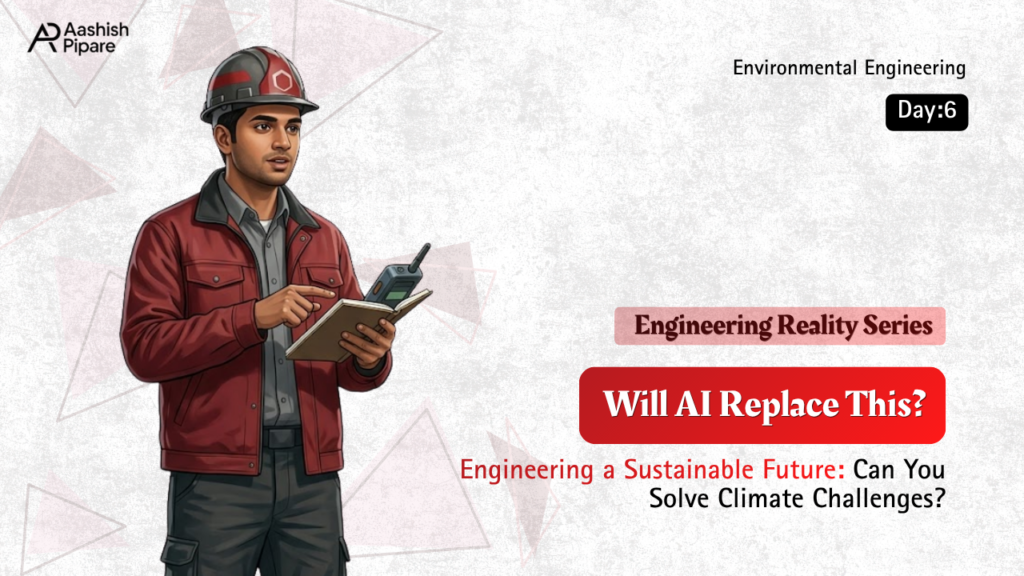
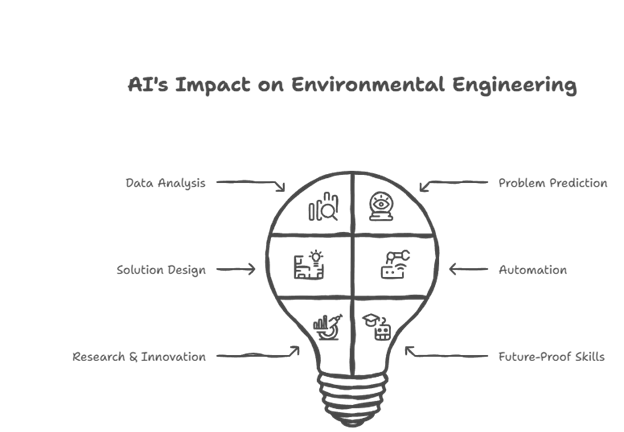
Artificial Intelligence (AI) is rapidly transforming environmental engineering by improving how engineers analyze data, predict problems, and design solutions. Environmental systems generate massive amounts of data—from air quality sensors, water monitoring stations, climate models, and satellite imagery. AI helps process this data quickly and accurately, which would otherwise take a huge amount of time manually.
For example, AI models can predict air pollution levels in cities by analyzing past data, weather patterns, and traffic conditions. This allows authorities to take preventive measures before pollution reaches dangerous levels. Similarly, AI is used in water treatment plants to optimize operations. It can automatically adjust chemical dosing, filtration rates, and energy use to improve efficiency and reduce costs.
AI also plays a major role in climate change modeling. It helps scientists predict temperature changes, rainfall patterns, and extreme weather events. This information is critical for planning sustainable infrastructure and disaster management systems.
Another important application is waste management optimization. AI can analyze waste generation patterns in cities and improve collection routes, recycling processes, and disposal methods. For instance, smart bins equipped with sensors can notify authorities when they are full, reducing unnecessary collection trips.
Automation, combined with AI, is also improving real-time environmental monitoring. Sensors connected to AI systems continuously track pollution levels and send alerts when limits are exceeded. This reduces human effort and increases accuracy.
AI is also accelerating research and innovation. It helps in discovering new materials for water purification, improving renewable energy systems, and designing sustainable technologies. Engineers who understand AI tools can contribute more effectively to these advancements.
Overall, AI enhances productivity, reduces errors, and enables smarter decision-making. However, engineers must adapt and learn how to work with AI systems to remain relevant in the future.
🔹What parts are at risk of automation?
Automation is gradually replacing repetitive and routine tasks in environmental engineering, especially those that involve data collection, monitoring, and basic analysis. For example, traditional methods of manually measuring air or water quality are now being replaced by automated sensors that continuously record data in real time.
In industries, automated systems monitor emissions from factories and power plants. These systems can track parameters like temperature, pressure, and pollutant levels without human intervention. Similarly, wastewater treatment plants use automated controls to manage processes like aeration, filtration, and sludge handling.
Basic reporting tasks are also being automated. Software can generate environmental reports, graphs, and compliance documents automatically using collected data. For instance, daily air quality reports in cities can now be generated without manual calculations.
However, automation has its limitations. Tasks that require critical thinking, decision-making, and problem-solving cannot be fully automated. For example, designing a wastewater treatment plant or planning a pollution control strategy requires human expertise and creativity.
Policy-making and environmental planning also depend on human judgment. Engineers must consider social, economic, and environmental factors, which cannot be fully handled by machines.
Automation reduces the need for manual labor but increases the demand for skilled professionals who can manage and interpret automated systems. Engineers who rely only on basic tasks may face challenges, while those with advanced skills will remain valuable.
Therefore, automation is not eliminating jobs but changing the nature of work. It shifts focus from routine tasks to high-level technical and analytical roles.
🔹What skills make me future-proof?
To stay relevant in the evolving field of environmental engineering, students and professionals must develop a combination of core knowledge and modern skills. Strong fundamentals in subjects like environmental chemistry, fluid mechanics, and pollution control remain essential. Without these basics, it is difficult to understand advanced technologies.
One of the most important future-proof skills is data analysis. Engineers must be able to interpret environmental data and make informed decisions. Learning tools like Excel, Python, or MATLAB can greatly improve this ability. For example, analyzing long-term air pollution data can help predict future trends.
Knowledge of AI and machine learning is becoming increasingly valuable. Engineers who understand how AI models work can use them for environmental monitoring, prediction, and optimization.
Problem-solving and critical thinking are always important. Environmental challenges are complex and require innovative solutions. For instance, designing a low-cost water purification system for rural areas requires creativity and technical knowledge.
Communication skills are also essential. Engineers must explain technical findings to non-technical stakeholders, such as government officials or the public. Clear reporting and presentation skills are highly valued.
Adaptability and continuous learning are key to long-term success. Technologies are changing rapidly, and engineers must keep updating their skills. Interdisciplinary knowledge, combining engineering with data science or sustainability, increases career opportunities.
Overall, engineers who combine technical expertise, digital skills, and adaptability will remain future-proof in this field.
🔹Is this branch becoming interdisciplinary?
Yes, environmental engineering is increasingly becoming an interdisciplinary field, combining knowledge from multiple domains to solve complex environmental problems. Traditionally, it was closely linked with civil and chemical engineering, but today it extends far beyond that.
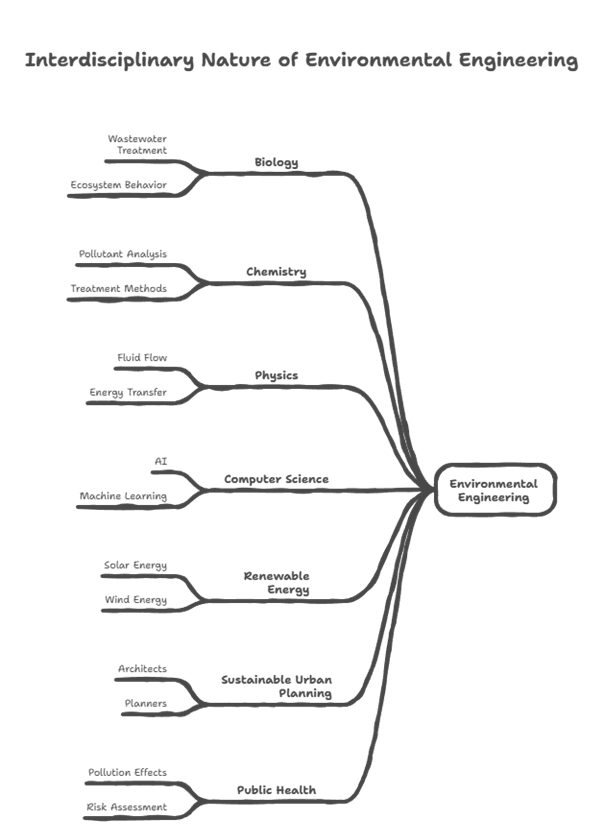
Environmental engineers now work with biology to understand microbial processes in wastewater treatment and ecosystem behavior. They use chemistry to analyze pollutants and design treatment methods. Physics helps in understanding fluid flow, energy transfer, and atmospheric processes.
The integration with computer science and data analytics is growing rapidly. Engineers use AI, machine learning, and big data tools to analyze environmental trends and optimize systems. For example, climate models require collaboration between environmental scientists and data scientists.
Renewable energy is another interdisciplinary area. Designing solar, wind, or bioenergy systems requires knowledge of engineering, environmental science, and economics. Similarly, sustainable urban planning involves collaboration with architects, planners, and policymakers.
Environmental engineering also overlaps with public health, as pollution directly affects human health. Engineers work with health experts to assess risks and design safer environments.
Collaboration across disciplines leads to more effective and innovative solutions. Complex issues like climate change, water scarcity, and waste management cannot be solved by a single field alone.
Therefore, students must be open to learning multiple subjects and developing diverse skills. Interdisciplinary knowledge not only improves problem-solving ability but also increases career opportunities in emerging fields.
Conclusion
Artificial Intelligence and automation are not replacing environmental engineering—they are fundamentally upgrading it. From smart pollution monitoring to predictive climate modeling, AI is enabling faster, more accurate, and data-driven decision-making. Systems that once depended heavily on manual effort—like water treatment operations or air quality tracking—are now becoming intelligent, adaptive, and efficient.
At the same time, automation is reshaping job roles rather than eliminating them. Routine tasks such as data collection, monitoring, and basic reporting are increasingly handled by machines, allowing engineers to focus on higher-level responsibilities like system design, innovation, and policy planning. Human judgment, creativity, and ethical decision-making remain irreplaceable in solving complex environmental challenges.
To stay relevant, engineers must evolve with the field. A strong foundation in environmental engineering combined with skills in data analysis, programming, and basic AI understanding is becoming essential. Equally important are problem-solving ability, communication skills, and adaptability in a rapidly changing technological landscape.
The field is clearly moving toward interdisciplinary integration—bringing together environmental science, data analytics, technology, and public policy. This shift not only expands career opportunities but also equips engineers to tackle global issues like climate change, resource scarcity, and sustainable development more effectively.
In summary, AI and automation are powerful enablers that are making environmental engineering smarter, faster, and more impactful. Those who embrace these changes and continuously upgrade their skills will lead the future of this field.
Don’t just learn environmental engineering—upgrade it. Start building skills in AI, data, and sustainability today to become a future-ready engineer. 🌱
Call to Action
Start preparing for the future today with focused action
- Learn one digital skill such as Python, data analysis, or basic AI concepts
- Work on a small project like pollution data analysis or smart monitoring
- Explore interdisciplinary areas like sustainability, climate tech, or renewable energy
- Stay updated with new technologies and environmental innovations
- Build a habit of continuous learning and practical application
Your career growth will depend on how early you adapt to change. Start now, stay consistent, and position yourself ahead of the curve.