
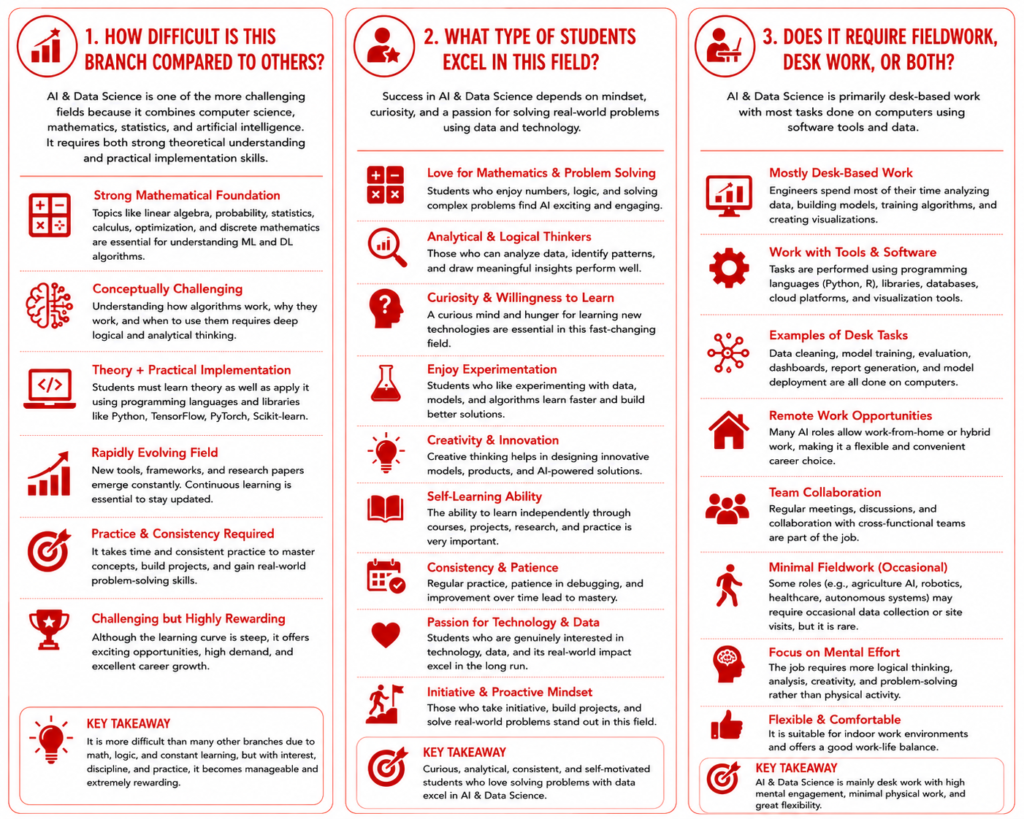
➤How difficult is this branch compared to others?
Artificial Intelligence (AI) & Data Science is generally considered one of the more challenging engineering and technology branches because it combines concepts from computer science, mathematics, statistics, and artificial intelligence. Unlike some branches that focus mainly on programming or theoretical concepts, AI & Data Science requires students to understand both the mathematical foundations behind algorithms and their practical implementation using programming languages and modern software tools. Although the learning curve can be steep initially, students who remain consistent and practice regularly can master the subject successfully.
One of the primary reasons this branch is considered challenging is its strong mathematical foundation. Topics such as linear algebra, probability, statistics, calculus, optimization, and discrete mathematics play an important role in understanding machine learning algorithms and deep learning models. While modern AI libraries simplify implementation, a strong understanding of mathematics helps students understand why algorithms work, how to improve their performance, and how to interpret results correctly.
➤What type of students excel in this field?
Artificial Intelligence (AI) & Data Science is a multidisciplinary field that combines mathematics, programming, statistics, and problem-solving to develop intelligent systems capable of learning from data. Success in this field does not depend only on high academic scores or exceptional intelligence. Instead, it depends on a student’s curiosity, willingness to learn, consistency, and ability to solve real-world problems. Students who develop the right mindset and continuously improve their skills can build successful careers in AI & Data Science.
One of the most important qualities is a strong interest in mathematics and logical reasoning. AI algorithms are built on concepts such as linear algebra, probability, statistics, calculus, and optimization. Students who enjoy working with numbers, identifying patterns, and solving mathematical problems often find it easier to understand machine learning concepts. While advanced mathematics may seem difficult initially, regular practice and conceptual understanding make it manageable.
➤Does it require fieldwork, desk work, or both?
Artificial Intelligence (AI) & Data Science is primarily a desk-based profession, with most tasks performed using computers, programming tools, cloud platforms, and data analysis software. Unlike branches such as Civil, Mechanical, Mining, or Agricultural Engineering, AI & Data Science involves very little physical fieldwork. Professionals spend the majority of their time collecting data, writing code, building machine learning models, analyzing results, and developing intelligent software solutions. This makes the field ideal for students who enjoy technology, programming, and analytical thinking.
A typical workday for an AI or Data Science professional involves tasks such as collecting and cleaning datasets, performing exploratory data analysis, developing machine learning models, training deep learning networks, evaluating model performance, creating dashboards, and deploying AI applications. These activities are performed using programming languages such as Python and SQL and tools like Jupyter Notebook, TensorFlow, PyTorch, Scikit-learn, Power BI, Tableau, and cloud platforms such as AWS, Microsoft Azure, and Google Cloud.
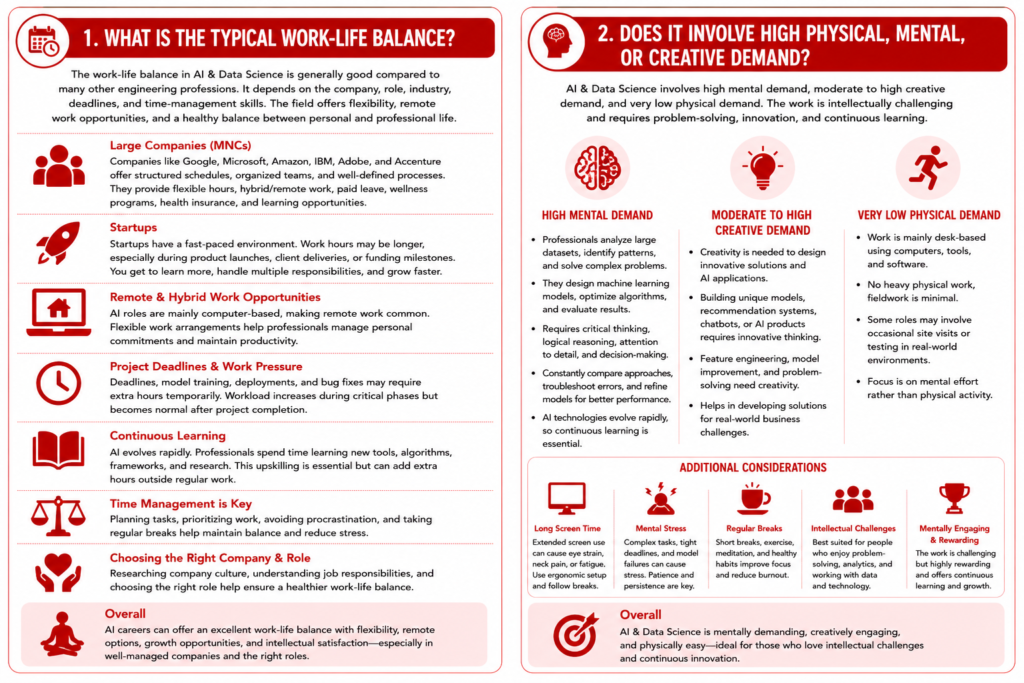
➤What is the typical work-life balance?
The work-life balance in Artificial Intelligence (AI) & Data Science is generally considered good compared to many other engineering professions. Since most AI-related work is computer-based and does not require physical fieldwork, professionals often enjoy flexible work environments, remote work opportunities, and structured office schedules. However, the work-life balance varies depending on factors such as the company, job role, industry, project deadlines, and individual time-management skills. While AI careers can be demanding, they also provide significant flexibility and opportunities for maintaining a healthy professional and personal life.
In large multinational companies (MNCs) such as Google, Microsoft, Amazon, IBM, Adobe, and Accenture, employees typically have well-defined working hours, structured project management processes, and organized teams. These companies usually encourage a healthy work-life balance by offering benefits such as flexible work schedules, hybrid or remote work options, paid leave, wellness programs, health insurance, and professional development opportunities. Employees often work in collaborative environments where responsibilities are shared among team members, reducing excessive workload.
➤Does it involve high physical, mental, or creative demand?
Artificial Intelligence (AI) & Data Science is a profession that involves high mental demand, moderate to high creative demand, and very low physical demand. Unlike many traditional engineering branches that require physical fieldwork, operating heavy machinery, or working in industrial environments, AI professionals primarily work with computers, data, algorithms, and intelligent software systems. Success in this field depends more on analytical thinking, logical reasoning, creativity, and continuous learning than on physical strength.
The mental demand in AI & Data Science is particularly high because professionals constantly solve complex real-world problems. They analyze large datasets, identify patterns, design machine learning models, optimize algorithms, and evaluate results to improve accuracy and performance. Every project requires critical thinking, logical reasoning, and careful decision-making. AI engineers must often compare multiple approaches, troubleshoot errors, and refine models until they achieve the desired outcome. This makes the work intellectually stimulating but also mentally challenging.
Conclusion
AI & Data Science can be challenging, especially due to its mathematical and analytical requirements. However, with interest and consistent effort, it becomes manageable. The work is mentally demanding but not physically intensive. Work-life balance depends on the role and organization. Students with logical thinking and curiosity perform well. The right mindset plays a crucial role in success.