

➤What are the current industry trends?
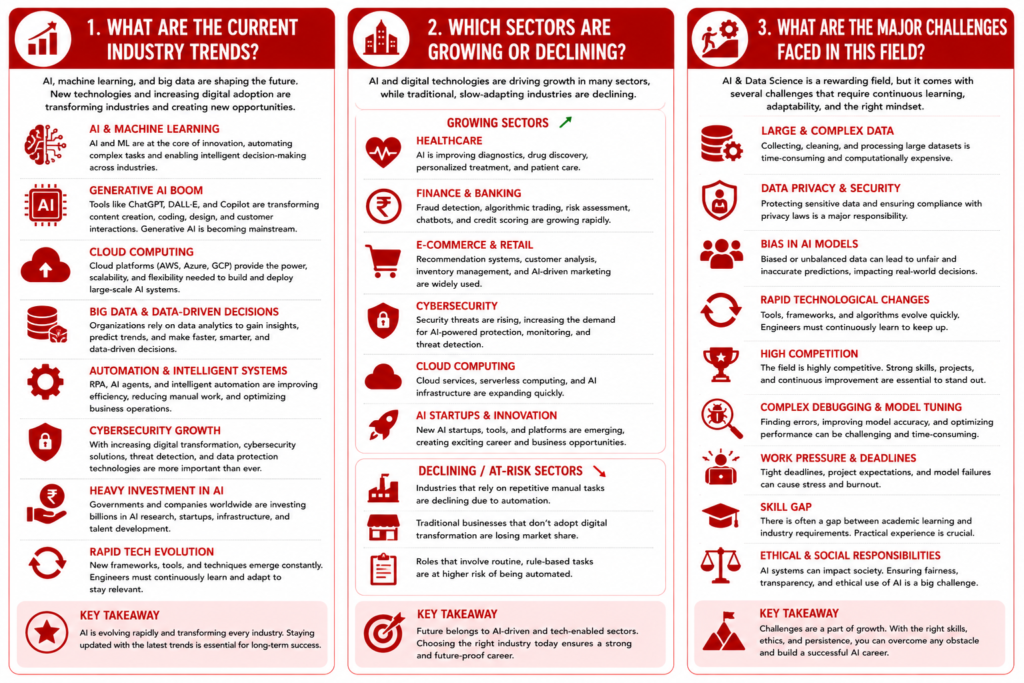
Artificial Intelligence (AI) & Data Science is one of the fastest-growing technology domains in the world. Rapid digital transformation, increasing data generation, and advances in computing power are changing how businesses operate. Organizations across industries are investing heavily in AI-driven solutions to improve productivity, reduce costs, automate repetitive tasks, and make smarter business decisions. As technology evolves, AI professionals must continuously learn new tools, frameworks, and techniques to remain competitive. Understanding current industry trends helps students prepare for future careers and identify the skills that employers value most.
One of the biggest trends today is the rapid growth of Generative AI. Technologies such as ChatGPT, Google Gemini, Claude, Microsoft Copilot, GitHub Copilot, and AI image generation tools have transformed how people create content, write code, design graphics, and interact with software. Businesses are increasingly using Generative AI for customer support, document generation, marketing, software development, and personalized services. As a result, professionals with expertise in Large Language Models (LLMs), prompt engineering, Retrieval-Augmented Generation (RAG), AI agents, and multimodal AI are in high demand.
➤Which sectors are growing or declining?
Artificial Intelligence (AI) & Data Science is transforming industries across the globe at an unprecedented pace. As organizations adopt digital technologies to improve efficiency, reduce costs, and deliver better customer experiences, some sectors are experiencing rapid growth, while others are declining or undergoing significant transformation. AI is no longer limited to technology companies—it is becoming a core part of healthcare, finance, education, manufacturing, agriculture, transportation, entertainment, and many other industries. Understanding which sectors are growing or declining helps students make informed career decisions and prepare for future opportunities.
One of the fastest-growing sectors is Healthcare. AI is improving disease diagnosis, medical imaging, personalized treatment, drug discovery, robotic surgery, and patient monitoring. Hospitals use AI to analyze medical data, detect diseases such as cancer at an early stage, and recommend effective treatment plans. Telemedicine, wearable health devices, and AI-powered healthcare assistants are also expanding rapidly. As healthcare becomes more digital, the demand for AI engineers, data scientists, and healthcare analytics professionals continues to increase.
➤What are the major challenges faced in this field?
Artificial Intelligence (AI) & Data Science is one of the most exciting and rapidly growing fields, but it also presents several technical, ethical, and professional challenges. AI professionals work with massive datasets, complex algorithms, and constantly evolving technologies to develop intelligent systems that solve real-world problems. While the career offers excellent opportunities, students and professionals must be prepared to overcome these challenges through continuous learning, practical experience, and strong problem-solving skills. Understanding these challenges helps aspiring AI engineers build realistic expectations and prepare for long-term success.
One of the biggest challenges in AI & Data Science is handling large and complex datasets. Modern organizations generate enormous amounts of structured and unstructured data every day from websites, mobile applications, sensors, social media, financial transactions, and IoT devices. Managing, cleaning, organizing, and processing such large datasets is often time-consuming and technically demanding. Poor-quality data containing missing values, duplicate records, inconsistencies, or incorrect information can significantly reduce the performance of machine learning models. Since AI systems rely heavily on data quality, data preprocessing often consumes a major portion of any AI project.
➤Are there government initiatives supporting this branch?
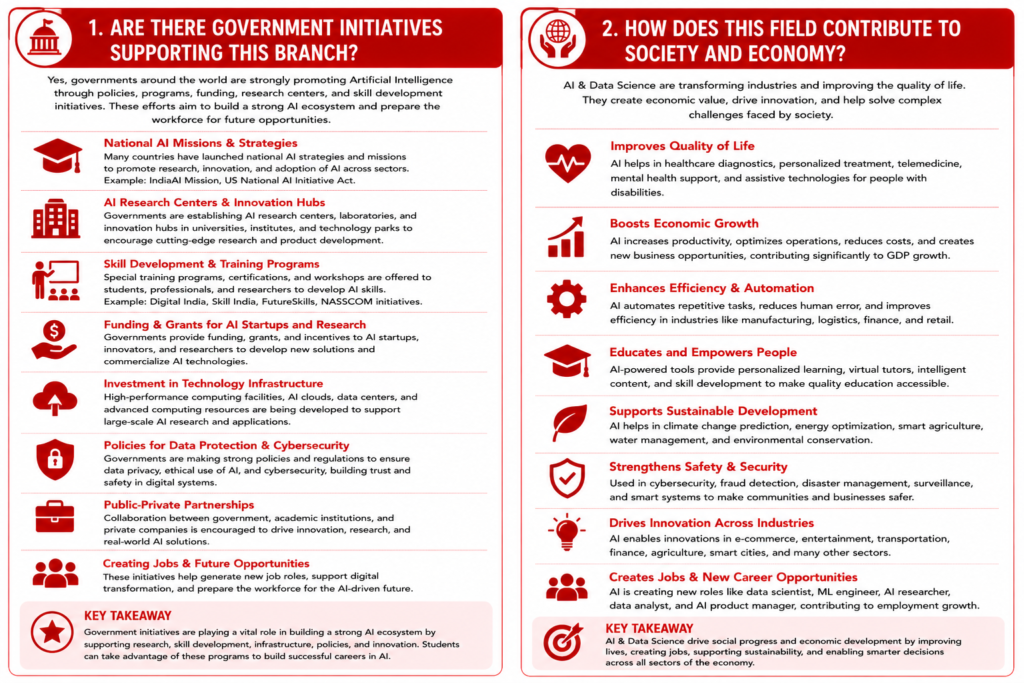
Yes, governments around the world are actively promoting Artificial Intelligence (AI) & Data Science because these technologies are considered key drivers of economic growth, innovation, digital transformation, and global competitiveness. AI is expected to revolutionize industries such as healthcare, education, agriculture, finance, manufacturing, transportation, and public administration. As a result, governments are investing heavily in AI research, digital infrastructure, skill development, startup ecosystems, and policy frameworks to prepare their countries for the future. These initiatives create excellent opportunities for students, researchers, entrepreneurs, and AI professionals.
In India, the Government has launched several initiatives to strengthen the AI ecosystem. One of the most significant is the IndiaAI Mission, which aims to accelerate AI innovation by supporting computing infrastructure, AI research, startups, datasets, and talent development. The mission focuses on making AI accessible, promoting responsible AI, and encouraging the development of AI solutions for sectors such as healthcare, agriculture, education, governance, and manufacturing.
➤How does this field contribute to society and economy?
Yes, governments around the world are actively promoting Artificial Intelligence (AI) & Data Science because these technologies are recognized as powerful drivers of economic growth, digital transformation, innovation, productivity, and global competitiveness. AI is no longer limited to research laboratories or technology companies; it is now becoming an essential part of sectors such as healthcare, agriculture, education, finance, manufacturing, transportation, defense, public administration, and smart cities. To remain competitive in the global economy, governments are investing billions of dollars in AI research, digital infrastructure, startup ecosystems, talent development, and policy frameworks. These initiatives create enormous opportunities for students, researchers, entrepreneurs, startups, and AI professionals.
In India, the Government has introduced several ambitious programs to strengthen the country’s AI ecosystem. One of the most important initiatives is the IndiaAI Mission, a national program designed to accelerate AI innovation and make India a global leader in Artificial Intelligence. The mission supports the development of advanced computing infrastructure, high-quality datasets, AI research, startup funding, talent development, and responsible AI practices. It also encourages the creation of AI solutions for important sectors such as healthcare, agriculture, education, manufacturing, governance, and financial services. Through this initiative, students, researchers, and startups gain access to valuable resources, research opportunities, and industry collaborations.
Conclusion
The AI industry is growing rapidly and influencing multiple sectors. Staying updated with trends is essential for career growth. Real-world challenges provide valuable practical learning. Government initiatives and digital transformation are accelerating development. AI plays a major role in economic and technological progress. It is a future-driven and impactful field.