
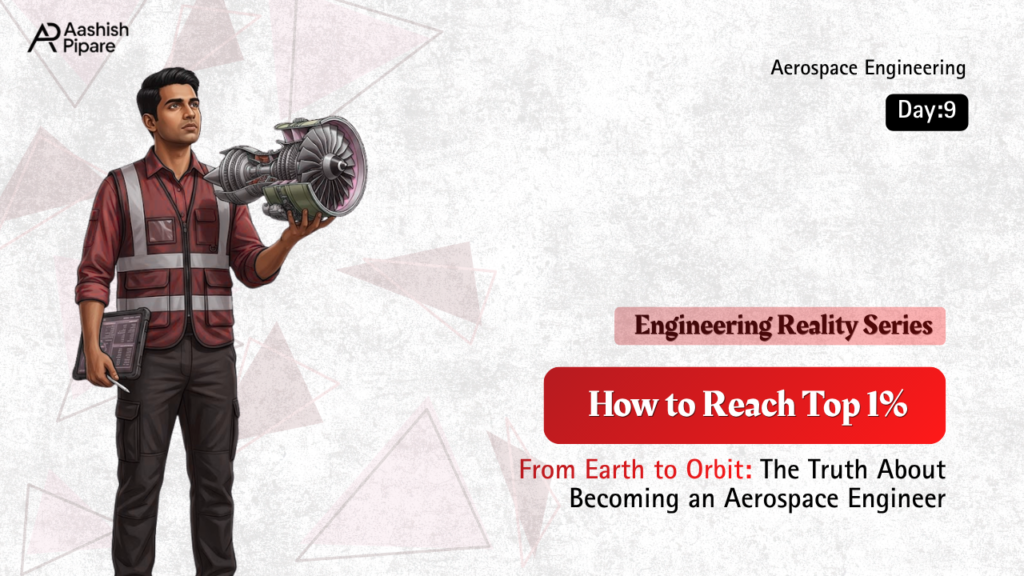
➤What are the specializations available?
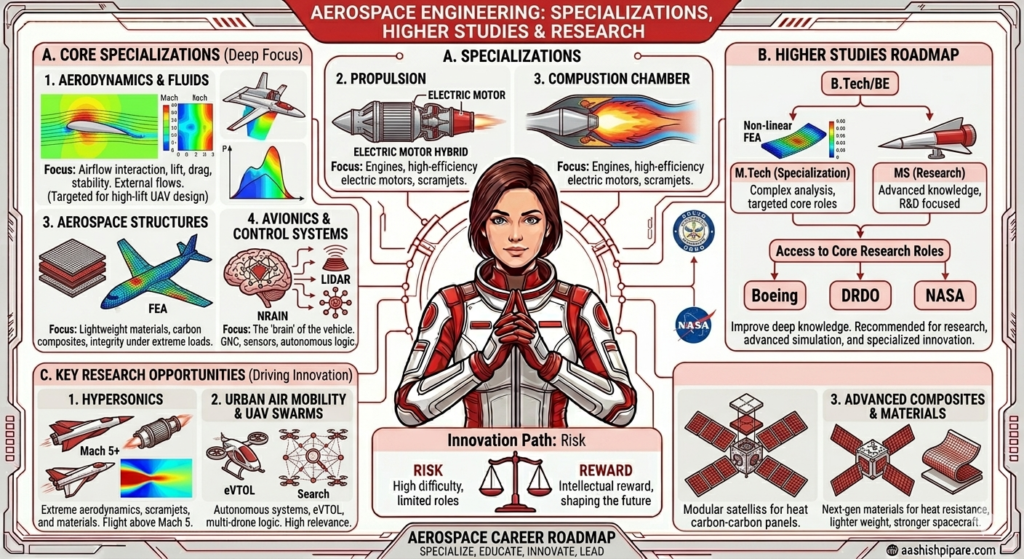
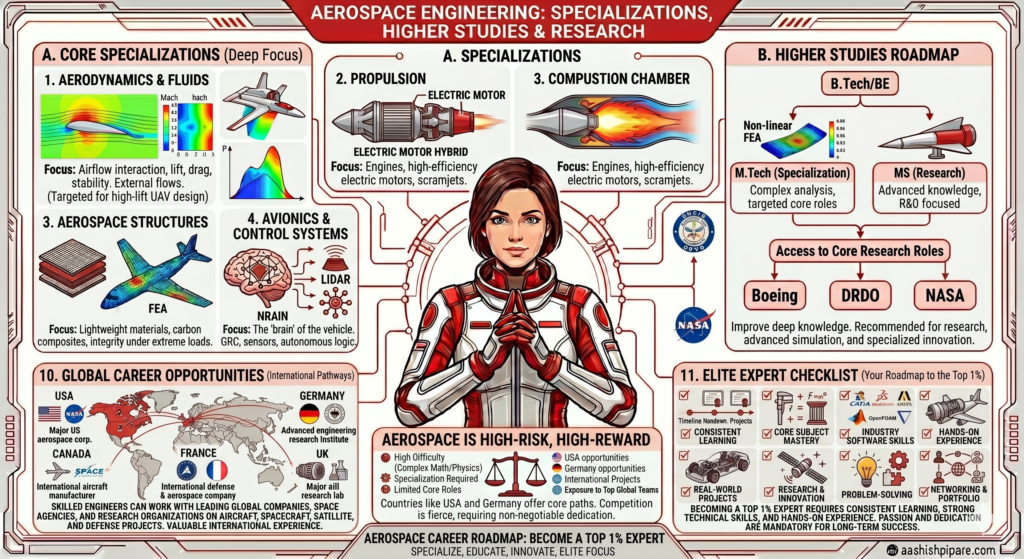
Aerospace Engineering offers a wide range of specializations, allowing students to focus on areas that match their interests and career goals. Aerodynamics deals with airflow and aircraft performance, while Propulsion focuses on jet and rocket engines. Aircraft Structures involves designing strong, lightweight airframes, and Flight Mechanics & Control Systems studies aircraft stability, navigation, and control. Avionics covers electronic systems such as communication, navigation, and radar. Students interested in space can specialize in Space Technology, which includes satellites, rockets, and spacecraft. Emerging fields like UAV (Drone) Technology and autonomous aerial systems also provide exciting career opportunities in modern aerospace industries.
➤Should I pursue higher studies?
Higher studies like M.Tech or MS are recommended. They improve knowledge. For example, research roles require advanced degrees.
Pursuing higher studies in Aerospace Engineering can significantly improve your career prospects, especially if you aim for research, development, or specialized technical roles. A master’s degree or Ph.D. allows you to gain expertise in areas such as aerodynamics, propulsion, space technology, avionics, or computational fluid dynamics (CFD). Higher education also opens opportunities in organizations like ISRO, DRDO, NASA, ESA, top aerospace companies, and universities. If your goal is to work on advanced technologies, lead innovative projects, or pursue an academic career, higher studies are a valuable investment. However, if you gain strong practical skills and relevant industry experience, you can also build a successful career directly after your bachelor’s degree.
➤What are the research opportunities?
Research includes space tech, hypersonics, and materials. Innovation drives progress. For example, reusable rockets are research areas.
Aerospace Engineering offers research opportunities in aerodynamics, propulsion, space technology, satellite systems, UAVs (drones), advanced materials, artificial intelligence, and sustainable aviation. Students can participate in research projects through universities, organizations like ISRO and DRDO, or industry collaborations to develop innovative aerospace technologie
➤What global opportunities exist?
Aerospace Engineering offers global career opportunities in countries such as the USA, Germany, Canada, France, and the UK. Skilled engineers can work with leading aerospace companies, space agencies, and research organizations on aircraft, spacecraft, satellite, and defense projects, gaining valuable international experience.
➤How can I become a top 1% expert?
Becoming a top 1% Aerospace Engineer requires consistent learning, strong technical skills, and hands-on experience. Build a solid foundation in core subjects such as aerodynamics, propulsion, flight mechanics, structures, and control systems. Learn industry-standard software like CATIA, SolidWorks, ANSYS, MATLAB, and OpenFOAM to strengthen your design and simulation skills. Work on real-world projects, participate in competitions, contribute to research, and complete internships with aerospace companies or research organizations. Stay updated with emerging technologies such as UAVs, AI in aerospace, reusable rockets, sustainable aviation, and satellite systems. Develop problem-solving, communication, and teamwork skills, build a strong portfolio, and continuously improve through certifications, higher studies, and networking with industry professionals. Consistent practice and curiosity are the keys to becoming an expert in the field.
Conclusion
Long-term success requires specialization, higher education, and continuous learning to reach top-level expertise.