
Introduction
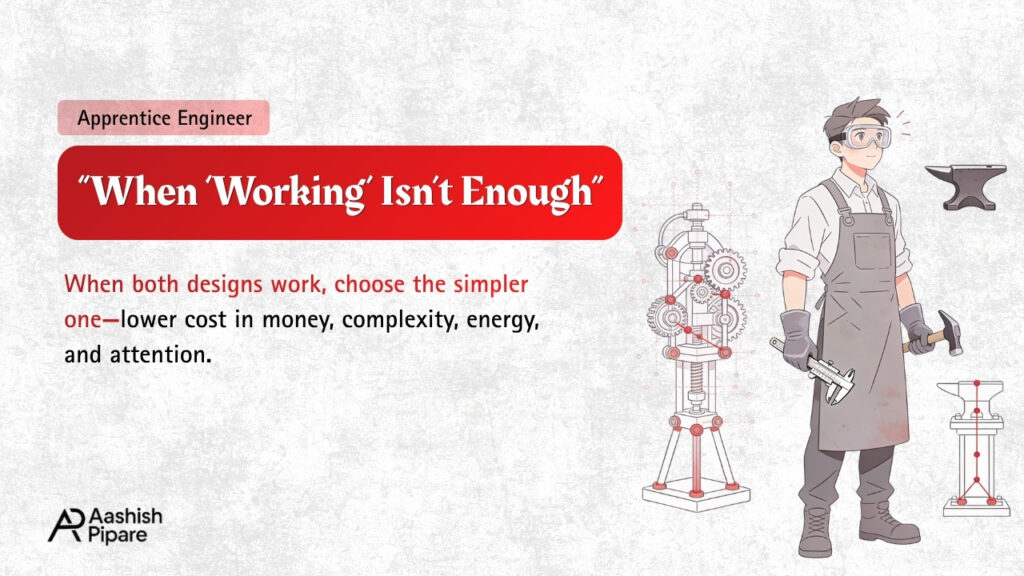
In real engineering work, multiple designs often meet the required specifications. When that happens, the challenge is no longer making something that works — it is deciding which working design is better. That decision requires evaluating the deeper costs and long-term consequences of each design.
Engineering Is the Art of Trade-Offs
Once two designs satisfy the required performance and safety criteria, engineering shifts from pure problem-solving to decision-making. At this point, the goal is no longer to prove that a design functions, but to determine which design will serve the system and its users most effectively over time.
Every engineering solution involves trade-offs. Improving one aspect of a design often makes another aspect worse. For example, increasing strength may increase weight, improving performance may increase cost, and reducing energy consumption may require more complex components.
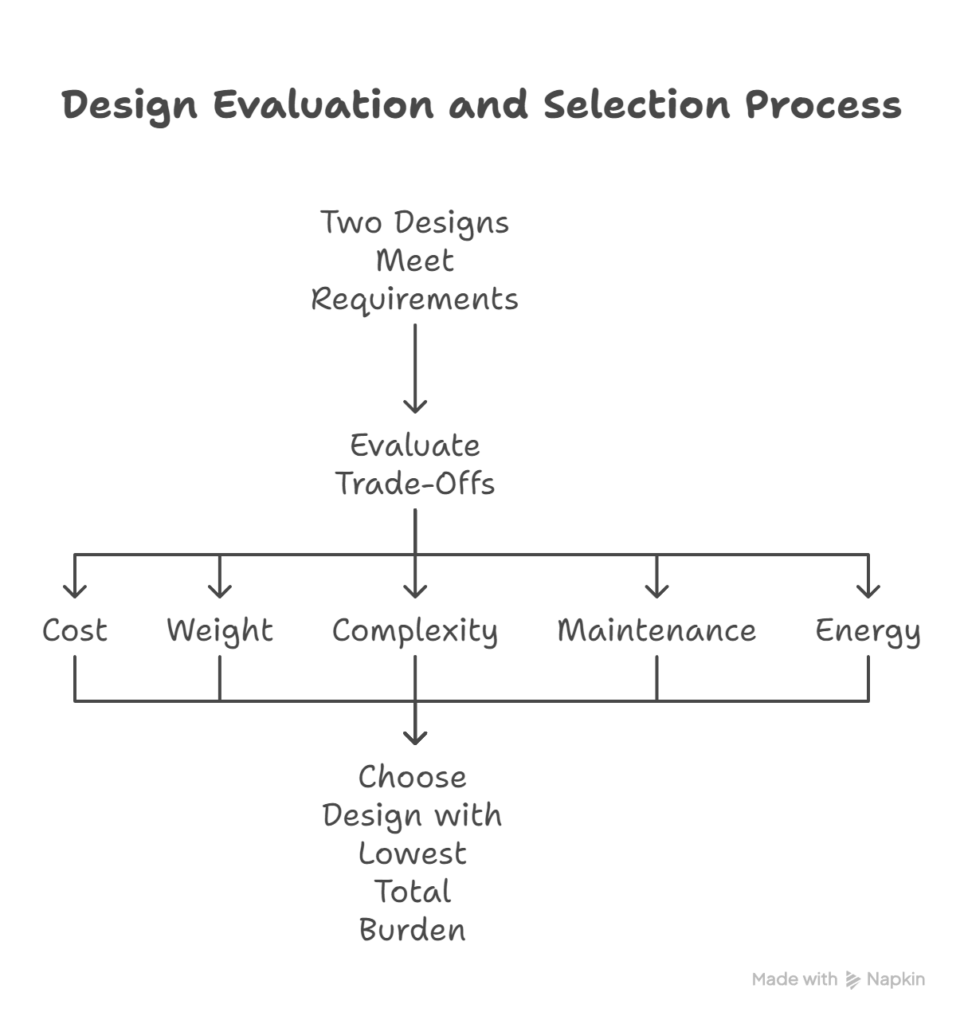
Because of these trade-offs, engineers must evaluate designs not only based on technical capability but also based on how efficiently they achieve their purpose. The best design is the one that accomplishes the required task while introducing the least unnecessary burden on the system.
This evaluation requires thinking beyond immediate performance and considering how the design behaves across its entire lifecycle.
Cost Means More Than Money
When comparing two working designs, financial cost is usually the most obvious factor. However, experienced engineers understand that the true cost of a system includes many other elements that influence its long-term success.
These include:
- Weight: Heavier systems may require stronger supports, consume more energy, or reduce efficiency in transportation systems.
- Energy consumption: Systems that require more energy often become more expensive to operate over time.
- Maintenance demands: Equipment that requires frequent servicing increases operational downtime and labor costs.
- Operational complexity: Systems that are difficult to understand or operate can increase training requirements and increase the risk of mistakes.
For example, a machine that is slightly cheaper to manufacture might require frequent maintenance. Over time, the accumulated maintenance cost could far exceed the initial savings.
Because of this, engineers often evaluate total lifecycle cost, not just the price of building the system.
Complexity Is Often the Hidden Risk
Complexity is one of the most underestimated sources of engineering problems. A design may appear sophisticated or innovative, but each additional component introduces new interactions and new potential points of failure.
Complex systems often suffer from issues such as:
- increased difficulty during assembly
- more potential failure points
- complicated troubleshooting procedures
- longer repair times
When systems become too complex, even small faults can create cascading problems that are difficult to diagnose.
In contrast, simpler systems tend to be easier to understand and maintain. With fewer components and interactions, engineers and technicians can more easily identify issues and restore the system to operation.
For this reason, experienced engineers often prioritize clarity and simplicity in system architecture.
Simplicity Creates Reliability
Simplicity in engineering does not mean removing necessary features. Instead, it means designing systems in a way that avoids unnecessary complication.
A simple design often has several advantages:
- fewer components that can fail
- clearer system behavior
- easier inspection and maintenance
- reduced manufacturing difficulty
Because of these qualities, simple systems are often more reliable in long-term operation.
In fields such as aerospace, mechanical design, and electronics, engineers frequently discover that the most elegant solution is not the most complicated one but the one that accomplishes the goal with the least number of moving parts.
Simplicity is therefore not a sign of limited thinking. It is often the result of deep understanding and careful refinement of a design.
The Human Cost of a Design
Engineering systems are not isolated machines; they exist within environments where people must interact with them.
Operators must run equipment, technicians must maintain it, and engineers must troubleshoot it when something goes wrong. A complicated design often increases the burden placed on these people.
For example, systems that require constant monitoring or complex procedures can create operational fatigue. Systems that rely on specialized knowledge may require extensive training or expert personnel to maintain.
Human attention is a valuable resource. Designs that demand constant oversight or complex intervention can become difficult to manage over time.
Good engineering therefore aims to create systems that are intuitive, understandable, and manageable for the people who use them.
Reliability Over Time
Another critical factor in comparing designs is how they behave after years of operation.
Many systems perform well when they are new, but long-term performance often reveals weaknesses that were not immediately visible. Designs with fewer components and simpler interactions generally age more gracefully.
Over time, factors such as wear, environmental exposure, and repeated use can degrade system performance. Designs that are simpler tend to be easier to inspect, repair, and maintain throughout their lifespan.
When engineers choose between two working solutions, they often ask which design will remain reliable after years or decades of service.
A slightly more efficient design may not be worth the risk if it introduces complexity that could reduce long-term reliability.
Visual Representation
Practical Questions Engineers Ask
| Question | Why It Matters |
| Which design has fewer components? | Fewer parts usually means fewer failures |
| Which design is easier to manufacture? | Reduces production time and errors |
| Which design is easier to maintain? | Improves long-term reliability |
| Which design consumes less energy? | Reduces operational costs |
| Which design is easier for people to understand? | Simplifies operation and training |
Key Takeaways
- When multiple designs work, the decision depends on trade-offs.
- Cost includes more than money — it includes weight, complexity, energy, and maintenance.
- Simpler systems are often more reliable and easier to operate.
- Good engineers think about the entire lifecycle of a system before making design choices.
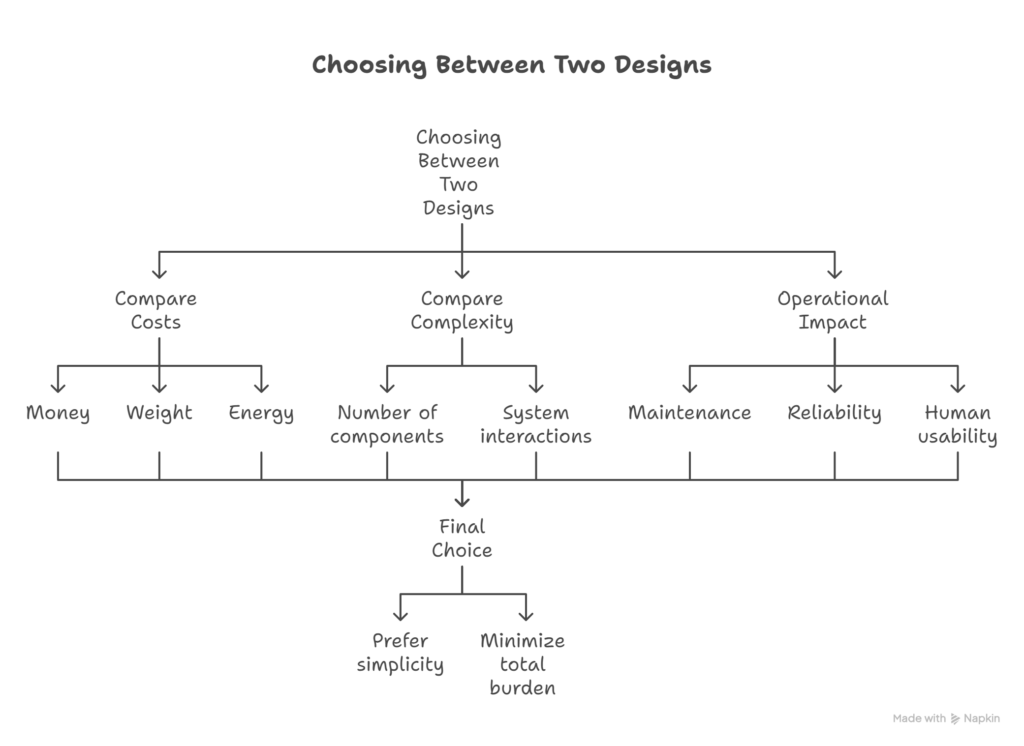
Mind Map
Conclusion
When two designs both work, engineering judgment becomes the deciding factor. The best design is not necessarily the most advanced or the most sophisticated. Instead, it is the design that achieves the required performance while minimizing unnecessary complexity, cost, and operational burden.
Simplicity is often the hallmark of excellent engineering. A simple, well-thought-out design tends to be easier to build, easier to maintain, and more reliable over time.
For this reason, many of the most successful engineering solutions are not the ones that impress with complexity but the ones that quietly solve the problem with elegance and efficiency.