
Introduction
Most engineering work improves what already exists.
Breakthroughs happen when the problem itself is redefined.
The Difference Between Improvement and Transformation
Improvement is linear. It refines existing solutions, making them faster, cheaper, or more efficient. It operates within known boundaries.
Breakthroughs are different. They are discontinuous. They do not optimize the current system—they change its structure.
An improved system answers the same question better.
A breakthrough asks a different question altogether.
This distinction matters because traditional engineering processes are designed for iteration, not transformation. They reward predictability, control, and incremental progress.
A Master Engineer understands that breakthroughs require a different kind of environment—one that allows the problem space itself to expand.
Recombination: Where New Ideas Come From
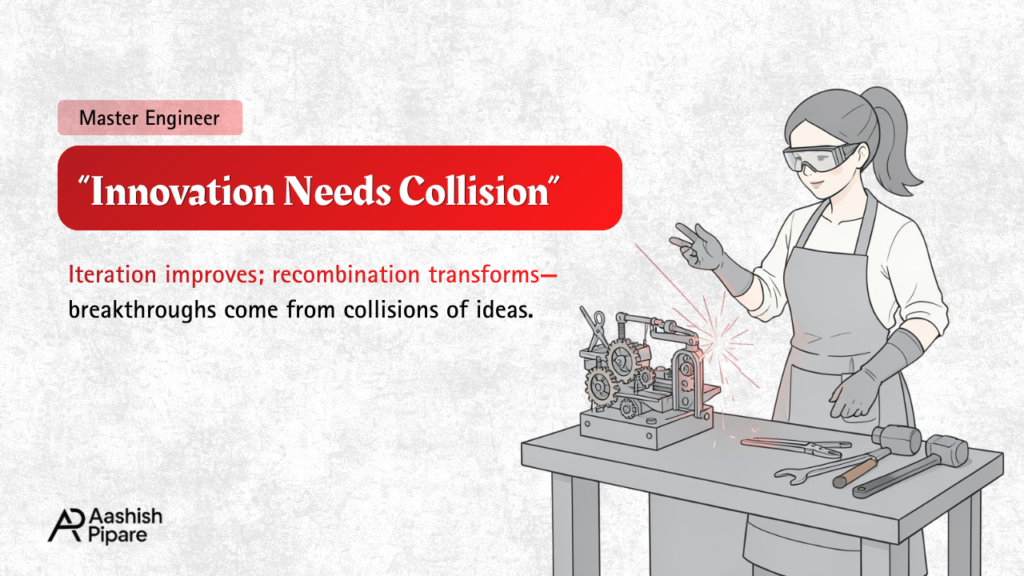
Breakthroughs rarely emerge from isolated thinking. They arise from recombination—the collision of ideas from different domains.
When concepts from unrelated fields interact:
- assumptions are challenged
- new analogies emerge
- unexpected solutions become visible
For example:
- biological systems inspiring engineering design
- network theory influencing logistics systems
- material science reshaping mechanical structures
These are not incremental improvements. They are conceptual shifts.
The key insight is that innovation often happens at the boundaries between disciplines, not within them.
Creating Environments for Collision
If breakthroughs depend on recombination, then the role of engineering leadership is to create conditions where ideas can collide.
This includes:
- bringing together people with different expertise
- encouraging cross-domain exploration
- reducing barriers between disciplines
However, simply placing diverse ideas in proximity is not enough. The environment must also allow:
- open questioning
- exploration without immediate evaluation
- space for incomplete or unconventional thinking
A Master Engineer designs environments where unexpected connections are not only possible, but likely.
The Role of Safe and Fast Failure
Breakthrough thinking involves uncertainty. Many ideas will not work. Some will appear impractical at first.
If failure is punished or slowed down:
- risk-taking decreases
- ideas become conservative
- exploration is limited
On the other hand, when failure is:
- safe (low consequence)
- fast (quick feedback)
Engineers are more willing to explore unconventional paths.
This does not mean ignoring rigor. It means separating exploration from validation:
- early stages prioritize learning
- later stages apply discipline and refinement
A Master Engineer understands that controlled failure is a tool for discovery.
Asking the Unaskable Question
One of the most powerful drivers of breakthroughs is the ability to question assumptions that are usually taken for granted.
These questions often sound unreasonable:
- What if we remove this constraint entirely?
- Why do we assume this step is necessary?
- What if the problem itself is defined incorrectly?
Such questions are often avoided because they challenge established knowledge or disrupt existing systems.
However, they are essential for transformation.
A Master Engineer creates an environment where no assumption is beyond examination.
Engineering Thinking: Expanding the Possibility Space
Traditional engineering narrows down solutions. It moves from many possibilities to one optimized answer.
Breakthrough-oriented thinking does the opposite in early stages:
- it expands the space of possibilities
- it explores multiple directions simultaneously
- it delays convergence to allow new ideas to emerge
This requires tolerance for ambiguity. Not all paths will be clear. Some ideas will seem impractical until further explored.
The goal is not immediate correctness—it is discovering new directions.
Real-World Implications
Organizations focused only on efficiency tend to produce continuous improvement—but rarely breakthroughs.
This happens because:
- systems are optimized for predictability
- risk is minimized
- experimentation is limited
In contrast, environments that enable breakthroughs:
- accept temporary inefficiency for long-term gain
- invest in exploration without guaranteed outcomes
- value learning as much as results
These environments are not accidental—they are intentionally designed.
Master Engineers recognize that innovation is not just about ideas—it is about the conditions that allow ideas to emerge.
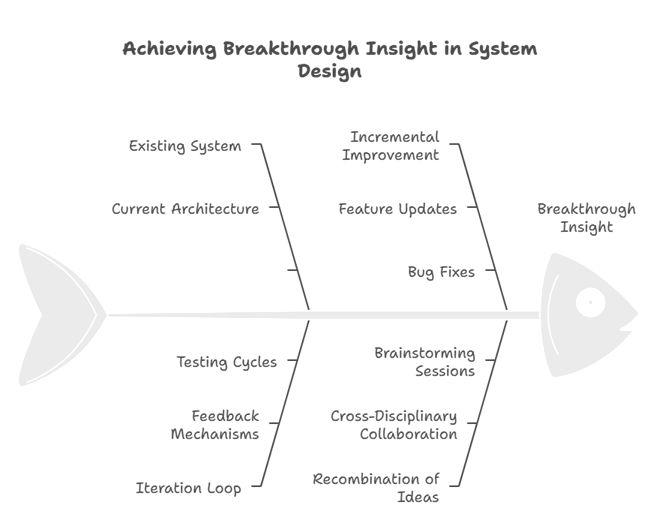
Visual Representation
Practical Table
| Factor / Question | Why It Matters | Example |
| Are different domains interacting? | Cross-domain ideas enable recombination | Engineers collaborating with biologists or designers |
| Is failure safe and fast? | Encourages exploration without fear | Rapid prototyping environments |
| Are assumptions being challenged? | Breakthroughs require questioning fundamentals | Rethinking system constraints |
| Is there space for exploration? | Early-stage thinking needs freedom | Dedicated research and experimentation time |
| Are ideas evaluated too early? | Premature judgment limits innovation | Rejecting unconventional ideas before testing |
Key Takeaways
- Improvements refine systems; breakthroughs redefine them
- Recombination across domains is a key source of innovation
- Environments must encourage idea collision and exploration
- Safe and fast failure enables unconventional thinking
- Questioning assumptions is essential for transformation
- Breakthroughs emerge from expanding, not narrowing, possibilities
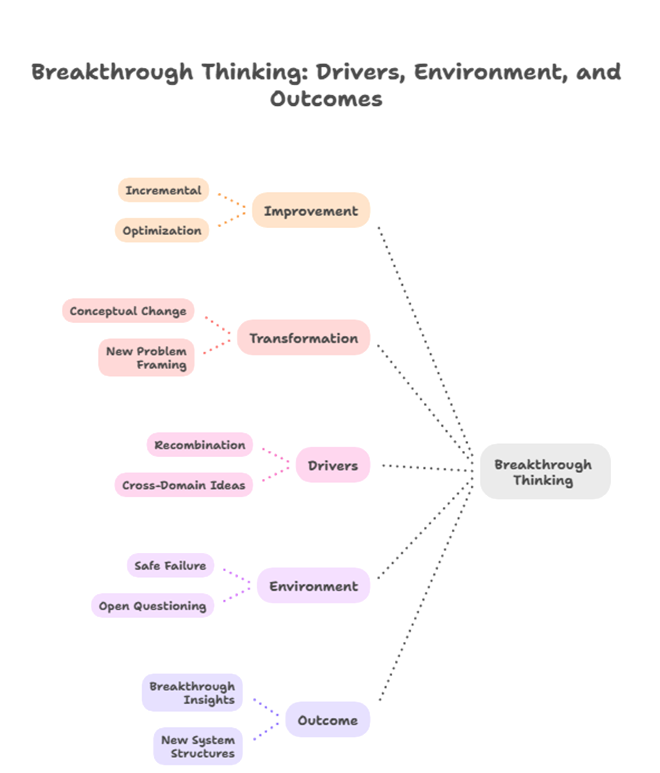
Mind Map
Conclusion
Engineering progress is often measured in increments. But true transformation comes from moments where the system itself is reimagined.
These moments cannot be forced—but they can be enabled.
By creating environments where ideas from different domains interact, where failure is part of learning, and where fundamental questions are allowed, engineers move beyond improvement into discovery.
A Master Engineer does not wait for breakthroughs to happen.
They design the conditions in which breakthroughs become possible.
Because in the end, innovation is not just about better answers—
it is about finding entirely new questions to ask.