
Introduction
Calculations can look correct on paper and still be completely wrong.
The real skill is not just calculating—but knowing when not to trust the result.
Calculation Is Not the First Step
For a budding engineer, it may feel natural to jump directly into formulas. But experienced engineers do something different—they estimate first.
Before calculating, they ask:
- What kind of answer should I expect?
- What order of magnitude makes sense?
This initial estimate creates a mental reference point. Without it, any number—even an incorrect one—can appear acceptable.
Estimation is not about precision. It is about building intuition before accuracy.
When Numbers Look Right but Are Wrong
A calculation can be mathematically correct and still be physically wrong.
This happens when:
- wrong assumptions are used
- incorrect inputs are applied
- units are inconsistent
- formulas are misapplied
The result may look clean and precise—but it may not reflect reality.
For example, a calculated speed might be 10,000 m/s for a system where such values are impossible. The math may be correct, but the thinking behind it is not.
As a budding engineer, you must learn to question results, not just produce them.
The Role of Estimation
Estimation acts as a filter for detecting errors.
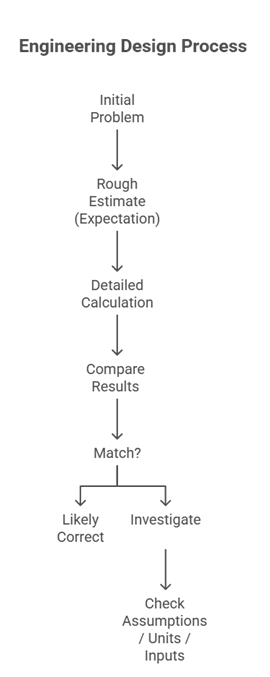
If your calculated answer is far from your estimate, something needs attention:
- either the calculation is wrong
- or your intuition is incomplete
Both situations are valuable.
If the calculation is wrong, you correct it.
If your estimate is wrong, you refine your understanding.
This interaction between estimation and calculation builds engineering judgment over time.
When Your “Gut” Disagrees
That moment when something “feels off” is important.
Your intuition is built from experience, patterns, and basic physical understanding. When a result violates that intuition, it is a signal—not something to ignore.
However, intuition is not always correct.
So the right approach is not blind trust, but investigation:
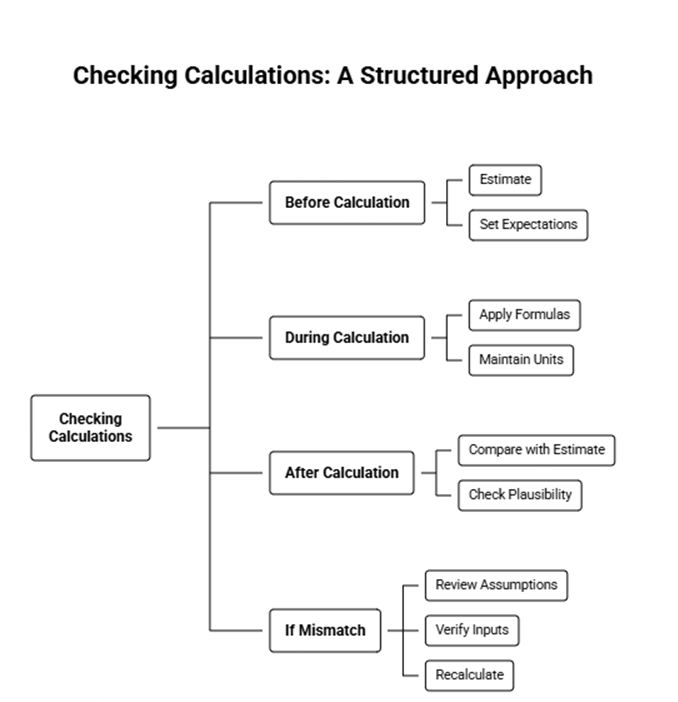
- Recheck assumptions
- Verify units
- Review boundary conditions
- Compare with similar systems
For a budding engineer, this habit is critical. It prevents silent errors from becoming real-world failures.
Common Signs a Calculation Is Wrong
Even without deep analysis, there are warning signs that a result may be incorrect.
These include:
- values that are too large or too small
- results that violate physical limits
- inconsistency with known behavior
- mismatch of units
These signals are not proofs of error—but they are strong indicators that something needs to be reviewed.
Balancing Estimation and Calculation
Engineering judgment comes from balancing two extremes.
If you rely only on calculations:
- you may trust incorrect results blindly
If you rely only on estimation:
- you may oversimplify and miss important details
The goal is to use both:
- estimation to guide expectations
- calculation to refine accuracy
For a budding engineer, this balance is where true confidence develops.
Visual Representation
Practical Table
| Check / Question | Why It Matters | Example |
| What do I expect roughly? | Creates a reference point for comparison | Estimating order of magnitude before solving |
| Are units consistent? | Prevents hidden calculation errors | Ensuring all values are in SI units |
| Does the result make sense? | Validates against physical reality | Speed not exceeding realistic limits |
| What assumptions were used? | Identifies hidden sources of error | Assuming constant load incorrectly |
| Can I verify another way? | Confirms reliability of result | Using an alternative formula or method |
Key Takeaways
- Estimation should come before calculation
- A precise answer can still be wrong
- Large deviations from expectation signal a problem
- Intuition is useful, but must be verified
- Units and assumptions are common sources of error
- Engineering judgment comes from balancing estimation and calculation
Mind Map
Conclusion
A correct calculation is not just about arriving at a number—it is about trusting that number for the right reasons.
For a budding engineer, the real skill lies in questioning results, not just producing them. Estimation provides intuition, calculation provides precision, and the dialogue between them builds confidence.
Blind calculation is dangerous. Blind intuition is equally risky.
But together, they create a system of thinking that catches errors before they become consequences.
Because in engineering, it is not enough to get an answer— you must know when that answer deserves to be believed.