
Introduction
Not all knowledge can be documented.
The most critical understanding in engineering often lives in experience, not text.
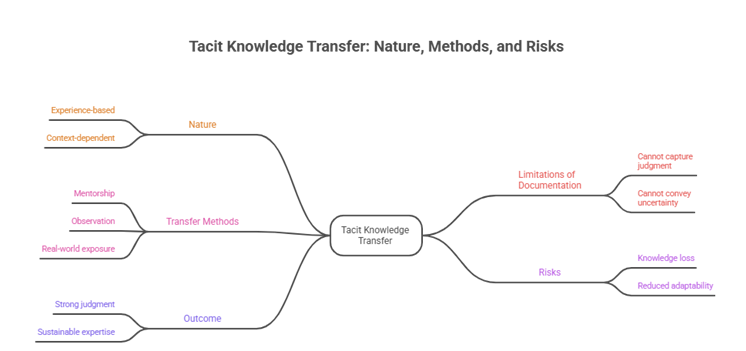
The Nature of Tacit Knowledge
In engineering, there is always a layer of understanding that goes beyond formulas, manuals, and procedures. This is tacit knowledge—the kind that is built through years of observation, failure, intuition, and judgment.
It includes:
- knowing when something “feels wrong” before data confirms it
- recognizing patterns that are not formally defined
- making decisions under uncertainty with incomplete information
This knowledge cannot be fully captured in documents because it is context-dependent. It is shaped by situations, constraints, and subtle signals that are difficult to formalize.
A Master Engineer understands that what matters most is often what cannot be explicitly explained.
Why Documentation Is Not Enough
Engineering culture often emphasizes documentation as the primary method of knowledge transfer. While necessary, documentation has limits.
Documents can describe:
- what to do
- how to do it
- expected outcomes
But they cannot fully convey:
- why certain decisions were made under pressure
- how to interpret ambiguous signals
- when to deviate from established procedures
This gap becomes critical in complex systems where conditions are unpredictable.
Relying only on written knowledge creates engineers who can follow processes—but struggle when reality deviates from expectations.
Learning Through Experience and Exposure
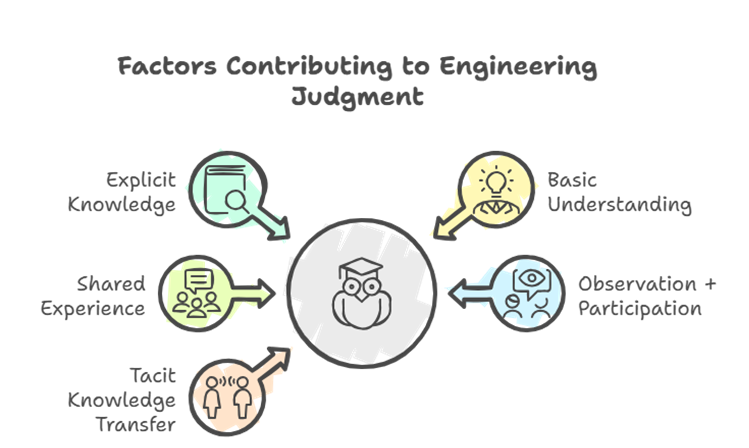
Tacit knowledge is transferred through shared experience, not just instruction.
This happens when less experienced engineers:
- observe decision-making in real situations
- participate in problem-solving under uncertainty
- witness both success and failure
The key is exposure to how thinking unfolds, not just what conclusions are reached.
For example:
- seeing how an experienced engineer diagnoses a problem step-by-step
- understanding how trade-offs are evaluated in real time
- observing how uncertainty is managed, not eliminated
This kind of learning cannot be compressed into documentation—it requires time, interaction, and context.
The Role of Mentorship
Mentorship is the primary mechanism for transferring tacit knowledge.
A mentor does more than provide answers. They:
- explain reasoning, not just outcomes
- share experiences, including mistakes
- guide thinking rather than dictate actions
Importantly, mentorship involves allowing space for failure. Tacit knowledge develops when individuals confront real challenges and reflect on them.
A Master Engineer recognizes that teaching is not about efficiency.
It is about developing judgment in others.
Hidden Risks of Losing Tacit Knowledge
When tacit knowledge is not transferred, systems become fragile.
Organizations may have:
- well-documented processes
- advanced tools and systems
Yet still struggle when unexpected situations arise.
This happens because:
- decision-making becomes rigid
- engineers rely too heavily on predefined rules
- adaptability is reduced
The loss of tacit knowledge creates a gap between knowing procedures and understanding reality.
This gap often becomes visible only during crises.
Engineering Thinking: Teaching Judgment, Not Just Knowledge
Transferring tacit knowledge requires a shift in focus:
from teaching answers → to teaching thinking.
This involves:
- explaining why decisions are made, not just what decisions are made
- encouraging questioning and exploration
- exposing learners to uncertainty instead of shielding them from it
It also requires patience. Tacit knowledge develops slowly, through repeated exposure and reflection.
A Master Engineer does not aim to create copies of themselves.
They aim to create engineers capable of independent, sound judgment.
Real-World Implications
In real engineering environments, the most experienced individuals often carry critical system understanding that is not documented.
When they leave without transferring this knowledge:
- systems become harder to maintain
- problem-solving slows down
- risks increase
This is especially critical in:
- complex infrastructure systems
- long-lived industrial processes
- highly specialized technical domains
Sustainable engineering is not just about building systems—it is about ensuring knowledge continuity across generations.
Visual Representation
Practical Table
| Factor / Question | Why It Matters | Example |
| Are learners exposed to real problems? | Experience is essential for tacit knowledge | Involving juniors in live troubleshooting |
| Is reasoning explained clearly? | Understanding thought process builds judgment | Explaining why a design choice was made |
| Are failures discussed openly? | Failures provide deep learning opportunities | Reviewing past system breakdowns |
| Is mentorship present? | Direct interaction enables knowledge transfer | Senior engineers guiding juniors |
| Is independent thinking encouraged? | Builds long-term capability | Allowing engineers to make decisions and learn |
Key Takeaways
- Tacit knowledge cannot be fully captured in documents
- Experience and observation are essential for its transfer
- Mentorship is the primary method of transmitting deep understanding
- Loss of tacit knowledge increases system risk and fragility
- Teaching should focus on judgment, not just procedures
- Knowledge continuity is critical for long-term engineering success
Mind Map
Conclusion
Engineering knowledge exists on two levels: what can be written, and what must be lived.
The written layer provides structure. But the deeper layer—judgment, intuition, and experience—is what allows engineers to navigate complexity and uncertainty.
This knowledge cannot be stored in systems. It must be passed from person to person, through time, effort, and shared experience.
A Master Engineer understands that their responsibility is not only to build systems, but to build the next generation of engineers who can understand and sustain them.
Because in the end, the most valuable knowledge in engineering is not what is documented— but what is carried forward.