
Introduction
Individual components can be understood.
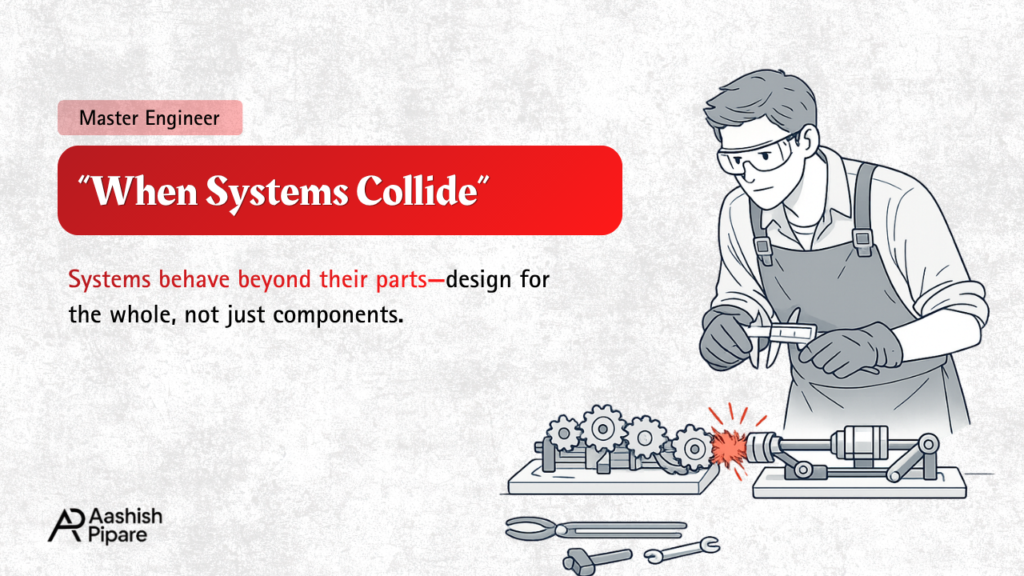
But when systems interact, behavior becomes something entirely different.
The Nature of Systems of Systems
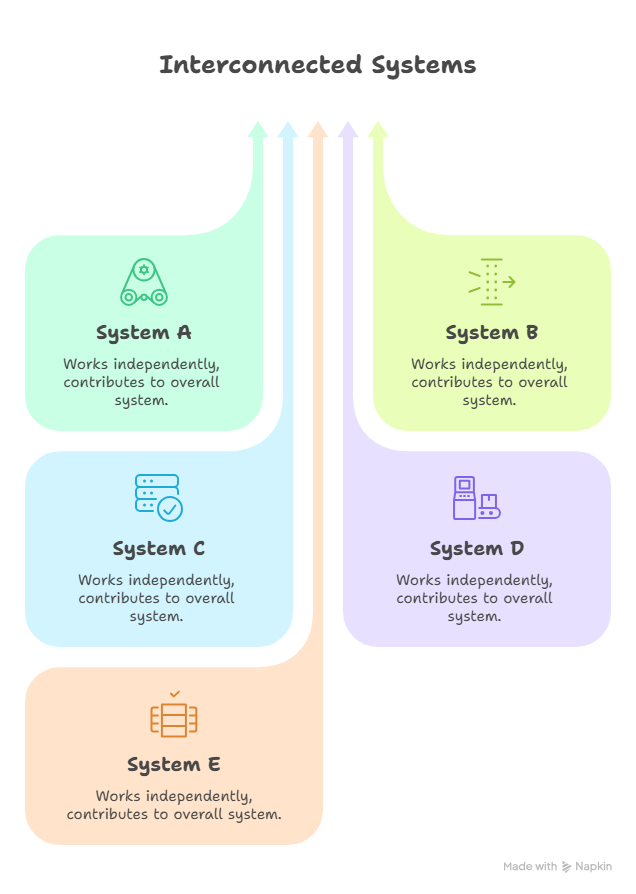
A system of systems is not just a larger system—it is a network of independent systems interacting with each other. Each subsystem may function correctly on its own, yet the combined behavior can be unexpected.
These systems are often:
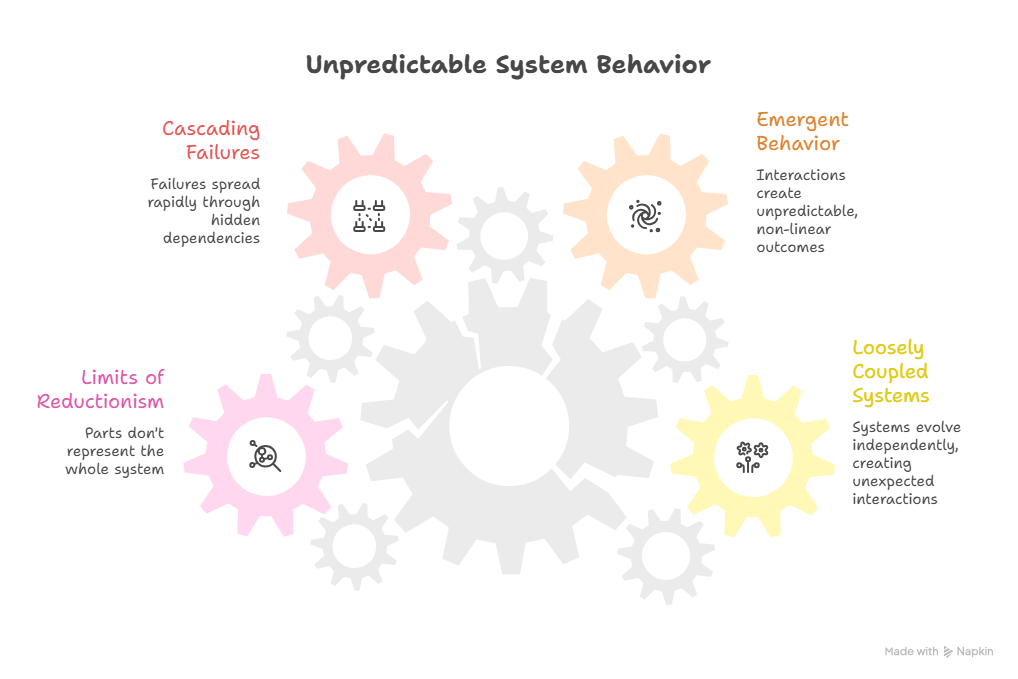
- loosely coupled
- independently evolving
- operating under different constraints
When such systems connect, they form a dynamic environment where outcomes are shaped not just by design, but by interaction.
A Master Engineer understands that the whole is not simply the sum of its parts—it is something fundamentally new.
Emergent Behavior: The Invisible Layer
Emergent behavior is the defining characteristic of systems of systems. It refers to patterns, behaviors, or outcomes that arise only when multiple systems interact.
These behaviors cannot be predicted by analyzing components in isolation.
For example:
- Traffic congestion emerges even when individual vehicles follow simple rules
- Network delays occur even when each node operates correctly
- Market instability arises from individually rational decisions
In engineering systems, this means that:
- Local correctness does not guarantee global stability
- Optimizing subsystems does not ensure optimal system behavior
The system begins to behave like a living entity—adaptive, unpredictable, and sometimes unstable.
Why Systems of Systems Fail
Failures in such systems are rarely caused by a single component breakdown. Instead, they emerge from interactions, dependencies, and feedback loops.
Common failure patterns include:
1. Cascading Failures
A small issue in one subsystem propagates through dependencies, causing widespread disruption.
2. Feedback Amplification
Positive feedback loops amplify small deviations into major instability.
3. Hidden Coupling
Systems assumed to be independent turn out to be tightly linked in subtle ways.
4. Synchronization Effects
Multiple systems reacting simultaneously can create spikes or overload conditions.
These failures are difficult to predict because they do not originate from obvious faults—they emerge from normal system behavior under certain conditions.
The Limits of Reductionist Thinking
Traditional engineering often relies on breaking problems into smaller parts and solving them independently. While effective for simple systems, this approach fails at scale.
In systems of systems:
- interactions matter more than components
- timing matters more than structure
- context matters more than individual performance
A perfectly designed subsystem can contribute to failure when placed in the wrong environment.
Master Engineers move beyond reductionist thinking and adopt a holistic perspective, focusing on relationships, flows, and system-wide dynamics.
Designing for System-Level Behavior
Since emergent behavior cannot be fully predicted, the goal of engineering shifts from control to guided stability.
This involves:
- designing for resilience rather than perfection
- introducing buffers and redundancies
- monitoring system-level signals, not just component metrics
- enabling graceful degradation instead of abrupt failure
Instead of asking, “Will each part work correctly?”, the question becomes:
“How will the entire system behave under stress, variation, and failure?”
This shift is what distinguishes advanced engineering judgment.
Real-World Implications
Modern infrastructure—power grids, transportation networks, digital platforms—are all systems of systems.
In such environments:
- failures are rarely isolated
- recovery is often complex and nonlinear
- small disturbances can have disproportionate effects
For example, a minor delay in one part of a supply chain can disrupt production across regions. Similarly, a small software glitch in a distributed system can cascade into large-scale outages.
Master Engineers anticipate these behaviors. They design not just for normal operation, but for unexpected interaction patterns.
Visual Representation
Practical Table
| Factor / Question | Why It Matters | Example |
| How do systems interact? | Interactions define emergent behavior | Software modules sharing resources unexpectedly |
| Where are hidden dependencies? | Unseen links can trigger cascading failures | Power systems linked across regions |
| What feedback loops exist? | Feedback can amplify or stabilize behavior | Automated control systems reacting to real-time data |
| What happens under stress? | Stress conditions reveal system-level weaknesses | Traffic systems during peak hours |
| Can the system degrade gracefully? | Smooth failure prevents total collapse | Cloud systems redistributing load during outages |
Key Takeaways
- Systems of systems behave differently than individual components
- Emergent behavior cannot be predicted from parts alone
- Failures often arise from interactions, not isolated faults
- Reductionist thinking is insufficient at large scale
- Designing for resilience is more important than optimizing components
- Master Engineers focus on system-wide dynamics and behavior
Mind Map
Conclusion
As systems grow in scale and complexity, the nature of engineering changes. It is no longer enough to understand individual components. The real challenge lies in understanding how systems interact, adapt, and sometimes fail together.
Emergent behavior reminds us that complexity cannot always be controlled—it must be respected.
A Master Engineer does not seek complete predictability. Instead, they design systems that can absorb uncertainty, adapt to change, and remain stable under stress.
Because in the end, systems do not fail because parts break—
they fail because interactions were not fully understood.