
Introduction
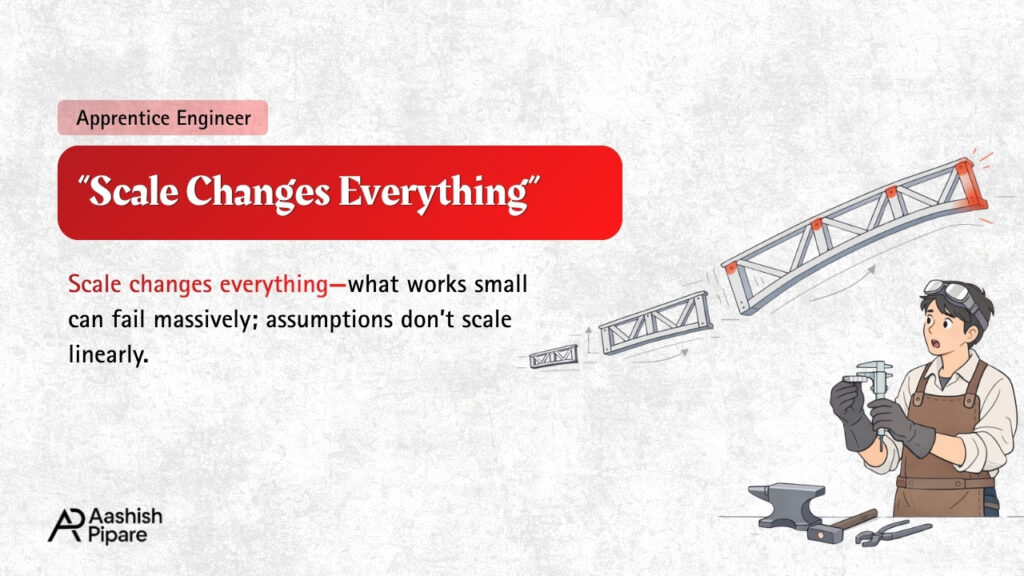
In engineering, changing the size of a system does more than simply make it bigger or smaller. As scale changes, the behavior of the system often changes in unexpected ways. Designs that work perfectly at small scales can fail completely when scaled up.
Why Scaling Is Not Linear
A common early assumption in engineering is that if something works at one size, it should work equally well at a larger size. In reality, scaling rarely behaves that simply.
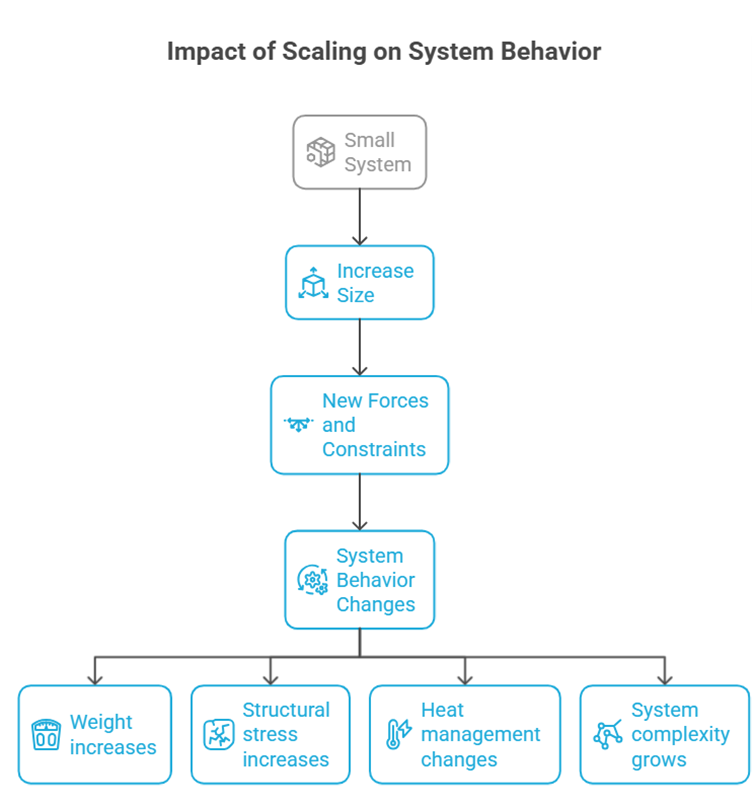
When the size of an object increases, its volume, surface area, weight, and structural forces change at different rates. These changes alter how the system behaves.
For example, if a structure is doubled in size, its volume — and therefore its weight — increases much faster than the strength of its structural elements. This means a structure that is stable at a small scale may collapse if it is simply enlarged without redesign.
Because of this, engineers cannot simply “scale up” a successful design. Instead, they must reconsider how the system behaves at the new scale.
Forces Change With Size
One of the main reasons scaling affects engineering systems is that physical forces behave differently as size increases.
At smaller scales, certain forces may be negligible. At larger scales, those same forces may become dominant.
For example:
- Weight increases faster than structural strength in large structures.
- Heat dissipation becomes more difficult in large machines or electronics.
- Fluid resistance behaves differently as size and speed change.
These changes mean that systems must be redesigned rather than simply enlarged.
For instance, a small model bridge may support its own weight easily, but a full-sized bridge must deal with enormous loads, wind forces, thermal expansion, and material fatigue.
Scaling Changes Materials and Structures
Materials behave differently depending on scale.
At small sizes, materials may appear extremely strong and rigid. As structures become larger, stresses distribute differently, and weaknesses become more significant.
Large structures must account for factors such as:
- stress concentrations
- material fatigue
- thermal expansion
- vibration and resonance
This is why large buildings, ships, and aircraft often require specialized structural designs that look very different from small prototypes.
The scaling process reveals limitations that were invisible at smaller sizes.
Systems Become More Complex as They Grow
As systems increase in size, they often become more complex to manage and operate.
For example:
- A small mechanical device might have only a few components.
- A large industrial system may involve thousands of interconnected parts.
With increased scale comes increased coordination challenges. Engineers must consider not only the physical system but also the infrastructure required to support it.
Large-scale systems often require:
- more advanced monitoring systems
- maintenance procedures
- safety mechanisms
- operational protocols
The design challenge grows not only in size but also in complexity.
Scale Changes Risk and Consequences
Another important effect of scale is that failures become more significant.
When a small device fails, the consequences may be minor. When a massive structure or industrial system fails, the impact can be far greater.
For example:
- the collapse of a large bridge
- failure in a power grid
- malfunction in an aircraft system
Because of this, engineers must design large systems with greater safety margins, redundancy, and monitoring.
The larger the system, the greater the responsibility to anticipate risks.
The Importance of Scaling Laws
To manage these challenges, engineers rely on scaling laws, which describe how physical quantities change as systems increase or decrease in size.
Scaling laws help engineers predict how factors such as strength, heat transfer, fluid flow, and energy consumption will change.
For example:
- surface area increases with the square of size
- volume increases with the cube of size
This means that a structure that doubles in height may become eight times heavier. Understanding these relationships helps engineers design systems that remain stable and efficient at different scales.
Examples of Scaling in Engineering
| Engineering Field | Scaling Challenge |
| Civil Engineering | Large structures must handle enormous loads and environmental forces |
| Mechanical Engineering | Larger machines require stronger materials and better cooling |
| Aerospace Engineering | Aircraft design must balance size, weight, and aerodynamic forces |
| Electrical Engineering | Larger circuits require more careful power and heat management |
| Software Engineering | Systems handling millions of users require different architectures |
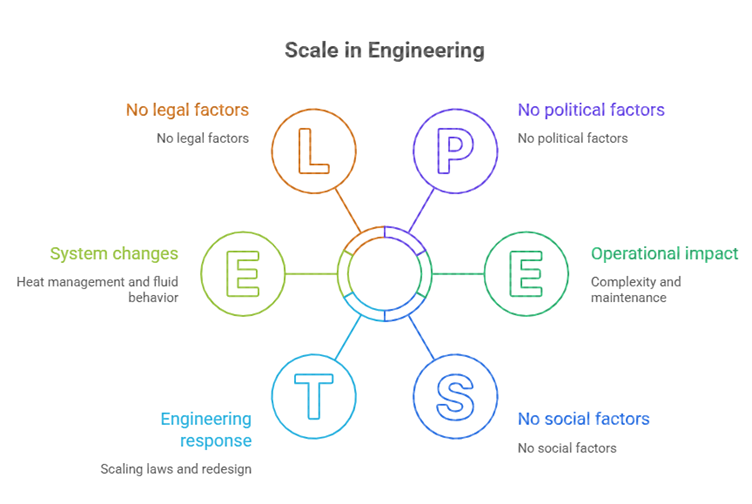
These examples show how increasing scale transforms design requirements.
Key Takeaways
- Scaling a system changes more than its size — it changes how forces behave.
- Weight, heat, stress, and complexity often increase rapidly as systems grow.
- Designs that work at small scales may fail at larger scales.
- Engineers must reconsider assumptions whenever a system changes size.
Conclusion
Scale is one of the most powerful forces shaping engineering systems. A design that performs perfectly at one size may behave very differently at another.
As systems grow, forces, stresses, and operational challenges grow with them. Engineers must therefore treat scaling not as a simple resizing of a design but as an opportunity to rethink how the system behaves.
Understanding how scale changes assumptions allows engineers to design systems that remain safe, efficient, and reliable — no matter how large they become.