
Introduction
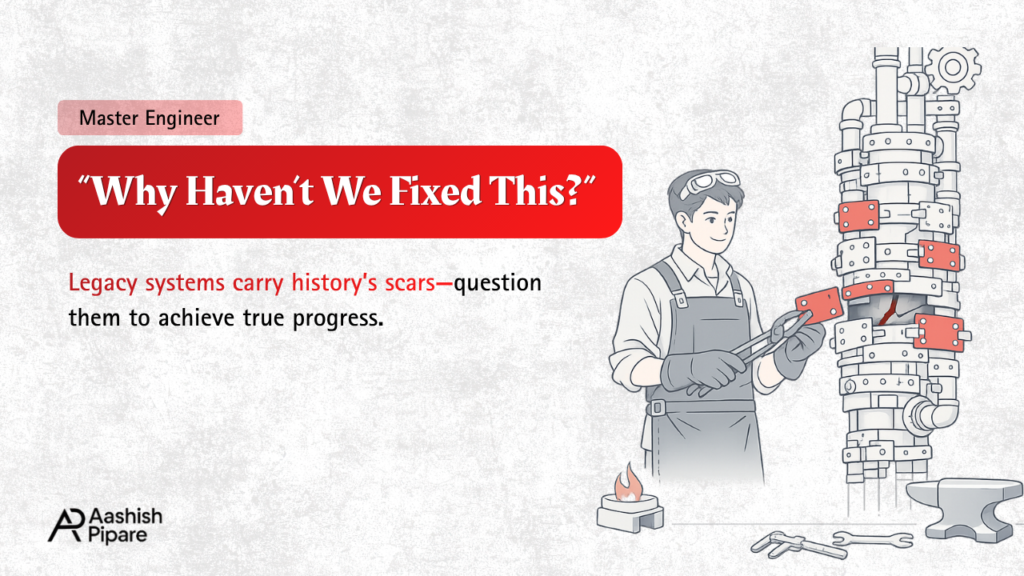
Every system carries its past within it.
The real question is not what is built—but what still remains that no longer belongs.
Systems as Accumulated History
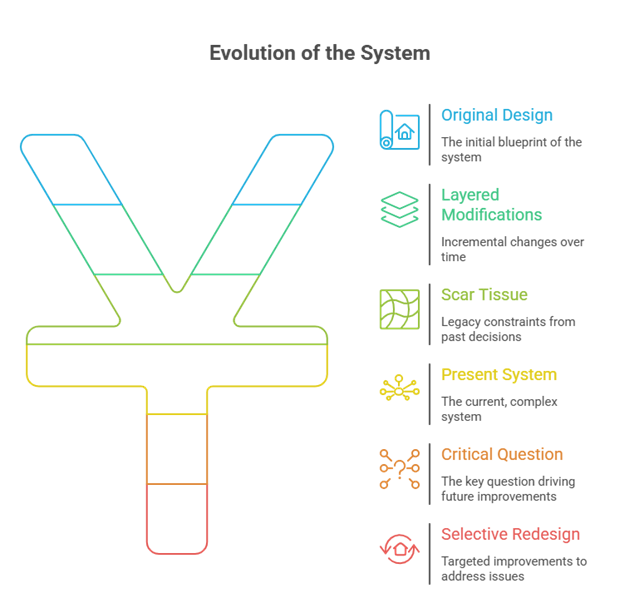
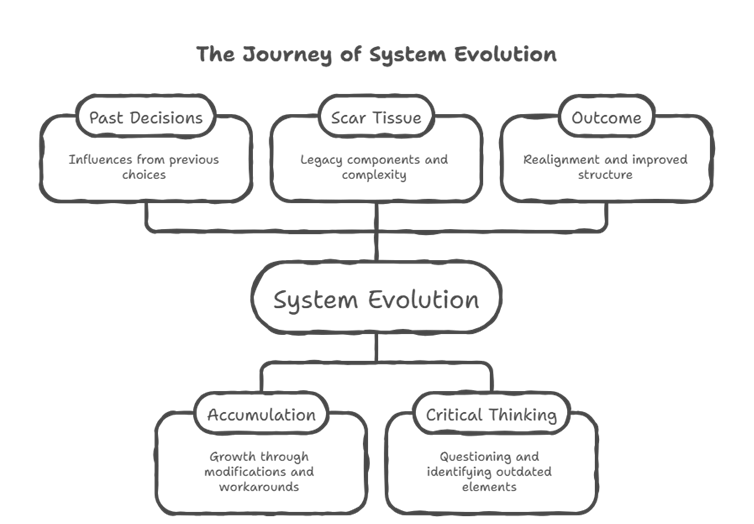
No real-world system is designed in a single moment. It evolves over time, shaped by constraints, decisions, and trade-offs made under specific conditions.
These conditions may include:
- limited technology at the time
- incomplete understanding of the problem
- urgency or external pressure
- assumptions that once seemed valid
As the system grows, these decisions accumulate. They form layers—some still relevant, others outdated.
What remains is not a pure design, but a historical artifact.
A Master Engineer recognizes that every mature system contains elements that exist not because they are optimal—but because they were once necessary.
The Presence of Scar Tissue
Over time, systems develop what can be called “scar tissue”:
- workarounds added to fix past issues
- constraints that no longer apply
- components that exist only to support legacy behavior
These elements often persist because removing them is difficult, risky, or disruptive.
The system continues to function, but with increasing:
- complexity
- inefficiency
- fragility
The danger is not that these elements exist.
The danger is that they become invisible—accepted as part of the system’s natural structure.
The Power of the Reset Question
Asking, “What would we never do again?” forces a break from incremental thinking.
It shifts perspective from:
- adapting the existing system
to - re-evaluating the system’s fundamental structure
This question reveals:
- outdated assumptions
- unnecessary complexity
- design decisions that no longer make sense
It is not about criticism of past decisions.
It is about recognizing that context has changed.
A Master Engineer uses this question to expose what the system has outgrown.
Why Systems Resist Change
If the issues are visible, why are they not corrected?
The answer lies in the nature of real-world systems.
Barriers to change include:
- high cost of redesign
- risk of introducing new failures
- dependencies built around existing structure
- organizational inertia and resistance
In many cases, the system is “good enough” to continue operating. The immediate cost of change outweighs the perceived benefit.
This creates a state where:
- known inefficiencies are tolerated
- suboptimal structures persist
- long-term improvement is delayed
The system becomes stable—but not optimal.
The Hidden Cost of Not Changing
While avoiding change reduces short-term risk, it introduces long-term consequences.
These include:
- increasing maintenance complexity
- slower adaptation to new requirements
- accumulation of technical debt
- reduced system resilience
Over time, the system becomes harder to modify, understand, and improve.
At a certain point, the cost of maintaining the system exceeds the cost of redesigning it—but reaching that point often takes years.
A Master Engineer anticipates this trajectory and acts before the system reaches critical rigidity.
Engineering Thinking: Balancing Continuity and Reinvention
Redesigning from scratch is rarely practical. Existing systems must continue to function.
The challenge is to:
- identify which parts must be preserved
- isolate what can be redesigned
- gradually replace outdated structures
This requires:
- deep understanding of the system’s history
- clarity about current requirements
- vision for future evolution
The goal is not to erase history—but to prevent it from limiting the future.
A Master Engineer does not simply maintain systems.
They continuously realign them with present reality.
Real-World Implications
In large systems—software platforms, infrastructure, industrial processes—this question becomes critical.
Without periodic re-evaluation:
- systems become bloated and inefficient
- innovation slows down
- risks increase as complexity grows
Organizations that succeed long-term are those that:
- regularly challenge their own systems
- are willing to replace outdated components
- invest in structural improvement, not just surface fixes
This is not a one-time action.
It is a continuous discipline.
Visual Representation
Practical Table
| Factor / Question | Why It Matters | Example |
| What assumptions no longer hold? | Outdated assumptions create inefficiency | Designing for old technology constraints |
| Which components exist only for legacy support? | Identifies removable complexity | Maintaining outdated system compatibility |
| What is difficult to change, and why? | Reveals structural rigidity | Highly coupled modules in software |
| What would we design differently today? | Provides direction for improvement | Simplifying system architecture |
| What prevents change? | Identifies barriers to progress | Cost, risk, or organizational resistance |
Key Takeaways
- Mature systems carry historical decisions that may no longer be valid
- “Scar tissue” accumulates as systems evolve over time
- Asking what should not be done again reveals outdated structures
- Systems resist change due to cost, risk, and dependency
- Avoiding change increases long-term complexity and fragility
- Master Engineers balance maintaining systems with strategic redesign
Mind Map
Conclusion
Every system tells a story—not just of what was built, but of the constraints and decisions that shaped it.
Over time, this story becomes embedded in the system itself. Some parts remain essential. Others persist only because they were never questioned.
The ability to ask, “What would we never do again?” is an act of clarity.
The ability to act on that answer is an act of courage.
A Master Engineer does not reject the past—but neither are they bound by it.
Because in the end, engineering is not just about preserving what exists—
it is about ensuring that the system continues to reflect what is true now, not what was once necessary.