

🔹 a. What are the specializations available in this branch?
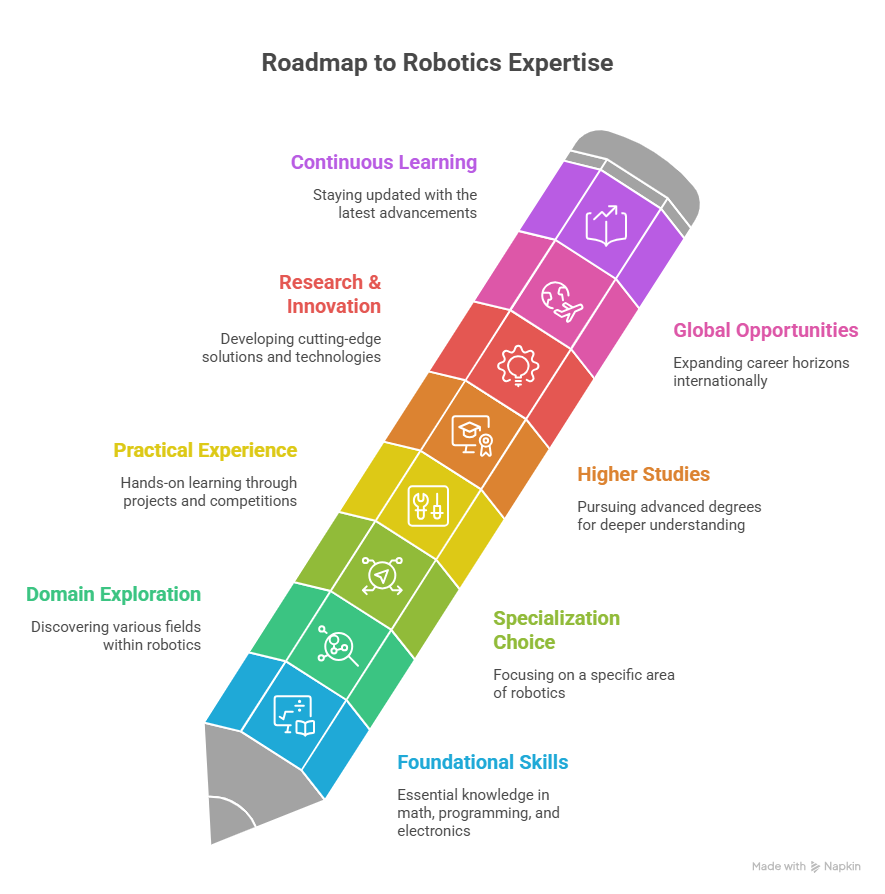
As you progress in Robotics Engineering, the field opens up into multiple specialized domains that allow you to focus deeply on specific technologies and applications. In the early stages, students are exposed to a broad range of subjects to build a strong foundation. However, as knowledge and experience grow, choosing a specialization becomes essential for developing expertise and aligning with career goals. Each specialization represents a unique combination of skills and applications within robotics.
One of the major specializations is Autonomous Systems, which focuses on developing robots that can operate independently without human control. This includes self-driving cars, drones, and robotic navigation systems. Another important area is Artificial Intelligence in Robotics, where machine learning and computer vision are used to make robots intelligent and capable of decision-making. Industrial Automation is also a widely востребित specialization, involving the use of robots in manufacturing and production environments to improve efficiency and reduce human effort.
Other key specializations include Embedded Systems, which deals with integrating hardware and software within robotic systems, and Human-Robot Interaction (HRI), which focuses on designing robots that can safely and effectively interact with humans. At a beginner level, students explore all these areas to understand their interests. At an expert level, specialization allows for deep expertise and career advancement. For example, a specialist in autonomous systems may design robots that can navigate complex environments without human intervention, such as self-driving vehicles.
Subpoints:
- Autonomous Systems (self-driving cars, drones, navigation)
- Artificial Intelligence in Robotics (ML, computer vision)
- Industrial Automation (manufacturing robots)
- Embedded Systems (hardware-software integration)
- Human-Robot Interaction (HRI)
- Domain specialization for deep expertise
🔹 Should I pursue higher studies (M.Tech, MS, MBA, PhD)?
Higher studies can play a significant role in advancing a career in Robotics Engineering, especially for those aiming for specialized or high-level roles. While a bachelor’s degree provides a solid foundation, advanced degrees offer deeper knowledge, exposure to cutting-edge technologies, and better career opportunities. The choice of higher education depends on your career goals, whether they are technical, managerial, or research-oriented.
An M.Tech in Robotics or Automation is a good option for gaining advanced technical knowledge within India, focusing on practical and industry-relevant skills. Pursuing an MS abroad provides global exposure, access to advanced research facilities, and opportunities to work with international experts. For those interested in leadership roles, an MBA can help transition into management, project leadership, or business-oriented positions in tech companies.
A PhD is ideal for individuals interested in research, innovation, and academic careers. It allows you to work on advanced problems, contribute to new technologies, and become an expert in a specific domain. At a beginner level, a basic degree may seem sufficient, but at an expert level, higher education opens doors to specialized roles and global opportunities. For example, a student pursuing an MS in Robotics abroad may work on advanced AI-driven robotic systems, gaining experience that is highly valued worldwide.
Subpoints:
- M.Tech (Robotics/Automation – technical depth)
- MS (Abroad – global exposure, advanced learning)
- MBA (management and leadership roles)
- PhD (research, innovation, academia)
- Career-oriented decision making
- Access to advanced opportunities
🔹 What are the research opportunities in this field?
Robotics Engineering offers extensive research opportunities in some of the most advanced and impactful areas of technology. Research in robotics is focused on solving complex problems and developing innovative solutions that can be applied in real-world scenarios. This includes areas such as autonomous navigation systems, where robots are designed to move independently in dynamic environments, and AI-based robotics, which involves creating intelligent systems capable of learning and decision-making.
Another exciting area is swarm robotics, where multiple robots work together as a coordinated system to perform tasks more efficiently. This concept is inspired by natural systems such as ant colonies and bird flocks. Medical robotics is also a rapidly growing research field, focusing on robotic systems that assist in surgeries, rehabilitation, and patient care. Additionally, space robotics involves developing robots for exploration and operations in space, such as planetary rovers and robotic arms used in spacecraft.
At a beginner level, research often starts with academic projects and small experiments. As expertise grows, it can lead to significant innovations and contributions to new technologies. For example, researchers are developing robots that can explore Mars or assist surgeons in performing highly precise operations. These research opportunities not only advance technology but also have a meaningful impact on society.
Subpoints:
- Autonomous navigation systems
- AI-based robotics
- Swarm robotics
- Medical robotics
- Space robotics
- Innovation and technology development
🔹 What global opportunities exist in this field?
Robotics Engineering offers strong global opportunities due to the widespread adoption of automation and intelligent systems across industries. Countries around the world are investing heavily in robotics research and development, creating a high demand for skilled professionals. This makes robotics a globally relevant field, where expertise is valued across borders.
The United States is a major hub for AI and robotics innovation, offering opportunities in advanced research and technology development. Germany is known for its strong manufacturing sector and industrial automation, making it an attractive destination for robotics engineers. Japan is a global leader in advanced robotics, particularly in areas such as humanoid robots and automation technologies. Canada is also emerging as a key player, especially in AI and robotics research.
At a beginner level, opportunities may seem limited to local markets. However, at an expert level, robotics engineers can work with global companies, research institutions, and startups. For example, a robotics engineer specializing in AI-based systems can join international organizations developing next-generation robots. This global demand makes robotics a highly rewarding and flexible career path.
Subpoints:
- USA (AI and robotics innovation)
- Germany (industrial automation)
- Japan (advanced robotics development)
- Canada (AI and robotics research)
- Global demand for automation skills
- International career opportunities
🔹 How can I become a top 1% expert in this domain?
Becoming a top 1% expert in Robotics Engineering requires consistent effort, deep understanding, and a strong focus on practical experience. The journey begins with building a solid foundation in core subjects such as mathematics, electronics, and programming. These fundamentals are essential for understanding how robotic systems function and for solving complex technical problems. Without a strong base, it becomes difficult to progress to advanced levels.
Practical experience is equally important, as robotics is a hands-on field. Building multiple real-world projects helps in applying theoretical knowledge and developing problem-solving skills. Learning advanced technologies such as artificial intelligence, machine learning, and computer vision is crucial, as these areas are driving the future of robotics. Participating in competitions, hackathons, and collaborative projects can further enhance skills and provide valuable exposure.
At a beginner level, the focus should be on learning the basics and building small projects. At an expert level, the focus shifts to innovation, research, and creating impactful solutions. Continuous learning and staying updated with new technologies are essential for maintaining expertise. For example, a top robotics expert may design advanced robotic systems used in industries or research labs, solving complex problems on a global scale and contributing to technological advancements.
Subpoints:
- Strong fundamentals (math, electronics, programming)
- Real-world robotics projects
- AI, machine learning, and computer vision skills
- Participation in competitions and hackathons
- Continuous learning and skill updates
- Focus on innovation and real-world impact
🔹Conclusion
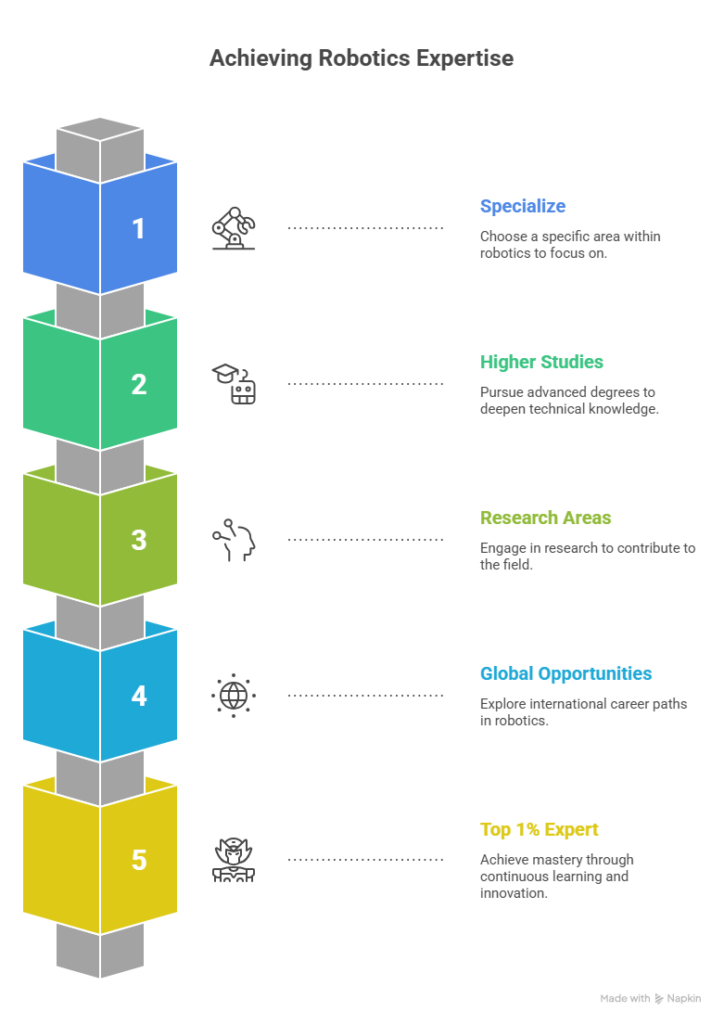
The advanced growth path in Robotics Engineering offers numerous opportunities for specialization, higher education, and global career development. As students progress in the field, choosing a specialization becomes essential for building deep expertise and aligning with specific career goals. Whether it is autonomous systems, AI in robotics, or industrial automation, each domain provides unique challenges and opportunities.
Higher studies play a crucial role in enhancing knowledge and opening doors to advanced roles in research, industry, and management. Options such as M.Tech, MS, MBA, and PhD allow individuals to tailor their education based on their interests and career aspirations. These qualifications not only improve technical skills but also provide access to global opportunities and cutting-edge research.
Research in robotics is one of the most exciting aspects of the field, offering the chance to work on innovative technologies that can transform industries and improve lives. From medical robotics to space exploration, the possibilities are vast and impactful. Combined with the global demand for robotics professionals, this makes the field highly promising for long-term career growth.
Ultimately, becoming a top expert in robotics requires dedication, continuous learning, and a strong focus on practical experience. By building a solid foundation, working on real-world projects, and staying updated with emerging technologies, individuals can achieve excellence in this field. Robotics Engineering not only offers a rewarding career but also provides the opportunity to contribute to the future of technology and innovation.