
🔹 What are the key subjects I must master in this branch?
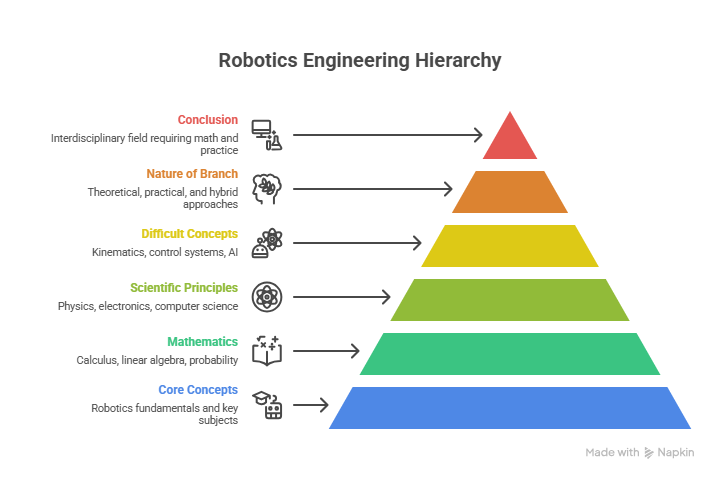
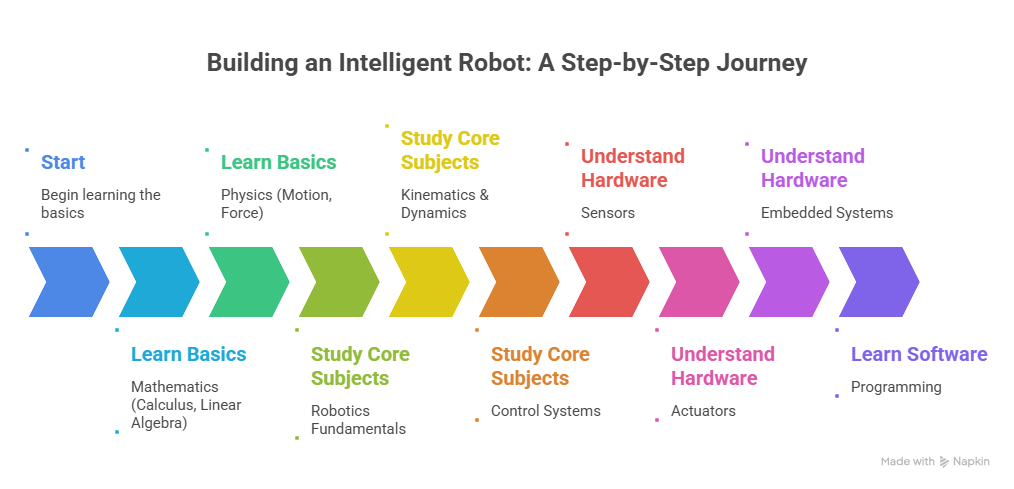
To become strong in Robotics Engineering, you must master subjects that collectively enable you to design, control, and program intelligent machines capable of operating in real-world environments. Robotics is not limited to a single subject but is an integration of multiple domains that work together to create functional systems. One of the most important areas is Robotics Fundamentals, which introduces the core concepts of robot design, structure, and operation. This subject helps in understanding how different components such as sensors, actuators, and controllers interact within a robotic system.
Another critical subject is Kinematics and Dynamics, which deals with motion and forces in robots. Kinematics focuses on describing motion in terms of position, velocity, and acceleration without considering forces, while dynamics explains how forces and torques cause that motion. In addition, Control Systems are essential for ensuring that robots move accurately and respond correctly to inputs. Without proper control mechanisms, robots would not be able to maintain stability or achieve precise movements, making this subject crucial for performance and reliability.
Further, Sensors and Actuators and Embedded Systems form the backbone of interaction between hardware and software. Sensors allow robots to perceive their surroundings, while actuators enable them to perform actions such as movement or object manipulation. Embedded systems integrate these components into a cohesive unit. At advanced levels, Artificial Intelligence (AI) becomes essential, enabling robots to learn, adapt, and make decisions autonomously. While beginners study these subjects individually, at an expert level they are integrated to build complete robotic systems capable of complex tasks.
Subpoints:
- Robotics Fundamentals (design and working of robots)
- Kinematics and Dynamics (motion, position, forces)
- Control Systems (accuracy, stability, feedback)
- Sensors and Actuators (environment sensing and action)
- Embedded Systems (hardware-software integration)
- Artificial Intelligence (learning and decision-making)
🔹 What level of mathematics is required?
Robotics Engineering requires a strong and advanced level of mathematics, as mathematical concepts form the foundation for understanding motion, control, and intelligent behavior in robots. One of the most important areas is calculus, which helps in analyzing how quantities such as position, velocity, and acceleration change over time. This is crucial for designing robots that can move smoothly and efficiently, especially in dynamic environments where continuous motion must be controlled precisely.
Another essential area is linear algebra, which is widely used for representing positions and transformations in two-dimensional and three-dimensional space. Robotics often involves working with coordinate systems, rotations, and matrix operations, all of which rely heavily on linear algebra. This is particularly important in applications such as robotic arms and autonomous navigation systems, where precise positioning and orientation are required.
In addition, probability and statistics play a significant role in handling uncertainty in real-world environments. Sensors may produce noisy or incomplete data, and robots must make decisions based on this imperfect information. At a beginner level, students use basic formulas, but at advanced levels, robotics involves complex mathematical models and optimization techniques. For example, a robot navigating in a 3D space uses mathematical equations to calculate its path, avoid obstacles, and reach its destination efficiently.
Subpoints:
- Calculus (motion, rate of change)
- Linear Algebra (vectors, matrices, transformations)
- Probability and Statistics (uncertainty handling)
- Mathematical Modeling (system representation)
- Optimization Techniques (efficient path planning)
🔹 Which scientific principles are fundamental here?
Robotics Engineering is built upon fundamental scientific principles drawn from physics, electronics, and computer science, each contributing to a different aspect of a robot’s functionality. Physics provides the understanding of motion, force, energy, and mechanics, which are essential for designing robots that can move and interact with their environment. Concepts such as Newton’s laws, torque, and energy transfer are critical for ensuring that robots function efficiently and safely.
Electronics plays a key role in enabling robots to sense and respond to their surroundings. It involves circuits, sensors, actuators, and signal processing. Sensors collect data such as distance, light, or temperature, while electronic systems process this information and convert it into signals that the robot can understand. Without electronics, robots would lack the ability to perceive their environment and react accordingly.
Computer Science provides the intelligence behind robotic systems through programming and algorithms. Software allows robots to process data, make decisions, and execute tasks effectively. At a beginner level, these principles are studied separately, but at an advanced level, they are integrated into a unified system. For example, a robot uses physics to move, electronics to sense, and software to decide actions, demonstrating the interconnected nature of these scientific principles.
Subpoints:
- Physics (motion, force, energy, mechanics)
- Electronics (circuits, sensors, signal processing)
- Computer Science (programming, algorithms)
- Integration of all principles into one system
🔹 d. What are the most difficult concepts students struggle with?
Students in Robotics Engineering often face difficulties with complex topics that require both strong theoretical understanding and practical application. One of the most challenging areas is robot kinematics, which involves calculating the movement and position of robotic components in space. This requires strong mathematical skills and the ability to visualize motion in multiple dimensions, which can be difficult for beginners.
Another challenging subject is control systems, where students must understand how to maintain stability and accuracy in robotic movements. This involves analyzing system behavior, designing feedback loops, and tuning parameters to ensure proper performance. Even small errors in control design can lead to instability, making this topic both critical and challenging to master.
Additionally, Artificial Intelligence (AI) and embedded system integration are often difficult due to their complexity. AI involves advanced algorithms and data processing, while embedded systems require integrating hardware and software seamlessly. At a beginner level, these topics may seem abstract, but with practice and hands-on experience, they become essential tools. For example, designing a self-balancing robot requires deep understanding of control systems, sensors, and real-time processing.
Subpoints:
- Robot Kinematics (motion calculation)
- Control Systems (stability and accuracy)
- Artificial Intelligence and Machine Learning
- Embedded Systems Integration
- Real-time system challenges
🔹Is this branch more theoretical, practical, or hybrid?
Robotics Engineering is a highly hybrid field, combining both theoretical knowledge and practical application. The theoretical aspect involves understanding mathematical models, algorithms, and system design principles that define how robots should behave. This includes studying motion equations, control strategies, and computational methods that form the foundation of robotic systems.
The practical aspect involves building, testing, and improving robots in real-world conditions. This includes assembling hardware components, programming microcontrollers, integrating sensors, and troubleshooting issues. Practical work is essential because real-world systems often behave differently from theoretical predictions, requiring adjustments and problem-solving skills.
At a beginner level, students tend to focus more on theory to build a strong foundation. However, at advanced levels, hands-on experience becomes crucial. Real learning happens when theoretical knowledge is applied to real-world projects. For example, while you may learn how a robot should move in theory, true understanding comes when you build and test the robot physically.
Subpoints:
- Theoretical Knowledge (equations, models, algorithms)
- Practical Implementation (building and testing robots)
- Hands-on Learning (projects and experimentation)
- Industry Application (real-world problem solving)
🔹Conclusion
Robotics Engineering, as explored through its core concepts and academic foundations, is a field that requires a deep understanding of multiple disciplines working together. Mastering key subjects such as kinematics, control systems, and artificial intelligence is essential for developing the ability to design and build intelligent machines. These subjects form the backbone of robotics and enable engineers to create systems that can operate efficiently in complex environments.
Mathematics and scientific principles play a critical role in strengthening this foundation, as they provide the tools needed for modeling, analysis, and decision-making. Concepts from physics, electronics, and computer science are integrated to create systems that can sense, process information, and act accordingly. This interdisciplinary approach highlights the complexity and importance of robotics in modern technology.
The challenges faced in learning robotics, particularly in areas such as control systems and AI, emphasize the need for continuous practice and problem-solving. While these concepts may initially seem difficult, they become more intuitive with experience and hands-on application. Overcoming these challenges not only builds technical knowledge but also enhances analytical and critical thinking skills.
Ultimately, Robotics Engineering is a perfect blend of theory and practice, where real learning occurs through experimentation and application. As the demand for automation and intelligent systems continues to grow, robotics will play an increasingly important role in shaping the future. A strong understanding of its academic foundations prepares students to innovate and contribute effectively to this rapidly evolving field. a robot should move in theory, but actual learning happens when you build and test the robot physically.