
🔹 What software tools are essential in this branch?
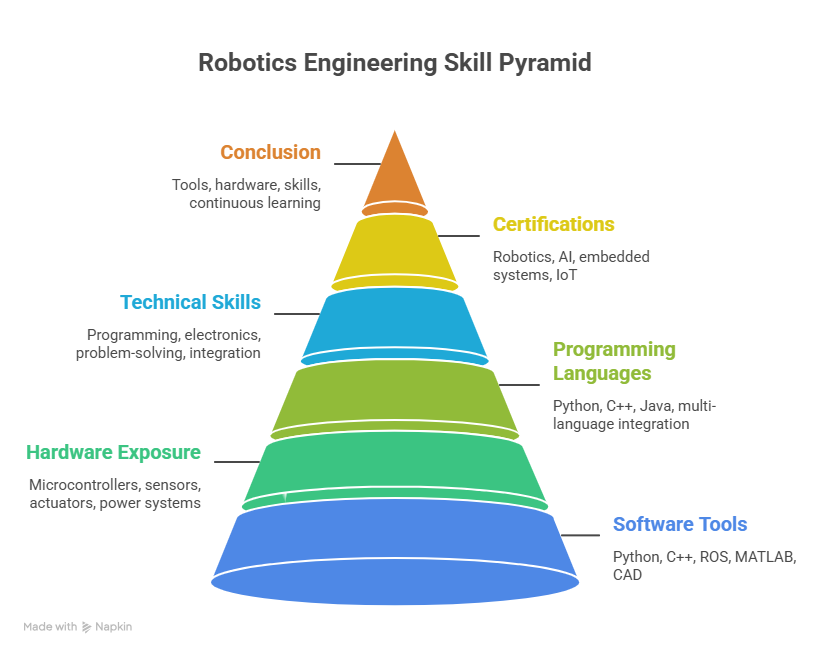
Robotics Engineering relies heavily on a wide range of software tools that help engineers design, simulate, program, and control robotic systems efficiently. These tools are essential because building a robot is not just about hardware; it also involves creating intelligent behavior through software. One of the most widely used programming languages in robotics is Python, which is known for its simplicity and versatility. It is extensively used in artificial intelligence, machine learning, and data processing, making it an ideal choice for beginners as well as advanced developers working on intelligent robotic systems.
Another important set of tools includes C and C++, which are commonly used for real-time control and embedded systems programming. These languages are preferred when performance and speed are critical, such as controlling motors or handling low-level hardware operations. Additionally, ROS (Robot Operating System) is a powerful framework that allows developers to manage complex robotic systems by providing tools for communication, control, and integration. It acts as a middleware that connects different components of a robot, making development more organized and scalable.
Simulation and design tools also play a crucial role in robotics. MATLAB and Simulink are widely used for modeling, simulation, and control system design, allowing engineers to test algorithms before implementing them in real hardware. Similarly, CAD software such as SolidWorks is used to design the physical structure of robots. At a beginner level, students typically start with simple tools like Python, but at an advanced level, multiple tools are integrated to develop complete robotic systems. For example, a robot’s movement can be simulated in MATLAB before physically building it, which helps save both time and cost.
Subpoints:
- Python (AI, data processing, easy programming)
- C/C++ (real-time control, embedded systems)
- ROS (Robot Operating System framework)
- MATLAB/Simulink (simulation and control design)
- CAD Software like SolidWorks (mechanical design)
- Simulation tools (testing before implementation)
🔹 What hardware or lab exposure is required?
Robotics Engineering is a highly practical field, and hands-on experience with hardware is essential for developing real-world skills. Understanding hardware components allows students to translate theoretical knowledge into functional systems. One of the most important hardware elements in robotics is microcontrollers, such as Arduino and Raspberry Pi. These devices act as the brain of the robot, controlling inputs and outputs and executing programmed instructions.
Sensors and actuators are also fundamental components in robotics systems. Sensors, such as ultrasonic sensors, infrared sensors, and cameras, allow robots to perceive their environment by collecting data about distance, light, or objects. Actuators, such as motors and servos, enable robots to perform physical actions based on that data. Without these components, a robot would not be able to interact with its surroundings effectively. Additionally, understanding power systems and circuits is crucial to ensure that all components function reliably and efficiently.
At a beginner level, students typically start by learning basic circuits, connecting simple components, and building small projects. As they progress, they move toward designing and integrating complete robotic systems that involve multiple sensors, actuators, and control units. For example, an obstacle-avoiding robot uses sensors to detect objects and motors to change direction accordingly. This hands-on experience is critical for understanding how different components work together in a real-world robotic system.
Subpoints:
- Microcontrollers (Arduino, Raspberry Pi)
- Sensors (ultrasonic, infrared, camera systems)
- Actuators (motors, servos)
- Power systems and circuit design
- Hardware integration and testing
- Lab-based project development
🔹 Which programming languages are needed?
Programming is one of the most essential skills in Robotics Engineering, as it enables robots to perform tasks, process data, and make decisions. Among the various programming languages, Python is one of the most widely used due to its simplicity and extensive libraries. It is particularly useful in areas such as artificial intelligence, computer vision, and data processing, making it ideal for developing intelligent robotic systems. Beginners often start with Python because it is easy to learn and allows rapid development.
C and C++ are equally important, especially for low-level programming and real-time applications. These languages are used to control hardware components directly, such as motors and sensors, and are preferred when performance and speed are critical. They provide greater control over system resources, making them essential for embedded systems and time-sensitive operations in robotics.
In some cases, Java may also be used, particularly in certain robotic applications and platforms, although it is less common compared to Python and C/C++. At a beginner level, basic coding skills are sufficient to build simple robotic programs. However, at an advanced level, programming becomes more complex and involves real-time control, optimization, and intelligent behavior. For example, a robot may use C++ to control motor speed and Python to process camera data, demonstrating how multiple programming languages can be used together in a single system.
Subpoints:
- Python (AI, machine learning, easy development)
- C/C++ (low-level control, fast execution)
- Java (optional, specific applications)
- Multi-language integration in robotics
- Real-time programming and control
🔹 What are the must-have technical skills for freshers?
Freshers entering the field of Robotics Engineering must develop a strong set of technical and problem-solving skills to build a solid foundation. One of the most important skills is programming, as it enables the creation of algorithms and control logic for robotic systems. Along with coding, a basic understanding of electronics and circuits is essential, as robots rely heavily on electrical components for sensing and actuation.
Another important skill is knowledge of sensors and actuators, which allows freshers to understand how robots interact with their environment. Being able to select and use the right components for a specific task is crucial in designing effective robotic systems. In addition, problem-solving and logical thinking skills are vital, as robotics often involves troubleshooting issues and optimizing system performance.
System integration is another key skill that freshers must develop, as robotics involves combining hardware and software into a single functional unit. At a beginner level, the focus is on learning the basics and building small projects. At an advanced level, the focus shifts to designing complete systems that can perform complex tasks. For example, a fresher should be able to build a simple robot that follows a path or avoids obstacles, demonstrating both technical understanding and practical ability.
Subpoints:
- Programming and coding skills
- Electronics and circuit understanding
- Sensors and actuators knowledge
- Problem-solving and logical thinking
- System integration (hardware + software)
- Basic robotics project development
🔹 What certifications add value in this domain?
Certifications play an important role in enhancing a student’s profile and improving job opportunities in Robotics Engineering. They provide structured learning and help validate skills in specific areas. One of the most valuable types of certifications is in robotics and automation, which covers the fundamentals of designing and controlling robotic systems. These certifications help build a strong foundation and demonstrate practical knowledge to potential employers.
Certifications in Artificial Intelligence and Machine Learning are also highly valuable, as they enable robots to perform intelligent tasks such as object recognition, decision-making, and learning from data. Similarly, certifications in embedded systems are important for understanding how hardware and software interact in real-time environments. These certifications focus on microcontrollers, real-time programming, and system integration.
Another growing area is IoT (Internet of Things), which connects robotic systems to networks and allows them to communicate with other devices. At a beginner level, certifications provide foundational knowledge and help students explore different areas of robotics. At an advanced level, they allow for specialization and career growth. For example, an AI certification can help in building robots that can recognize objects or faces, adding significant value to a professional profile.
Subpoints:
- Robotics and Automation certifications
- Artificial Intelligence and Machine Learning certifications
- Embedded Systems certifications
- IoT (Internet of Things) certifications
- Skill validation and career advancement
- Specialization in advanced domains
🔹Conclusion
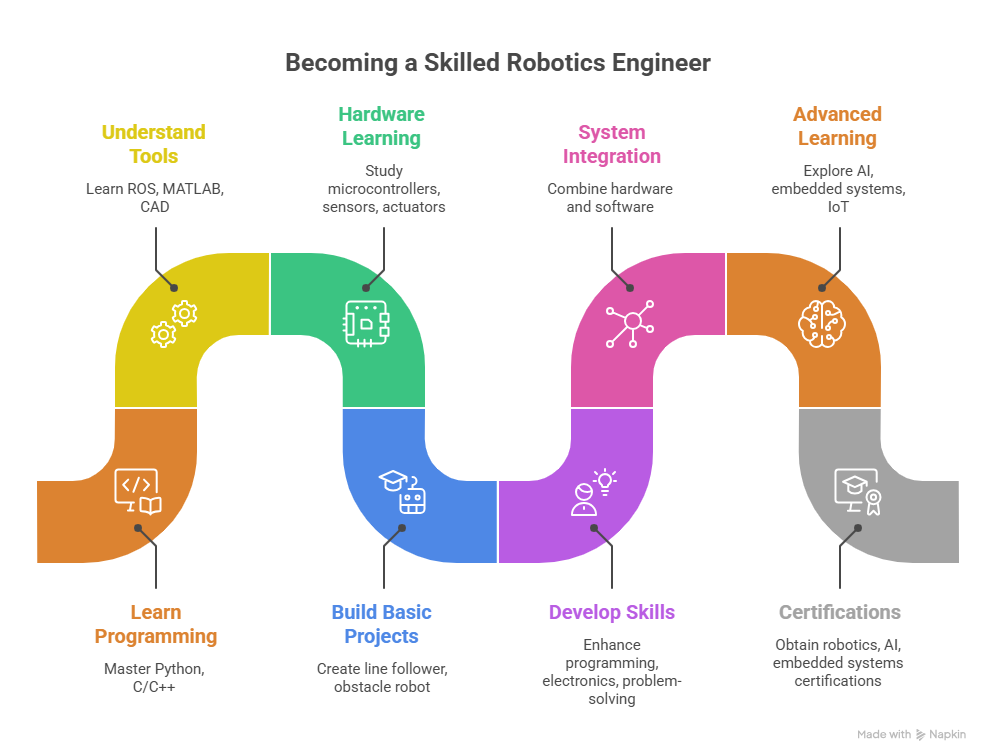
Robotics Engineering, through its tools, technologies, and required skills, represents a field that is both technically demanding and highly practical. Mastering software tools such as programming languages, simulation platforms, and design software is essential for developing efficient robotic systems. These tools enable engineers to design, test, and optimize robots before implementing them in real-world scenarios, making development more effective and reliable.
At the same time, hardware knowledge and lab exposure play a crucial role in bridging the gap between theory and practice. Understanding microcontrollers, sensors, actuators, and circuits allows students to build and experiment with real robotic systems. This hands-on experience is essential for gaining confidence and developing the ability to solve practical problems.
Programming and technical skills further strengthen a student’s ability to work in robotics, as they enable the creation of intelligent and responsive systems. Combined with problem-solving abilities and system integration skills, these competencies form the core skill set required for success in this field. Certifications add additional value by providing structured learning and helping students specialize in areas such as AI, embedded systems, and IoT.
In conclusion, Robotics Engineering is a field that requires continuous learning and adaptation to new technologies. By mastering the right tools, gaining hands-on experience, and developing strong technical skills, students can build a solid foundation for a successful career. As the demand for automation and intelligent systems continues to grow, these skills will play a crucial role in shaping the future of robotics and technological innovation.