
🔹 How will AI impact this branch?
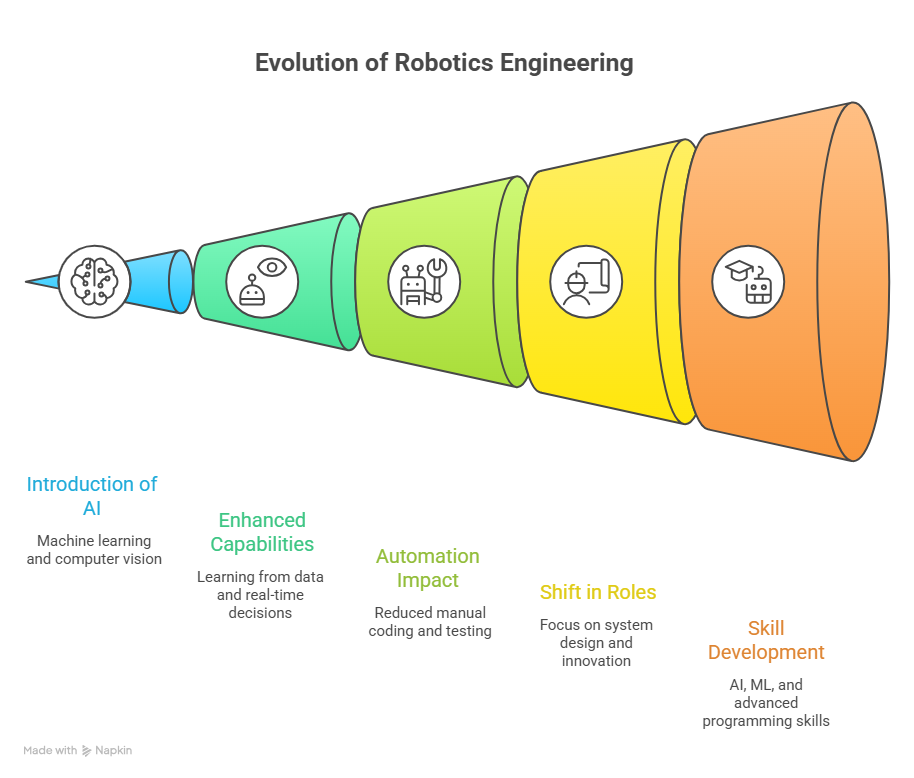
Artificial Intelligence (AI) is one of the most transformative forces in Robotics Engineering, fundamentally changing how robots operate and interact with the world. Traditionally, robots were designed to follow fixed instructions and perform repetitive tasks in controlled environments. However, with the integration of AI, robots are evolving into intelligent systems capable of learning, adapting, and making decisions in real time. This shift is redefining robotics from simple automation to advanced autonomy, where machines can operate in dynamic and unpredictable environments.
AI enables robots to learn from data, recognize objects and environments, and respond to situations without explicit programming for every possible scenario. For example, through machine learning algorithms, robots can improve their performance over time by analyzing past experiences. Computer vision allows robots to interpret visual data, enabling them to identify objects, detect obstacles, and understand their surroundings. This makes robots far more flexible and capable compared to traditional systems.
At a beginner level, robots are typically programmed with fixed instructions, limiting their ability to adapt. At an expert level, AI-powered robots become self-learning and autonomous, capable of handling complex tasks with minimal human intervention. For instance, a traditional robot may follow a predefined path, while an AI-powered robot can detect obstacles and dynamically adjust its path. This increased intelligence makes robotics systems more efficient, versatile, and suitable for real-world applications.
Subpoints:
- Learning from data (machine learning)
- Object and environment recognition (computer vision)
- Real-time decision-making
- Adaptability to changing conditions
- Transition from fixed automation to intelligent systems
- Increased efficiency and flexibility
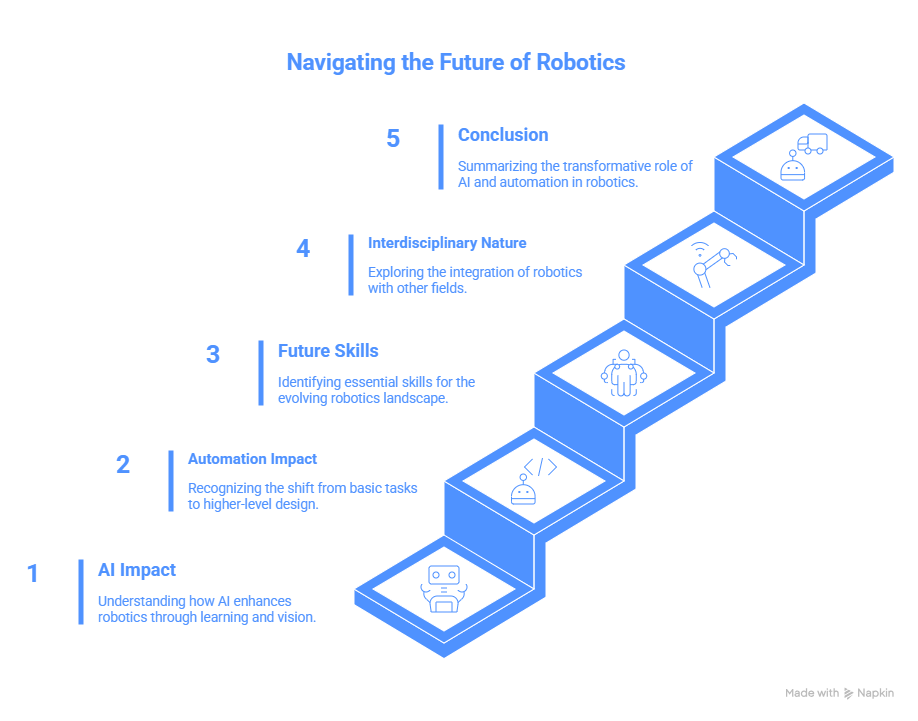
🔹 What parts of this field are at risk of automation?
In Robotics Engineering, automation does not eliminate the need for engineers but rather transforms the nature of their work. While the field itself is driven by automation, certain repetitive and low-level tasks are increasingly being automated by advanced tools and software. These include basic coding tasks, simple robot programming, and routine testing or monitoring processes. Automation tools can now generate code, simulate systems, and even detect errors, reducing the need for manual effort in these areas.
At a beginner level, these tasks are often part of the learning process, helping students understand the fundamentals of programming and system behavior. However, as technology advances, many of these routine activities are handled by automated systems, allowing engineers to focus on more complex and creative aspects of robotics. This shift emphasizes the importance of developing higher-level skills that cannot be easily automated.
At an expert level, Robotics Engineers focus on system design, innovation, and solving complex real-world problems. These tasks require critical thinking, creativity, and deep technical knowledge, which cannot be replaced by automation. For example, while software tools can generate basic robot code, designing a complete robotic system that operates efficiently in a real-world environment requires human expertise. Thus, automation enhances productivity but also raises the bar for skill requirements in the field.
Subpoints:
- Basic coding tasks (automated code generation)
- Simple robot programming
- Routine testing and monitoring
- Simulation and debugging automation
- Shift from manual work to high-level design
- Increased focus on innovation and problem-solving
🔹 What skills make me future-proof in this domain?
To remain relevant in the rapidly evolving field of Robotics Engineering, it is essential to develop skills that go beyond basic automation and focus on advanced technologies. One of the most important future-proof skills is knowledge of Artificial Intelligence and Machine Learning, which enables robots to learn from data and make intelligent decisions. As AI continues to integrate with robotics, engineers with expertise in these areas will be in high demand.
Another critical skill is computer vision, which allows robots to interpret and understand visual information from their environment. This is particularly important in applications such as autonomous vehicles, surveillance systems, and industrial automation. Advanced programming skills are also essential, as they enable engineers to develop efficient algorithms and control systems for complex robotic applications.
In addition, system design and integration skills are crucial for building complete robotic systems that combine hardware and software components seamlessly. Problem-solving abilities in real-world scenarios are equally important, as robotics often involves dealing with unpredictable conditions and challenges. At a beginner level, students should focus on learning tools and basic concepts, while at an expert level, they should aim to create intelligent and adaptive systems. For example, a robot capable of recognizing faces or objects relies on AI and computer vision, which are among the most valuable skills in modern robotics.
Subpoints:
- Artificial Intelligence and Machine Learning
- Computer vision (image and object recognition)
- Advanced programming skills
- System design and integration
- Real-world problem-solving abilities
- Development of intelligent and adaptive systems
🔹 Is this branch evolving towards interdisciplinary roles?
Yes, Robotics Engineering is increasingly evolving into a highly interdisciplinary field, combining multiple advanced domains to create more sophisticated and capable systems. Modern robotics is no longer limited to mechanical design or basic programming; it now integrates areas such as artificial intelligence, data science, Internet of Things (IoT), and automation. This convergence allows robots to perform complex tasks that require both physical interaction and intelligent decision-making.
For example, the integration of robotics with AI enables machines to learn and adapt, while the combination of robotics and data science allows for better analysis and optimization of system performance. Similarly, IoT connects robots to networks and other devices, enabling real-time communication and coordination. Automation further enhances efficiency by streamlining processes and reducing manual intervention. This interdisciplinary approach is driving innovation and expanding the capabilities of robotic systems.
At a beginner level, students typically learn these subjects separately, focusing on building a strong foundation in each area. However, at an expert level, professionals integrate these domains to develop advanced systems that can operate in complex environments. For instance, a smart home robot may use IoT to connect with other devices, AI to understand user commands, and robotics to perform physical actions. This demonstrates how the future of robotics lies in the seamless integration of multiple disciplines.
Subpoints:
- Robotics + AI (intelligent systems)
- Robotics + Data Science (data-driven decisions)
- Robotics + IoT (connected systems)
- Robotics + Automation (efficient processes)
- Integration of multiple technologies
- Development of advanced smart systems
Conclusion
The impact of AI and automation on Robotics Engineering is profound, transforming the field into one that focuses on intelligence, adaptability, and efficiency. AI has enabled robots to move beyond fixed programming and become systems that can learn, analyze, and make decisions in real time. This shift is redefining the capabilities of robots and expanding their applications across various industries, from healthcare and manufacturing to transportation and home automation.
While automation is streamlining many routine tasks within robotics, it is also creating new opportunities for engineers to focus on higher-level design and innovation. The automation of basic coding and testing processes allows professionals to dedicate more time to solving complex problems and developing advanced systems. This evolution highlights the importance of continuously upgrading skills to remain competitive in the field.
Future-proofing a career in robotics requires mastering advanced skills such as AI, computer vision, and system integration. These skills enable engineers to build intelligent and adaptive systems that can operate effectively in real-world environments. As the demand for such systems continues to grow, professionals with expertise in these areas will play a crucial role in shaping the future of technology.
Finally, the interdisciplinary nature of robotics is driving its evolution into a field that combines multiple domains to create innovative solutions. By integrating robotics with AI, data science, IoT, and automation, engineers can develop systems that are smarter, more connected, and more efficient. This makes Robotics Engineering not only a dynamic and exciting field but also one of the most future-oriented and impactful areas of study.