
🔹 What is the core problem domain this branch solves?
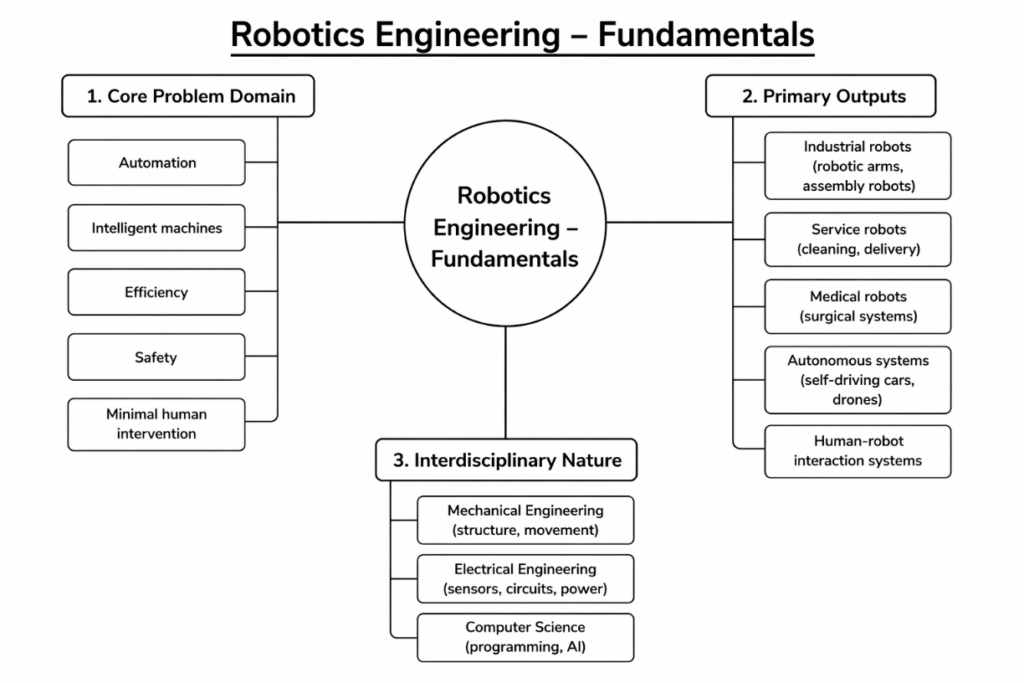
Robotics Engineering primarily focuses on solving the challenge of automation through intelligent systems that can perform tasks with minimal or no human intervention. The core problem it addresses is how to design machines that can replicate or even surpass human abilities in performing physical and cognitive tasks. This includes not only simple repetitive actions but also complex activities that require perception, decision-making, and adaptability. The field aims to reduce dependency on human labor in tasks that are time-consuming, dangerous, or require extreme precision, thereby improving efficiency, reliability, and safety across various domains.
At a foundational level, robotics deals with machines that operate based on predefined instructions, meaning they follow a fixed sequence of commands without deviation. However, as the field advances, robotics incorporates elements of artificial intelligence, machine learning, and real-time data processing, allowing robots to interact dynamically with their environment. These advanced systems are capable of analyzing sensor data, learning from experience, and making decisions on the fly, which significantly expands their scope of application. This shift from simple automation to intelligent autonomy represents the true depth of the problem robotics aims to solve.
For instance, in industrial environments such as manufacturing plants, manual assembly processes can lead to inconsistencies, fatigue, and human error over time. By introducing robotic systems, companies can achieve continuous, precise, and high-speed production without the limitations of human endurance. This not only enhances productivity but also ensures consistent quality, demonstrating how robotics effectively addresses real-world operational inefficiencies and challenges.
🔹 What are the primary outputs of this field (products, systems, services)?
The outputs of Robotics Engineering encompass a wide spectrum of physical machines, intelligent systems, and integrated solutions designed to perform specific tasks across different industries. These outputs include industrial robots used in manufacturing processes, service robots such as cleaning and delivery systems, medical robots that assist in surgeries, and autonomous systems like self-driving cars and drones. Each of these outputs represents a combination of hardware and software working together to achieve a defined objective efficiently and reliably.
At a basic level, the outputs are typically task-specific machines that perform repetitive operations in controlled environments. These robots are programmed to execute a single function with high accuracy, such as welding or packaging in factories. However, as the level of complexity increases, robotics outputs evolve into highly sophisticated systems capable of operating in dynamic and unpredictable environments. These advanced systems are equipped with sensors, processors, and intelligent algorithms that allow them to perceive their surroundings, make decisions, and adapt their behavior accordingly.
A clear illustration of this progression can be seen when comparing a robotic vacuum cleaner to an autonomous vehicle. While the vacuum cleaner uses basic navigation techniques to clean a predefined space, an autonomous car must interpret traffic conditions, recognize objects, and make split-second decisions to ensure safety. This demonstrates how robotics outputs range from simple automated devices to complex intelligent systems that significantly impact modern technology and daily life.
The main outputs include:
- Industrial robots (robotic arms, assembly robots)
- Service robots (cleaning robots, delivery robots)
- Medical robots (surgical systems)
- Autonomous systems (self-driving vehicles, drones)
- Human-robot interaction systems
Example:
A robotic vacuum cleaner that navigates a house and cleans automatically is a simple service robot.
An autonomous car that drives itself is an advanced output.
🔹How is this branch different from closely related branches?
Robotics Engineering is distinct from other engineering disciplines because it is inherently interdisciplinary, integrating concepts from Mechanical Engineering, Electrical Engineering, and Computer Science into a unified system. Unlike traditional branches that focus on specific aspects—such as structure and motion in mechanical engineering or circuits and power systems in electrical engineering—robotics combines these elements to create machines that can sense, process information, and act intelligently within their environment.
At the beginner level, these disciplines are usually studied independently, with each focusing on its own principles and applications. However, in robotics, the real challenge lies in integrating these components into a cohesive system where all parts function seamlessly together. A robot requires mechanical components for movement, electrical systems for sensing and power, and software for control and decision-making. The absence or failure of any one component can disrupt the entire system, highlighting the importance of integration in robotics.
For example, a mobile robot navigating through an environment must rely on its mechanical structure for movement, sensors to detect obstacles, and algorithms to determine the optimal path. If the sensors fail to provide accurate data or the software cannot process the information correctly, the robot will not function as intended. This deep interdependence of multiple engineering domains is what makes robotics unique and more complex compared to closely related fields
- Mechanical Engineering : Provides structure and movement
- Electrical Engineering : Provides sensors, circuits, and power
- Computer Science : Provides programming and intelligence
Robotics combines all three to create smart machines that can interact with the environment
At a beginner level, these fields are studied separately.
At an expert level, they are integrated into one complete system.
Example:
A robot needs:
- Mechanical parts to move
- Sensors to detect obstacles
- Software to decide direction
➡ All must work together seamlessly.
🔹 What are the real-world applications of this field?
Robotics Engineering finds extensive application in real-world scenarios where automation, precision, efficiency, and safety are of utmost importance. One of the most prominent areas is manufacturing, where robots are used for tasks such as assembly, welding, painting, and packaging. These robots can operate continuously with high precision, reducing human error and significantly increasing production efficiency. As a result, industries can achieve large-scale production with consistent quality.
Beyond manufacturing, robotics plays a critical role in advanced fields such as healthcare, defense, agriculture, and space exploration. In healthcare, robotic systems assist surgeons in performing delicate procedures with enhanced accuracy and minimal invasiveness. In defense, robots are deployed for surveillance, bomb disposal, and reconnaissance missions, minimizing risks to human life. Similarly, in agriculture, robots are used for planting, harvesting, and monitoring crops, improving productivity and reducing labor requirements.
Another crucial application of robotics is in hazardous environments where human presence is risky or impossible. For example, robots are used in nuclear plants, disaster zones, and deep-sea or space exploration missions. These environments require machines that can withstand extreme conditions while performing critical tasks. By enabling operations in such challenging settings, robotics not only enhances efficiency but also plays a vital role in ensuring human safety and expanding the boundaries of exploration.
Key applications include:
- Manufacturing (assembly line robots)
- Healthcare (robotic surgery)
- Defense (bomb disposal robots, drones)
- Agriculture (harvesting robots)
- Space exploration (planetary rovers)
- Home automation (cleaning robots)
Example:
In hazardous environments like nuclear plants, robots perform tasks that are too dangerous for humans.
🔹 What industries heavily depend on this branch?
A wide range of industries depend heavily on Robotics Engineering to enhance productivity, operational efficiency, and safety standards. The automobile industry is one of the largest adopters of robotics, utilizing robotic systems for tasks such as welding, painting, and assembling vehicle components. These robots ensure precision and consistency, allowing manufacturers to produce vehicles at a large scale while maintaining high-quality standards.
The electronics industry also relies extensively on robotics for assembling intricate components like microchips and circuit boards, where even minor errors can lead to significant issues. In the healthcare sector, robotics is used not only in surgeries but also in patient care, rehabilitation, and hospital logistics. Robots assist medical professionals by performing repetitive or physically demanding tasks, allowing them to focus on more critical aspects of patient care.
Additionally, industries such as logistics, warehousing, aerospace, and defense have increasingly integrated robotics into their operations. In warehouses, robots are used for sorting, transporting, and managing inventory, significantly improving efficiency and reducing human effort. In aerospace and defense, robotics is used for manufacturing, maintenance, and mission-critical operations. This widespread adoption highlights how robotics has evolved from being a specialized technology to becoming a fundamental driver of innovation and transformation across multiple industries.
Major industries include:
- Automobile manufacturing
- Electronics manufacturing
- Healthcare and medical technology
- Logistics and warehousing
- Aerospace and defense
Example:
In large warehouses, robots move goods from one place to another, reducing human effort and speeding up operations.

🔹Conclusion
Robotics Engineering emerges as one of the most transformative and interdisciplinary fields in modern technology, fundamentally reshaping how tasks are performed across industries and daily life. At its core, the field addresses the challenge of creating intelligent machines capable of performing tasks with efficiency, precision, and minimal human intervention. By combining principles from mechanical, electrical, and computer engineering, robotics goes beyond traditional automation and moves toward developing systems that can sense, think, and act in real-world environments. This integration allows robotics to solve complex problems that cannot be addressed by a single discipline alone, making it a unique and powerful area of study.
As the field evolves, the outputs of robotics continue to expand from simple programmed machines to highly advanced autonomous systems. These systems are no longer limited to controlled environments but are increasingly capable of operating in dynamic and unpredictable conditions. From industrial robots that ensure mass production to autonomous vehicles that navigate real-world traffic, robotics demonstrates a clear progression toward intelligence and adaptability. This evolution highlights the growing importance of robotics in shaping future technologies and emphasizes its role in driving innovation across multiple domains.
The real-world applications of robotics further reinforce its significance, as it plays a crucial role in enhancing efficiency, safety, and productivity in various sectors. Whether it is assisting surgeons in performing delicate operations, exploring distant planets, or handling hazardous tasks in dangerous environments, robotics extends human capabilities in ways that were once unimaginable. By reducing human exposure to risk and improving the accuracy of complex operations, robotics not only optimizes performance but also contributes to overall societal advancement.
In conclusion, Robotics Engineering represents a critical step toward a future where intelligent machines and humans work collaboratively to achieve higher levels of efficiency and innovation. As technology continues to advance, the role of robotics will only become more prominent, opening new possibilities and redefining the boundaries of what machines can accomplish. Understanding the fundamentals of this field provides not only technical knowledge but also insight into the future of automation and intelligent systems, making it an essential area of study in the modern world.