
Introduction
At a senior level, engineering is no longer confined to solving problems within a system.
It involves questioning whether the system itself is built on valid thinking.
The Invisible Foundation of Every Discipline
Every engineering field is built on a set of assumptions that are rarely written down. These assumptions become so deeply embedded over time that they are treated as unquestionable truths.
They appear as:
- “Standard practices”
- “Industry norms”
- “How things have always been done”
These are not necessarily wrong—but they are rarely re-examined.
As a field matures, its foundational ideas become invisible. Engineers operate within these boundaries without realizing they are boundaries at all. This creates a stable system, but also a rigid one.
A senior engineer recognizes that every system is shaped as much by its assumptions as by its calculations.
Why This Matters at Senior Level
At early stages, working within established frameworks is efficient. It allows teams to build reliably without constantly rethinking fundamentals.
However, at scale, these same assumptions can become limiting.
They can:
- constrain innovation
- hide inefficiencies
- prevent adaptation to new conditions
Most incremental improvements happen within existing assumptions. But breakthroughs occur when those assumptions are challenged or removed.
For a senior engineer, the responsibility shifts from optimizing the system to occasionally asking:
“Is this system built on something outdated?”
How Assumptions Become Blind Spots
Assumptions rarely fail loudly. They fail quietly by shaping what engineers do not question.
Common sources of hidden assumptions include:
- historical constraints that no longer apply
- legacy technologies influencing modern design
- simplifications made for past limitations
- models that ignore edge-case realities
Over time, these assumptions get reinforced through repetition. They become part of education, tools, and processes.
The danger is not that they are incorrect—it is that they are never revisited under new conditions.
Engineering Thinking: Seeing the Axioms
To question a field’s assumptions, a senior engineer must step outside normal problem-solving mode.
This involves:
- identifying what is being taken for granted
- asking why certain constraints exist
- examining whether current conditions still justify them
This is not about rejecting everything. It is about selectively challenging what no longer holds true.
For example:
- Is a design constraint based on past manufacturing limits still relevant?
- Is a safety margin based on outdated data models?
- Is a process step necessary, or just inherited?
The ability to see assumptions is rare because it requires thinking beyond the system while still understanding it deeply.
Where Breakthroughs Actually Come From
Major advancements rarely come from improving known solutions. They come from redefining the problem itself.
When a core assumption is questioned:
- new solution spaces open
- previously impossible approaches become viable
- entire workflows can be simplified or eliminated
This is where innovation shifts from incremental to transformative.
The engineer who can identify and challenge foundational assumptions is not just solving problems—they are reshaping the field’s direction.
Real-World Implications
In practice, challenging assumptions is not always welcomed. Established systems are built for stability, not disruption.
There are risks:
- resistance from teams or stakeholders
- uncertainty in outcomes
- potential short-term inefficiencies
However, not challenging assumptions carries a different risk—the risk of stagnation.
Senior engineers must balance:
- respecting proven knowledge
- questioning outdated thinking
The goal is not to disrupt for the sake of it, but to ensure that the system evolves with reality.
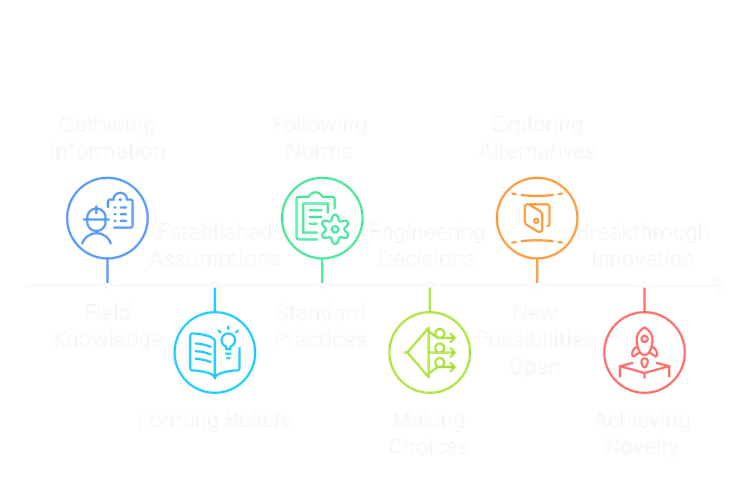
Visual Representation
Practical Table
| Question / Factor | Why It Matters | Example |
| What is being treated as “given”? | Reveals hidden assumptions | Assuming constant operating conditions in dynamic systems |
| Why does this constraint exist? | Identifies outdated or inherited limitations | Legacy design limits from older manufacturing processes |
| What has changed since this was defined? | Checks if assumptions still hold under new conditions | New materials replacing old performance constraints |
| What if this assumption is removed? | Opens new solution possibilities | Eliminating unnecessary safety margins based on old data |
| Who benefits from keeping this unchanged? | Highlights inertia and resistance within systems | Processes maintained for organizational convenience |
Key Takeaways
- Every engineering field is built on assumptions that are often invisible
- These assumptions shape decisions more than explicit design choices
- Breakthrough innovation comes from questioning foundational beliefs
- Senior engineers must balance respect for knowledge with critical thinking
- Unchallenged assumptions can lead to stagnation and inefficiency
- Seeing the axioms requires stepping outside normal problem-solving patterns
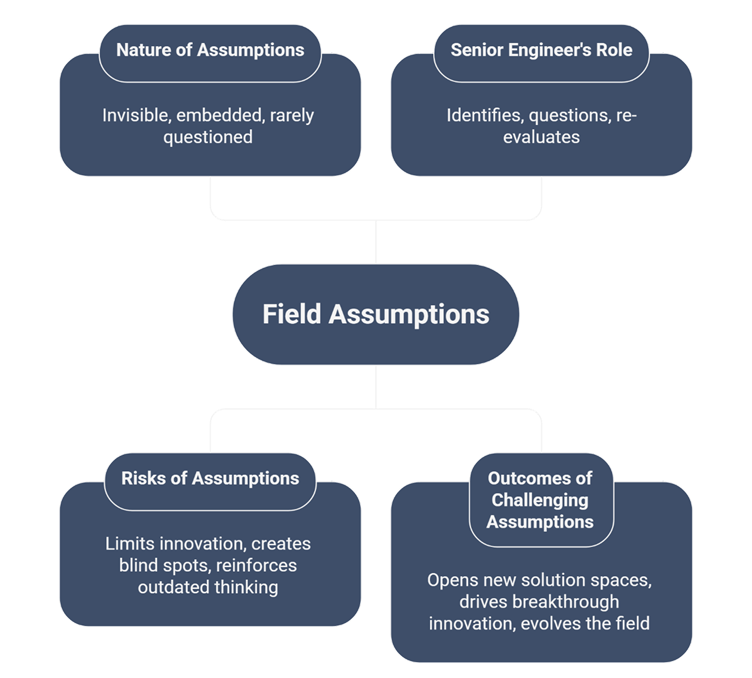
Mind Map
Conclusion
At the senior level, engineering is no longer just about solving within boundaries—it is about recognizing that boundaries themselves are constructed.
Every field carries assumptions that once made sense but may no longer hold. These assumptions define what engineers see as possible.
The ability to identify and question them is not just a technical skill—it is a shift in perspective.
Because the future of any discipline is not built only by those who refine it, but by those who are willing to ask: “What if the foundation itself needs to change?”