

Introduction
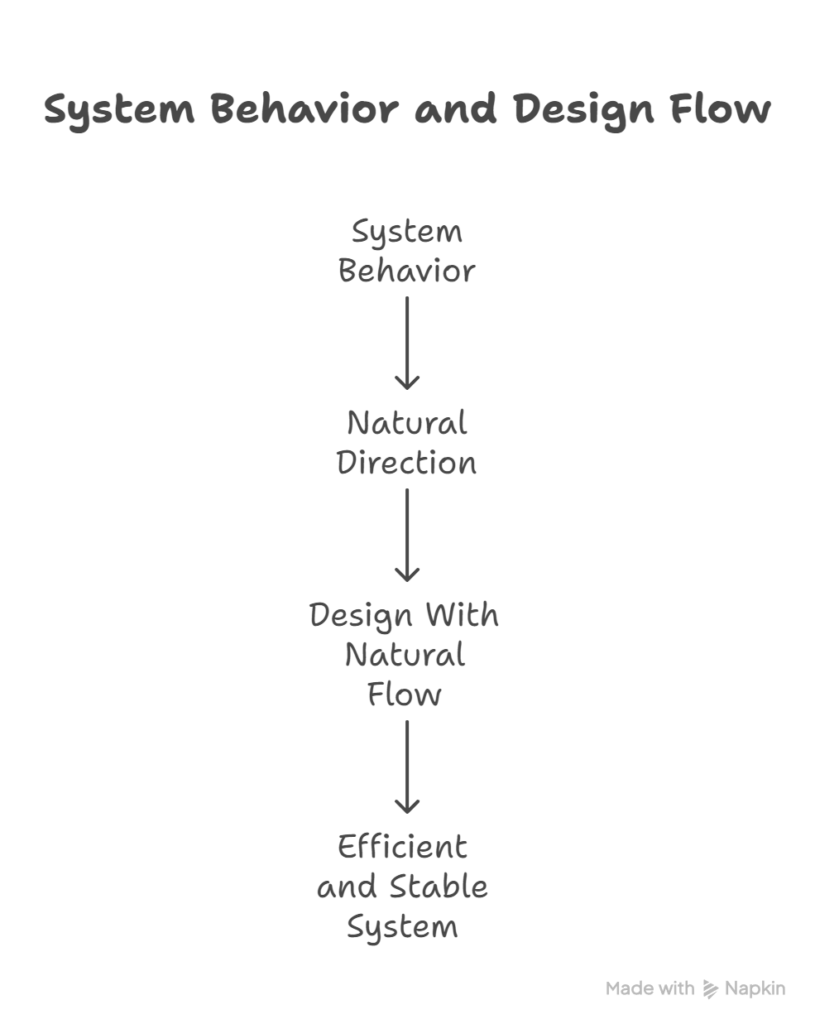
Every engineered system operates within the laws of physics and natural behavior. Instead of forcing systems to behave unnaturally, good engineering often comes from understanding how a system naturally behaves and designing solutions that work with those tendencies.
Every System Has a Natural Direction
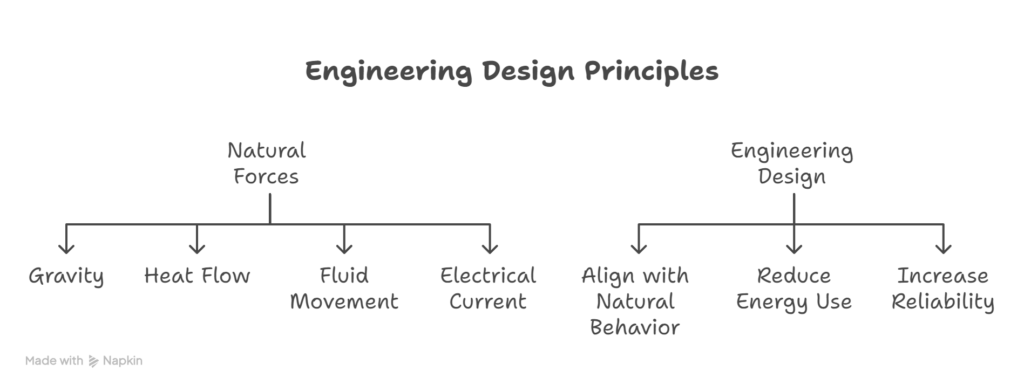
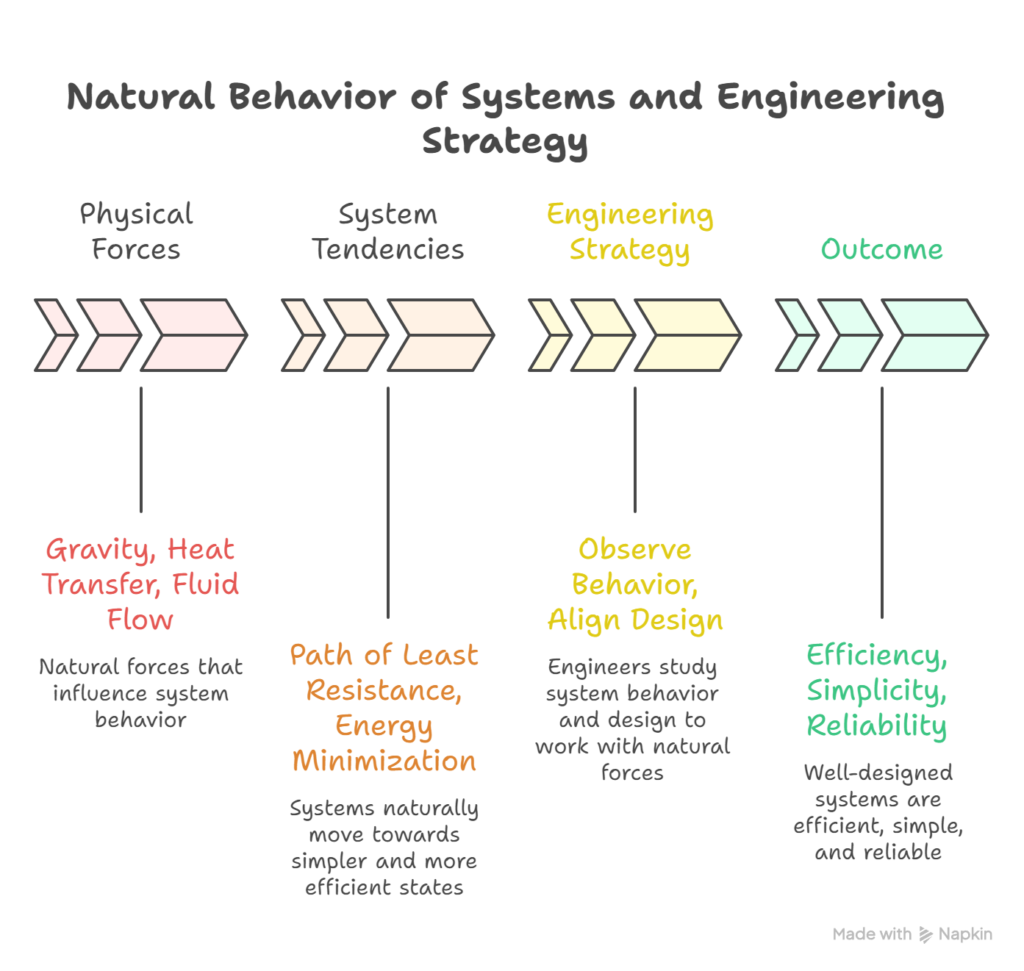
In the physical world, systems tend to move toward states that require the least energy or resistance. This natural direction often determines how materials, fluids, heat, and forces behave.
For example:
- Water flows downhill due to gravity
- Heat moves from hotter regions to colder ones
- Electrical current flows along paths of lower resistance
- Structures distribute forces along paths of least stress
These tendencies are not optional behaviors — they are built into the fundamental laws governing physical systems.
When engineers design systems that cooperate with these natural tendencies, the result is often more efficient and reliable. When engineers try to force systems to behave against their natural direction, the design typically requires additional energy, complexity, or maintenance.
Understanding what a system “wants” to do is therefore a key step in intelligent design.
The Cost of Fighting Natural Behavior
Designs that oppose natural system tendencies often introduce hidden costs. These costs may appear as increased energy consumption, more complicated machinery, or reduced reliability.
For example, pumping water uphill requires significant energy because the design must work against gravity. If the system can instead use gravity to move water downhill, the same task may require far less energy.
Similarly, cooling systems that attempt to trap heat without allowing natural airflow may require powerful fans or active cooling systems. Designs that allow heat to naturally rise and escape can often achieve better performance with fewer components.
When engineers ignore natural system behavior, they often end up compensating with additional technology to overcome forces that could have been used to their advantage.
Designing With Natural Forces
Some of the most elegant engineering solutions come from aligning designs with natural forces rather than opposing them.
Consider examples such as:
- Hydroelectric dams, which generate power by allowing water to flow downhill through turbines
- Sailboats, which harness wind instead of resisting it
- Passive cooling systems, which allow heat to naturally rise and escape through ventilation
These designs succeed because they cooperate with natural physical processes instead of resisting them.
By observing how systems behave naturally, engineers can often discover simpler and more energy-efficient solutions.
Natural Tendencies Exist in Many Systems
The concept of natural tendencies applies not only to physical forces but also to many types of engineering systems.
For example:
- In mechanical systems, friction and wear gradually influence motion.
- In electrical systems, current flows along the easiest conductive paths.
- In software systems, users naturally adopt behaviors that minimize effort.
- In transportation systems, traffic tends to concentrate along the fastest routes.
These tendencies emerge because systems naturally move toward states that reduce effort, energy, or resistance.
Recognizing these patterns helps engineers design systems that behave predictably and efficiently.
Observing Before Designing
A valuable habit for engineers is to observe how a system behaves before attempting to modify it.
Instead of immediately designing a solution, engineers may ask questions such as:
- How does the system behave without intervention?
- Where do forces, energy, or materials naturally move?
- What patterns emerge when the system operates normally?
- What behaviors appear repeatedly over time?
These observations reveal the natural direction of the system.
Designs that respect these natural tendencies are often simpler, more stable, and easier to maintain.
Visual Representation
Expanded concept:
Examples Across Engineering Fields
| Field | Natural System Behavior |
| Civil Engineering | Water drainage following gravity |
| Mechanical Engineering | Heat rising in thermal systems |
| Electrical Engineering | Current flowing through low resistance paths |
| Aerospace Engineering | Aircraft using airflow for lift |
| Software Engineering | Users favoring simple and fast workflows |
These examples show how natural tendencies influence system performance.
Key Takeaways
- Every system has a natural direction or path of least resistance.
- Fighting natural behavior often increases complexity and energy consumption.
- Designs that cooperate with natural forces are usually more efficient.
- Observing system behavior helps engineers create better solutions.
Mind Map
Conclusion
Engineering becomes far more effective when it respects the natural tendencies of systems. Forces such as gravity, heat flow, and electrical resistance shape how systems behave, and these forces cannot be ignored.
Designs that fight natural behavior often require additional energy, complexity, and maintenance. In contrast, designs that work with natural tendencies tend to be simpler, more efficient, and more reliable.
Great engineers learn to observe how systems behave before trying to control them. By understanding what a system naturally wants to do, they can guide that behavior in ways that achieve the desired outcome with elegance and efficiency.