
Introduction
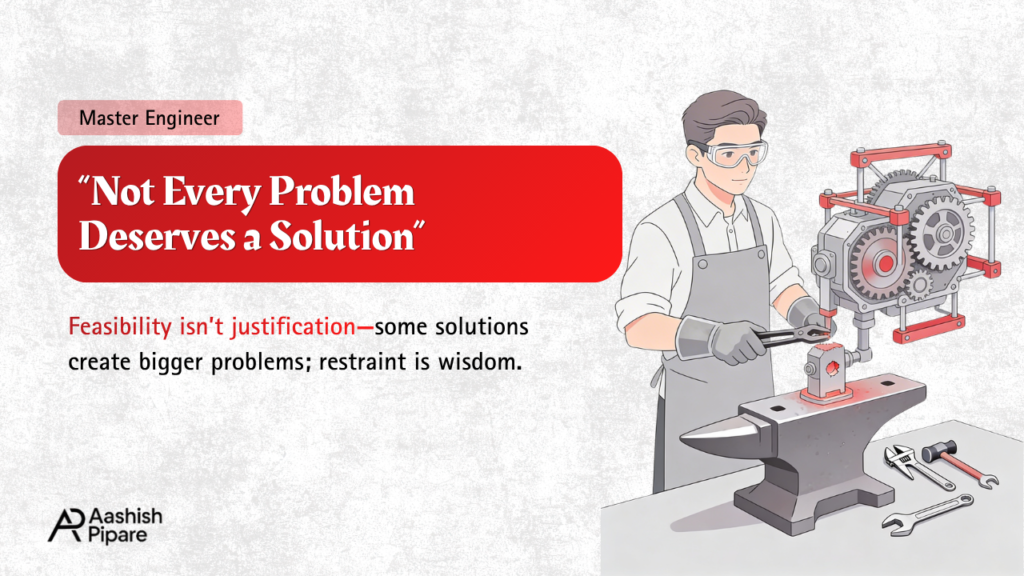
Engineering is often seen as the act of solving problems.
But not every solvable problem should be solved.
The Illusion of Technical Capability
Modern engineering gives us immense power. With enough resources, time, and knowledge, many problems can be solved. This creates a dangerous assumption—that feasibility alone justifies action.
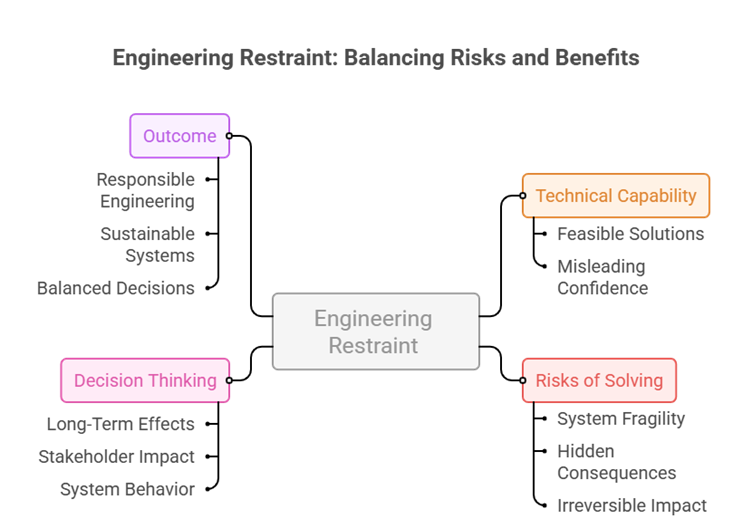
However, technical capability does not exist in isolation. Every solution interacts with a larger system: social, environmental, economic, and ethical. When engineers focus only on can we build it, they risk ignoring what happens after we build it.
A Master Engineer understands that solving a problem is not a neutral act. It changes the system permanently. And not all changes are beneficial.
When Solutions Create Bigger Problems
Some engineering solutions appear valuable at a local level but introduce larger systemic risks.
For example, optimizing a system for maximum efficiency can reduce redundancy. While this may improve short-term performance, it can also make the system fragile. When disruption occurs, the system fails more severely because it lacks buffers.
Similarly, technologies designed for convenience can create long-term dependency, reduce human skill, or introduce hidden vulnerabilities.
The key insight is this:
A problem solved in isolation can create multiple problems at a higher level of the system.
Master Engineers think in terms of consequences, not just outputs.
The Ethics of Engineering Restraint
Restraint is rarely discussed in engineering education, but it is one of the most critical skills at advanced levels.
Choosing not to solve a problem requires:
- awareness of long-term impact
- understanding of system-wide consequences
- willingness to challenge incentives like profit, speed, or recognition
Some problems, once solved, cannot be undone. They reshape behavior, infrastructure, and expectations.
In such cases, the question shifts from:
“Can we build this?”
to:
“Should this exist at all?”
This is where engineering becomes a moral discipline, not just a technical one.
Hidden Risks in Over-Solving
There is a tendency in engineering to continuously optimize, automate, and improve. But excessive intervention can lead to unintended consequences.
Over-solving a problem can:
- remove natural stabilizing mechanisms
- introduce unnecessary complexity
- create dependence on the engineered system
- reduce system adaptability
For example, adding layers of automation may reduce human error but can also reduce human awareness. When the system fails, recovery becomes harder because users no longer understand the underlying process.
A Master Engineer recognizes when less intervention leads to more resilient systems.
Engineering Thinking at the System Level
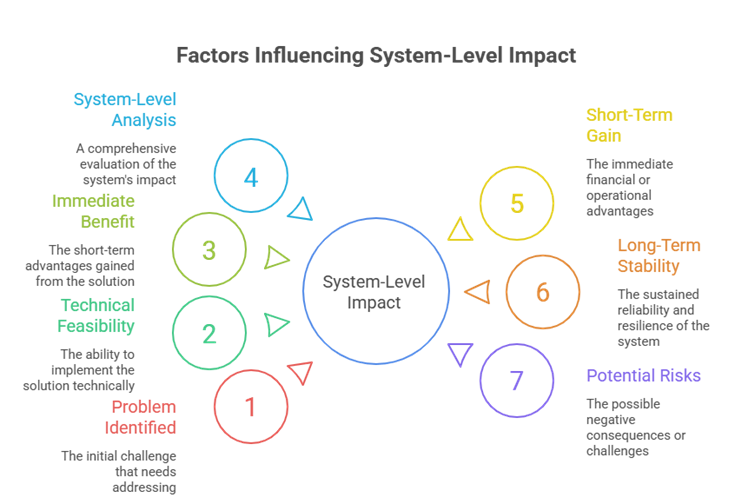
To decide whether a problem should be solved, engineers must expand their perspective beyond the immediate task.
This includes asking:
- What system does this solution become part of?
- What behaviors will it encourage or discourage?
- What new risks will it introduce?
- Who benefits, and who is affected negatively?
Engineering is not just about creating solutions—it is about shaping systems. Every decision influences how the system evolves over time.
A narrow focus leads to efficient solutions.
A wide focus leads to responsible engineering.
Real-World Implications
In real-world practice, engineers face pressure to deliver solutions quickly. Business goals, deadlines, and competition often push toward action rather than reflection.
However, many large-scale failures and unintended consequences in engineering history are not due to poor execution, but due to solving the wrong problem—or solving the right problem without considering the broader impact.
Master Engineers introduce deliberate pauses in decision-making. They question direction, not just implementation.
Because sometimes, the most responsible action is not improvement—but restraint.
Visual Representation
Practical Table
| Factor / Question | Why It Matters | Example |
| What are the long-term effects? | Solutions may introduce delayed consequences | Automation reducing human oversight over time |
| Does this increase system fragility? | Optimization can reduce resilience | Removing redundancy in critical infrastructure |
| Who is negatively affected? | Solutions can shift problems to other stakeholders | Technology displacing certain job roles |
| Can the solution be reversed? | Irreversible changes carry higher risk | Large-scale environmental modifications |
| Are we solving the right problem? | Misidentified problems lead to harmful solutions | Treating symptoms instead of root causes |
Key Takeaways
- Technical feasibility is not a sufficient reason to act
- Some solutions create larger problems at the system level
- Over-optimization can reduce resilience and adaptability
- Restraint is a critical engineering skill, not a limitation
- Engineers must evaluate long-term and system-wide consequences
- The best decision is sometimes choosing not to solve the problem
Mind Map
Conclusion
Engineering is often defined by the problems it solves. But mastery is defined by the problems it refuses to solve.
Every solution carries weight. It reshapes systems, influences behavior, and creates new realities that persist long after implementation. Acting without reflection can lead to progress that is technically impressive but fundamentally harmful.
A Master Engineer does not measure success by the number of problems solved, but by the quality and consequences of those decisions.
Because true engineering wisdom lies not just in creation—
but in knowing when not to create at all.