
Interfaces Combine Different Worlds
Every interface brings together two environments that may operate according to different rules.
For example:
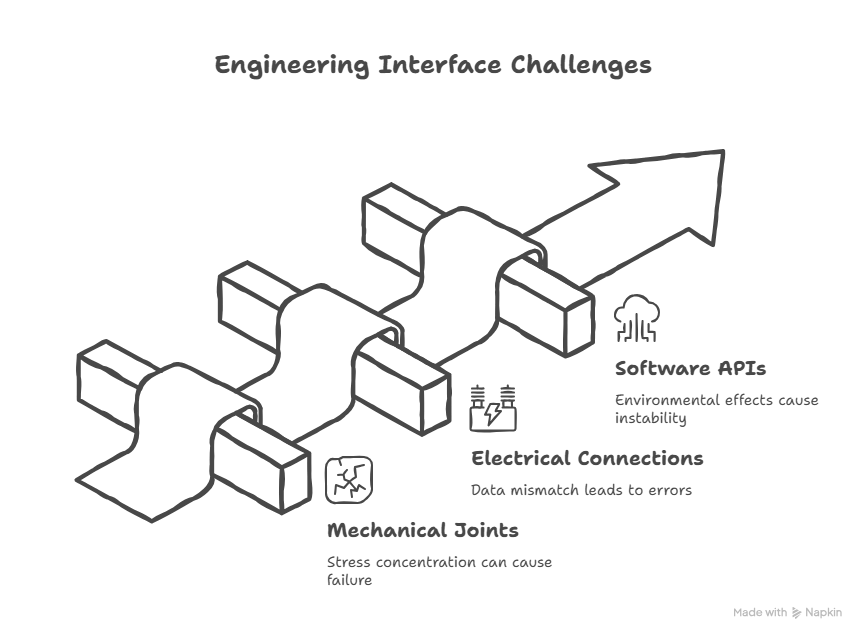
- In civil engineering, a steel beam may connect to concrete. Steel and concrete expand differently under temperature changes. If this difference is not accounted for, stresses can accumulate at the interface.
- In electrical engineering, components may operate at different voltage levels. If the interface does not regulate these differences, electrical damage can occur.
- In software engineering, two systems may interpret data differently. If one system expects a number while another sends text, the interface becomes a point of failure.
At interfaces, small mismatches become amplified because two different systems must cooperate precisely.
Complexity Hides at the Edges
One reason interfaces are dangerous is that they often appear deceptively simple.
A bridge joint might look like a small mechanical detail compared to the massive structure surrounding it. Yet that small joint must accommodate:
- temperature expansion
- traffic loads
- vibration
- long-term material fatigue
Similarly, a simple line of software code connecting two services may hide complex assumptions about timing, error handling, and data structure.
Because interfaces look small, they sometimes receive less attention during design. Yet they often carry a disproportionate amount of complexity.
Engineering Attention Should Focus on Boundaries
Experienced engineers learn to pay special attention to interfaces during design and analysis.
When examining a system, they often ask questions such as:
- How do these two components interact?
- What assumptions does each side make about the other?
- What happens when conditions change unexpectedly?
- How are forces, data, or energy transferred across the boundary?
These questions help uncover hidden weaknesses that may not be visible when examining individual components in isolation.
In many cases, improving an interface can significantly increase the reliability of an entire system.
Designing Better Interfaces
Good interface design requires careful thinking about compatibility, communication, and tolerance.
Effective interfaces often include:
- clear standards that define how systems interact
- tolerances that allow for slight variations without failure
- buffers or safeguards that absorb unexpected changes
- redundancy to prevent small issues from escalating
For example, mechanical systems often include flexible joints or expansion gaps to accommodate temperature changes. Software systems may include error-handling mechanisms to prevent communication failures from crashing the entire system.
These design strategies recognize that interfaces must handle uncertainty and variability.
Visual Representation
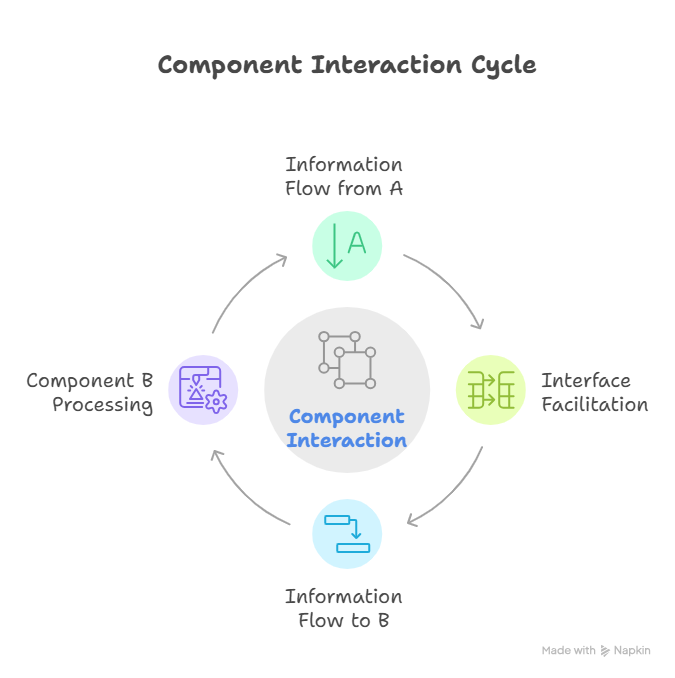
Expanded concept:
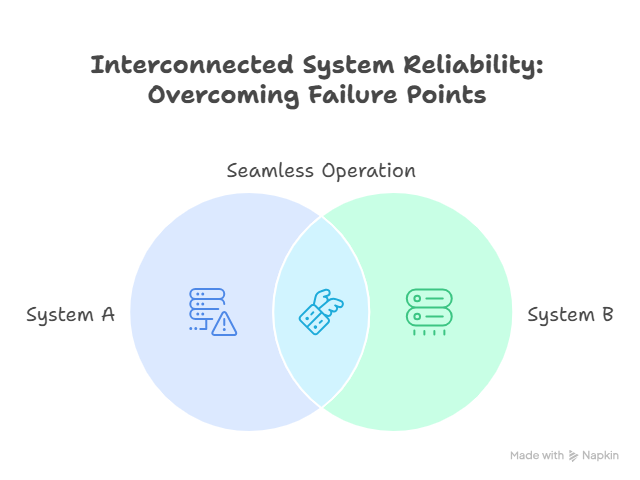
Examples Across Engineering Disciplines
| Field | Interface Example |
| Civil Engineering | Expansion joints in bridges |
| Mechanical Engineering | Bearings and mechanical couplings |
| Electrical Engineering | Power connectors and circuit interfaces |
| Software Engineering | APIs between services |
| Aerospace Engineering | Material joints between different structural elements |
Across all disciplines, engineers discover that interfaces require careful attention and thoughtful design.
Key Takeaways
- Interfaces are the boundaries where systems interact.
- Failures often occur at these boundaries rather than inside components.
- Interfaces combine different materials, assumptions, or behaviors.
- Good engineering design carefully manages interactions at these boundaries.
Mind Map
Conclusion
Engineering systems rarely fail because individual components are weak. More often, failures emerge where those components meet.
Interfaces are the places where forces combine, assumptions collide, and complexity accumulates. For this reason, they deserve careful attention during design, testing, and operation.
An engineer who understands the importance of boundaries learns to look beyond individual parts and focus on the interactions between them. In many systems, the interface is not a minor detail — it is where the true challenge of engineering begins.