
Introduction
Engineering is often seen as problem-solving or technical work.
But at a deeper level, it is about understanding reality so clearly that outcomes can be shaped with intention.
Engineering as Understanding Before Action
For a budding engineer, it is tempting to see engineering as building, designing, or fixing things. But before any of that begins, engineering starts with understanding.
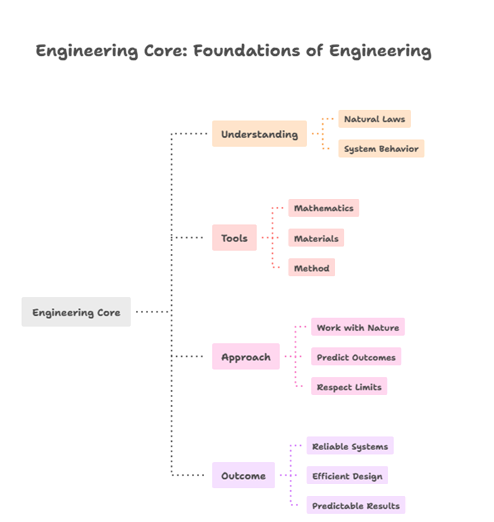
Every system—whether mechanical, electrical, or digital—operates within rules that cannot be ignored. These rules are not created by engineers; they are discovered. Gravity, heat flow, material strength, and logic define what is possible.
Engineering begins when you stop asking “What do I want to build?” and start asking “What is actually possible under these conditions?”
This shift is subtle but powerful. It transforms engineering from trial-and-error into intentional creation.
The Idea of Making the Impossible Inevitable
At first glance, engineering often deals with things that seem impossible—lifting massive structures, transmitting information across the world instantly, or creating machines that operate with precision.
But engineering does not break the laws of nature. Instead, it works so deeply within them that desired outcomes become predictable.
For example:
- An aircraft does not defy gravity—it uses airflow and pressure differences to generate lift.
- A bridge does not “resist” forces—it distributes them intelligently through its structure.
What appears impossible is often just not yet understood or properly aligned with natural laws.
As a budding engineer, your role is not to fight reality—but to understand it so well that results become inevitable.
Engineering as a Covenant with Nature
Engineering is not domination over nature—it is cooperation with it.
Nature sets the rules:
- Energy must be conserved
- Forces must balance
- Materials have limits
Engineers operate within these boundaries. The more deeply these rules are understood, the more effectively they can be used.
This creates a kind of silent agreement:
- Nature provides constraints
- Engineering provides solutions within those constraints
When this balance is respected, systems become efficient and reliable. When it is ignored, systems become fragile and costly.
The Role of Mathematics, Materials, and Method
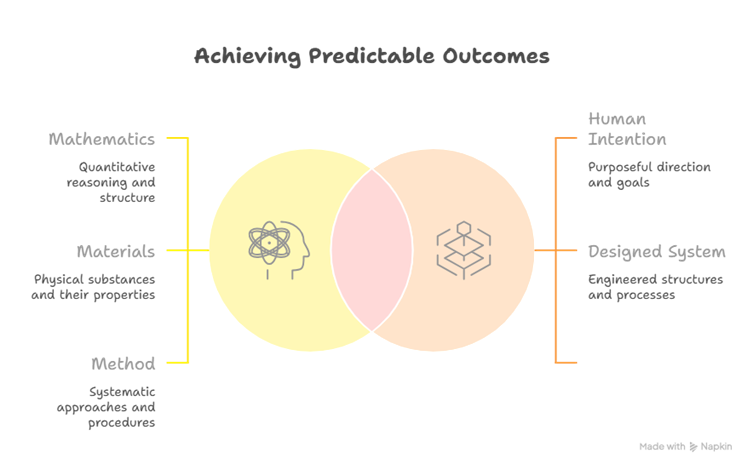
Engineering is not only philosophical—it is practical. To translate understanding into reality, engineers rely on three core tools:
Mathematics allows precise prediction of behavior.
Materials define what can physically exist and endure.
Method provides a structured way to move from idea to implementation.
For a budding engineer, these are not just subjects to study—they are instruments of control and clarity.
Without mathematics, outcomes are uncertain.
Without understanding materials, designs fail.
Without method, even good ideas collapse in execution.
Engineering lives at the intersection of these three.
The Responsibility of a Budding Engineer
Understanding engineering at its core also brings responsibility.
As a budding engineer, you are not just creating systems—you are influencing safety, efficiency, and human experience. Poor understanding can lead to failure, while deep understanding leads to systems that quietly and reliably serve their purpose.
This means:
- Questioning assumptions instead of accepting them
- Respecting limitations instead of ignoring them
- Thinking about long-term behavior, not just immediate results
Engineering is not just about making things work—it is about making them work consistently, safely, and predictably.
Visual Representation
Practical Table
| Element / Question | Why It Matters | Example |
| What laws govern this system? | Defines what is possible and what is not | Understanding thermodynamics in engine design |
| How can this be predicted? | Ensures outcomes are reliable, not accidental | Using equations to calculate load in structures |
| What materials are suitable? | Determines strength, durability, and feasibility | Choosing steel vs aluminum in construction |
| What method will be followed? | Provides structure and reduces errors in execution | Following design → test → validate cycle |
| What are the limits? | Prevents overdesign or failure | Knowing maximum stress before material failure |
Key Takeaways
- Engineering begins with understanding reality, not just building solutions
- It does not break natural laws—it works deeply within them
- “Impossible” problems become solvable through proper understanding
- Mathematics, materials, and method form the foundation of engineering
- A budding engineer must focus on clarity, not just execution
- True engineering creates predictable and reliable outcomes
Mind Map
Conclusion
At its core, engineering is not about machines, structures, or code—it is about understanding reality deeply enough to shape outcomes with confidence.
For a budding engineer, this realization changes everything. It shifts the focus from doing to understanding, from guessing to predicting, from reacting to designing with intention.
Engineering is the quiet transformation of the uncertain into the inevitable—not by force, but by clarity.
And the deeper your understanding becomes,
the more the world stops feeling unpredictable—
and starts becoming something you can thoughtfully shape.