
Introduction
At a senior level, complexity is no longer just a technical characteristic.
It is a long-term liability that silently shapes reliability, cost, and human performance.
Complexity Does Not Stay Isolated
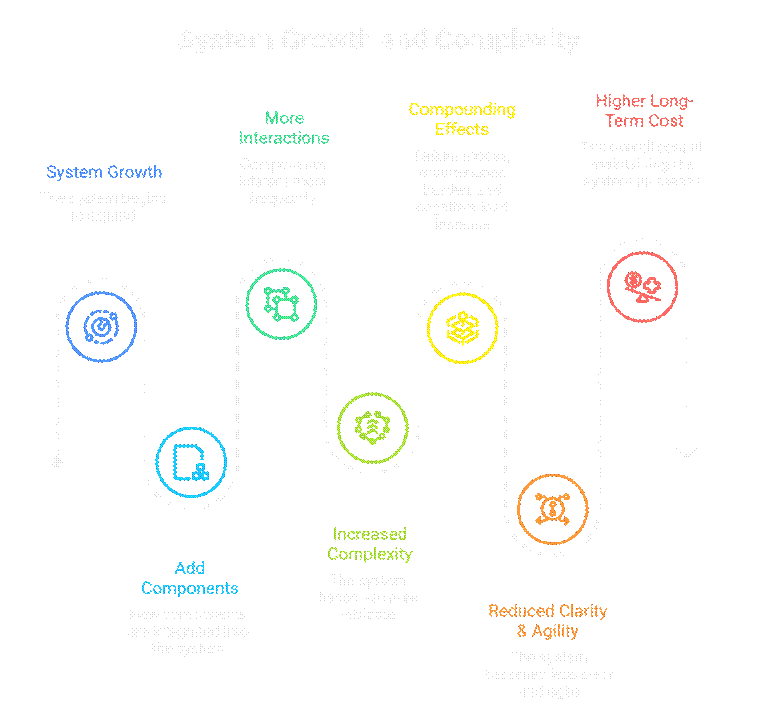
Every added component, feature, or dependency may appear small in isolation. But in a system, complexity does not add linearly—it compounds.
Each addition interacts with existing elements, creating new relationships:
- more interfaces
- more dependencies
- more points of coordination
Over time, the system becomes harder to understand, not just harder to build.
A senior engineer recognizes that complexity is not just what is added—it is what multiplies.
The Hidden Multipliers of Complexity
The true cost of complexity is rarely visible during design. It emerges gradually across the system lifecycle.
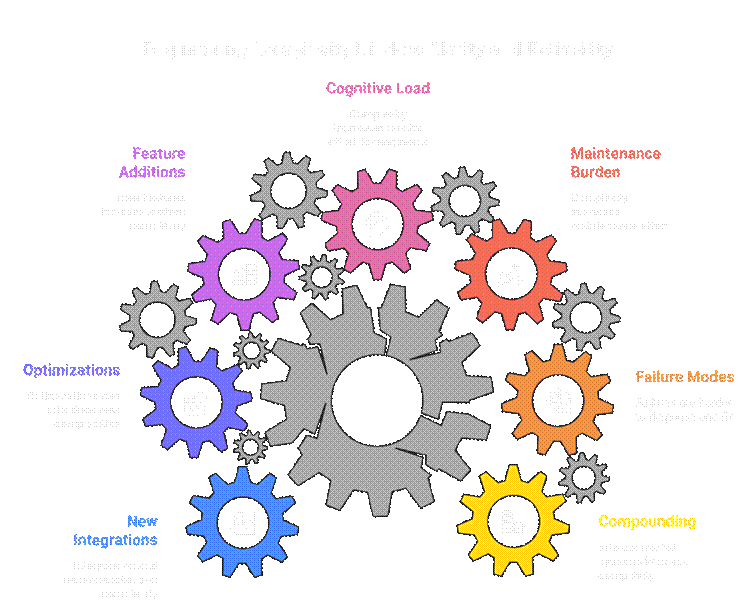
Each additional element introduces:
- new failure modes
- additional testing scenarios
- more maintenance paths
- increased training requirements
But beyond these visible costs, there is a deeper impact—cognitive load.
Engineers, operators, and users must hold more information in their minds:
- how components interact
- where failures might originate
- how to troubleshoot issues
As complexity grows, clarity reduces. Decision-making slows. Mistakes become more likely.
Why Complexity Feels Necessary
Complexity often enters systems through reasonable decisions:
- adding features to meet requirements
- introducing optimizations for performance
- integrating new technologies for capability
Each decision is locally justified. But globally, they accumulate.
This is why complex systems rarely appear suddenly. They evolve gradually until the system becomes difficult to manage.
The danger is not that complexity is introduced—it is that it is rarely removed.
Engineering Thinking: Subtraction as Mastery
At a senior level, engineering shifts from creation to refinement.
The question is no longer just: “What should we add?”
but increasingly: “What can we remove without losing value?”
Removing complexity requires deeper understanding than adding it:
- identifying unnecessary dependencies
- simplifying interactions
- reducing system surface area
This is difficult because removal feels risky. It challenges existing assumptions and requires confidence in understanding the system.
Yet the most resilient systems are often the simplest ones that still meet requirements.
The most sophisticated engineering achievement is not visible in what exists—but in what has been intentionally eliminated.
The Long-Term Consequences
Complex systems carry long-term operational costs that exceed initial development effort.
These include:
- increased downtime due to harder diagnosis
- slower onboarding of new engineers
- higher risk of cascading failures
- reduced ability to adapt or scale
Over time, complexity reduces system agility. Changes that should be simple become expensive.
In contrast, simpler systems:
- are easier to reason about
- fail in more predictable ways
- recover faster
The difference is not just technical—it is organizational.
Real-World Implications
In real systems, complexity often hides behind functionality.
A feature-rich system may appear powerful, but if it requires:
- extensive training
- constant maintenance
- specialized knowledge to operate
then its cost is not in building—but in sustaining.
Senior engineers must evaluate not just whether something works, but:
- how much effort it takes to keep it working
- how many people can understand it
- how quickly it can be fixed when it breaks
Because systems are not judged only by capability—but by operational survivability.
Visual Representation
Practical Table
| Factor / Question | Why It Matters | Example |
| How many dependencies exist? | More dependencies increase failure propagation | Interconnected software services |
| Can the system be easily understood? | High cognitive load reduces efficiency and increases errors | Complex control systems requiring expert knowledge |
| What is the cost of maintenance? | Ongoing effort often exceeds initial build cost | Frequent updates across multiple components |
| How easy is troubleshooting? | Complex systems slow down failure diagnosis | Difficult root cause analysis in multi-layer systems |
| What can be removed safely? | Simplification improves reliability and clarity | Eliminating redundant modules or features |
Key Takeaways
- Complexity compounds—it grows faster than it appears
- Each added component increases failure modes and system burden
- Cognitive load is one of the most critical hidden costs
- Complexity often enters through reasonable decisions but accumulates over time
- Removing complexity requires deeper understanding than adding it
- Simplicity improves reliability, maintainability, and adaptability
Mind Map
Conclusion
At a senior level, complexity must be treated with caution, not pride.
It is easy to build systems that are capable. It is far harder to build systems that remain understandable, maintainable, and resilient over time.
The true cost of complexity is not paid upfront—it is paid continuously, through every interaction, every failure, and every decision made within the system.
A developing engineer proves skill by adding capability.
A mature engineer demonstrates mastery by removing what is unnecessary.
Because in the end, the strength of a system is not measured by how much it contains, but by how little it needs to function reliably.